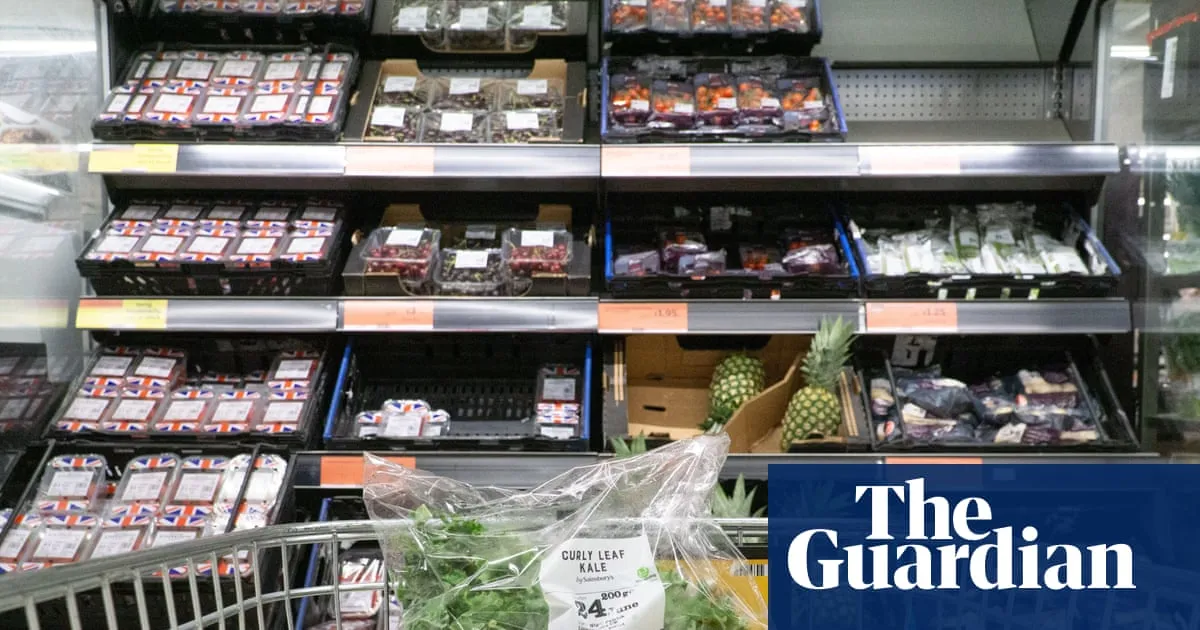
Britons started 2026 by buying more healthy food such as fruit and yoghurt as they attempted to hit new year health goals, while grocery price inflation eased to the lowest level since April, research has shown.Annual grocery inflation fell back to 4% in the four weeks to 25 January from 4.7% in December, offering some relief for shoppers, according to a monthly snapshot of the grocery sector from the research company Worldpanel by Numerator.Consumers turned to healthy eating, it said, with sales volumes of fresh fruit and dried pulses up 6% year on year, while fresh fish was up 5%, poultry 3% and chilled yoghurt 4%. Cottage cheese sales jumped by 50% and it was bought by 2.8 million households, 600,000 more than last year.Nearly a quarter of shoppers sought out high-protein foods and more than a quarter looked for high-fibre products.Fraser McKevitt, the Worldpanel head of retail and consumer insight, said: “Shoppers are actively seeking out foods that support their health goals, with strong demand for staples high in nutrients like protein and fibre.“While interest in seasonal diet-focused trends like Veganuary on the decline, shoppers are taking a more practical, balanced and achievable approach to healthy eating, built around foods already familiar to most households.”Waitrose reported on Monday that Dry January was not so dry after all. “Move over Blue Monday, it’s all about ‘Damp Monday’,” said the upmarket grocer.This year, the January slump in alcohol sales ended early on 12 January, when shoppers started adding more wines, beers and spirits back into their baskets, with sales up 11% compared with the week before.As many shoppers cut back after record spending on groceries in December, in January they usually spend more on supermarkets’ own-label items, which tend to be cheaper than branded goods. This year, own-label accounted for 52.2% of grocery spending – the highest level recorded to date.“For most shoppers, January is all about resetting household budgets, and this year was no exception” McKevitt said. “Value remained front of mind for many – with own-label hitting a record high, accounting for more than half of all grocery spend.”Spending on promotions also picked up pace. While not hitting the Christmas highs, it rose by 10.9% year on year, marking the fastest rate of growth since October 2024. By contrast, full-price sales edged up by just 1.7% compared with the equivalent four weeks last year.The search for wellness was felt in the drinks aisle. Functional drinks, marketed around energy, gut health or mood enhancement, were bought by 11% of households, and spending was up by 13% year on year.McKevitt said it was notable how many people were willing to splash out on wellness, with functional drinks costing nearly four times as much as typical soft drinks at £4.69 a litre.Take-home sales at the grocers grew by 3.8% in the four weeks, the same rate as in December. The German discounter Lidl was the fastest-growing physical chain again, with sales up 10.1% over the 12 weeks to 25 January, increasing its market share to 7.7%.The online retailer Ocado fared well, with sales up 14.1%, raising its market share to 2.1%. Sainsbury’s and Tesco also notched up higher sales and market share gains, while Waitrose and Aldi held their market share.The data showed Asda and the Co-op were the only supermarkets to record a drop in sales, of 3.7% and 1.6% respectively.
SRCThe Guardian - World News
LANGEN
LEANCenter-Left
WORDS560
ENT4
TUE · 2026-02-03 · 08:42 GMTBRIEF NSR-2026-0203-12946
NSR-2026-0203-12946News Report·EN·Economic Impact
UK shoppers buy more fruit and yoghurt in healthy start to 2026
In January 2026, UK shoppers increased purchases of healthy foods like fruit and yoghurt, driven by New Year's resolutions. A report by Worldpanel by Numerator found that grocery price inflation eased to 4%, the lowest since April.
Julia KolleweThe Guardian - World NewsFiled 2026-02-03 · 08:42 GMTLean · Center-LeftRead · 3 min
The Guardian - World NewsFIG 01
Reading time
3min
Word count
560words
Sources cited
2cited
Entities identified
4entities
Quality score
100%
§ 01
Briefing Summary
AI-generatedNEWSAR · AI
In January 2026, UK shoppers increased purchases of healthy foods like fruit and yoghurt, driven by New Year's resolutions. A report by Worldpanel by Numerator found that grocery price inflation eased to 4%, the lowest since April. Sales volumes of fresh fruit, dried pulses, fresh fish, poultry, and chilled yoghurt increased, with cottage cheese seeing a significant rise. While interest in Veganuary declined, shoppers focused on high-protein and high-fibre foods. Waitrose reported a return to alcohol purchases mid-January. Consumers prioritized value, with own-label products accounting for a record 52.2% of grocery spending. Spending on promotions also increased, reflecting a focus on budget management after December's high spending.
Confidence 0.90Sources 2Claims 5Entities 4
§ 02
Article analysis
Model · rule-basedFraming
Economic Impact
Public Health
Tone
Measured
AI-assessed
CalmNeutralAlarmist
Factuality
0.80 / 1.00
Factual
LowHigh
Sources cited
2
Limited
FewMany
§ 03
Key claims
5 extracted01
Functional drinks were bought by 11% of households, and spending was up by 13% year on year.
statisticWorldpanel by Numerator
Confidence
1.00
02
Own-label accounted for 52.2% of grocery spending – the highest level recorded to date.
statisticFraser McKevitt, the Worldpanel head of retail and consumer insight
Confidence
1.00
03
Cottage cheese sales jumped by 50% and it was bought by 2.8 million households.
statisticWorldpanel by Numerator
Confidence
1.00
04
Sales volumes of fresh fruit and dried pulses were up 6% year on year.
statisticWorldpanel by Numerator
Confidence
1.00
05
Annual grocery inflation fell to 4% in the four weeks to 25 January.
statisticWorldpanel by Numerator
Confidence
1.00
§ 04
Full report
3 min read · 560 words§ 05
Entities
4 identifiedKey playerOppositionContextPositiveNeutralNegative
Organizations2
Locations1
§ 06
Keywords & salience
8 termshealthy eating
0.90
grocery price inflation
0.80
fruit and yoghurt
0.70
own-label products
0.70
household budgets
0.60
high-fibre products
0.50
high-protein foods
0.50
alcohol sales
0.40
§ 07
Topic connections
Interactive graph No topic relationship data available yet. This graph will appear once topic relationships have been computed.