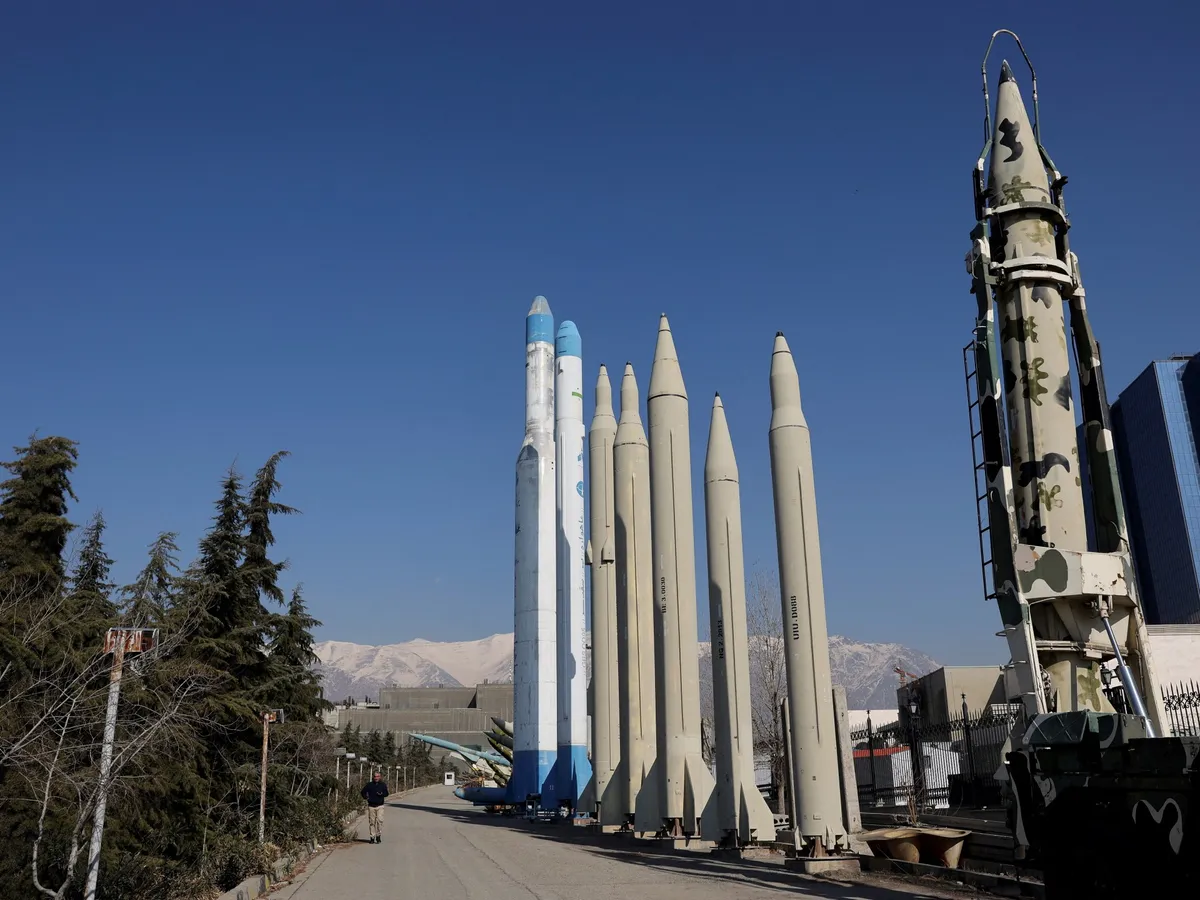
Whatever post-attack scenario unfolds in Iran – regime consolidation or turmoil – the region would suffer.Iranian missiles are displayed in a park in Tehran, Iran on January 31, 2026 [Majid Asgaripour/WANA via Reuters]PhD scholar at Maynooth University in Ireland.Published On 3 Feb 2026Growing tensions between the United States and Iran have left the two countries one spark away from a fire. An unprecedented accumulation of US military forces in the Middle East, coupled with Washington’s reliance on gunboat diplomacy, has distinctly increased the risk of war—one that engulfs Iran and the region, with far-reaching regional and global costs.In the aftermath of the recent crackdown on protests in Iran, US President Donald Trump announced that it was time to remove Iranian Supreme Leader Ayatollah Ali Khamenei. His administration then deployed the USS Abraham Lincoln aircraft carrier and supporting warplanes, along with various air defence assets—including additional THAAD and Patriot missile systems—across the Middle East.As military assets have been accumulated, Trump has threatened that if Iran does not agree to a deal, “the next attack will be far worse” than last June’s US attack on Iranian nuclear facilities.From the US perspective, a favourable agreement would require Iran to demolish its nuclear enrichment programme and ballistic missile capabilities, while also pulling back its regional influence. Such maximum demands, combined with Tehran’s deep distrust of negotiations with the US, make a deal highly unlikely. Alaeddin Boroujerdi, a member of the Iranian parliament’s National Security and Foreign Policy Commission, clarified on Monday that civilian nuclear capability, as well as missile and drone capabilities, represent a “red line” for Tehran.This does not necessarily signal a permanent diplomatic stalemate. However, Tehran interprets the US’s maximum demands as a potential threat of regime change—a notion repeatedly emphasised by Trump and hawks in Washington and Tel Aviv. In this context, another US strike would represent an “existential threat” to the Islamic Republic, eliminating any incentive for restraint.The impact of any US military action against Iran would principally depend on the attack’s type, scale, and targets, potentially triggering a severe crisis in Iran, across the region, and globally.Trump favours surgical and targeted military operations, which would probably combine leadership decapitation with efforts to significantly damage Iran’s Islamic Revolutionary Guard Corps (IRGC) military bases, Basij units—a paramilitary force under IRGC control—and police stations, which the US designates as responsible for firing on demonstrators.Any US effort to impose regime change through military means would undoubtedly lead to dangerous outcomes domestically and regionally. In Iran, an attack could lead to the consolidation of power. But it could also lead to a full takeover by the IRGC or even internal conflict.An attack on Iran similar to the one last year could well result in the Iranian people rallying behind the flag and rejecting regime change for several reasons. First, the Iranian people are afraid of a scenario similar to Syria and Libya where there is state collapse. Second, there is no credible moderate opposition that can lead change. Third, there is strong sociopolitical cohesion within Iran.Political institutions, the military, and the IRGC are well-organised and benefit from substantial resources generated by a sanctions-induced rentier system. Moreover, significant segments of society—particularly the working-class groups often referred to as “revolutionaries”—are aligned with this structure.If the attack is successful in targeting senior leadership of the Islamic Republic, this could bring about a succession crisis, create decision-making vacuums, and deepen competition within the regime. Under these circumstances, tensions between state institutions and military-security entities would grow. Given the concentration of hard power in the hands of the IRGC, the probability of establishing a military-dominated state would expand.The US and Israel may also try to encourage the outbreak of civil war to geopolitically weaken Iran. Last month, there were calls from some US officials, such as Texas Republican Senator Ted Cruz, to arm Iranian protesters. That could easily extend to armed groups, and there are a number of those that have clashed with the Iranian authorities that the US can turn to.Among them are the Mojahedin-e Khalq (MEK), formerly designated as a “terrorist” organisation by the US and the European Union (EU); the Party of Free Life of Kurdistan (PJAK), an armed Kurdish group looking for the secession of Iran’s western Kurdistan province; Al-Ahwaziya, an Arab nationalist movement supporting the separation of the oil-rich Khuzestan province in the southwest; Jaish al-Adl (Jundallah), an armed group operating in southeastern Iran; and pan-Turkic groups in the northwest chasing the alliance of Turkic populations across Turkiye, Azerbaijan, and Iran.Facing Washington’s continuing escalatory rhetoric and track record of regime change operations, Iran has adopted a so-called madman strategy, simultaneously issuing conciliatory and confrontational signals. This posture is apparent in Tehran’s expressed openness to establishing a framework of negotiations with the US, alongside Khamenei’s speech on Monday, which warned that any military attack on Iran would cause a “regional war”, underscoring the state’s prevailing priority of thwarting regime change at any cost—even at the risk of regional and global consequences.Iran has made clear that it will retaliate, including through allied forces in the region, potentially drawing Israel and Gulf states into a broader regional skirmish. This would trigger political instability and economic vulnerability, which in turn may prompt substantial capital flight, chiefly from the Gulf states, as well as increasing flows of refugees and migrants to Europe.Moreover, if Iran attacks shipping in the Strait of Hormuz or Gulf energy infrastructure, there would be a spike in global oil and gas prices, exacerbating market volatility, inflationary pressure from higher energy costs, and a knock-on effect for fragile economies, which would further worsen migration pressures.In the current situation, any US military escalation poses a risk not just for Iran but for the whole region. Middle Eastern history demonstrates that once a conflict is triggered, it spreads like a wildfire, destabilising the whole region in unpredictable ways.The views expressed in this article are the author’s own and do not necessarily reflect Al Jazeera’s editorial policy.
SRCAl Jazeera
LANGEN
LEANCenter
WORDS988
ENT10
TUE · 2026-02-03 · 18:07 GMTBRIEF NSR-2026-0203-13045
NSR-2026-0203-13045Analysis·EN·Conflict
What would be the impact of a US attack on Iran?
Tensions between the U.S. and Iran have escalated, raising concerns about a potential U.S.
Ali A Ghareh DaghiAl JazeeraFiled 2026-02-03 · 18:07 GMTLean · CenterRead · 4 min
Al JazeeraFIG 01
Reading time
4min
Word count
988words
Sources cited
2cited
Entities identified
10entities
Quality score
100%
§ 01
Briefing Summary
AI-generatedNEWSAR · AI
Tensions between the U.S. and Iran have escalated, raising concerns about a potential U.S. attack and its consequences. The U.S. has increased its military presence in the Middle East, with President Trump threatening a more severe attack if Iran doesn't agree to a deal regarding its nuclear program, ballistic missiles, and regional influence. Iran views these demands as a threat to its regime, making a deal unlikely. A U.S. military action, depending on its scale and targets, could trigger a crisis in Iran, the Middle East, and globally, regardless of whether it leads to regime consolidation or turmoil in Iran.
Confidence 0.90Sources 2Claims 5Entities 10
§ 02
Article analysis
Model · rule-basedFraming
Conflict
National Security
Tone
Mixed Tone
AI-assessed
CalmNeutralAlarmist
Factuality
0.60 / 1.00
Mixed
LowHigh
Sources cited
2
Limited
FewMany
§ 03
Key claims
5 extracted01
Civilian nuclear capability, as well as missile and drone capabilities, represent a “red line” for Tehran.
quoteAlaeddin Boroujerdi
Confidence
1.00
02
Trump has threatened that if Iran does not agree to a deal, “the next attack will be far worse” than last June’s US attack.
quoteDonald Trump
Confidence
1.00
03
An unprecedented accumulation of US military forces in the Middle East has distinctly increased the risk of war.
factual
Confidence
0.80
04
Any US effort to impose regime change through military means would undoubtedly lead to dangerous outcomes domestically and regionally.
prediction
Confidence
0.70
05
Growing tensions between the United States and Iran have left the two countries one spark away from a fire.
prediction
Confidence
0.70
§ 04
Full report
4 min read · 988 words§ 05
Entities
10 identifiedKey playerOppositionContextPositiveNeutralNegative
People3
Organizations1
§ 06
Keywords & salience
8 termsus attack on iran
1.00
military conflict
0.80
middle east
0.70
regional instability
0.70
nuclear program
0.60
regime change
0.50
diplomatic stalemate
0.50
military assets
0.40
§ 07
Topic connections
Interactive graph Network visualization showing 51 related topics
View Full Graph Person Organization Location Event|Click node to navigate|Edge numbers = shared articles