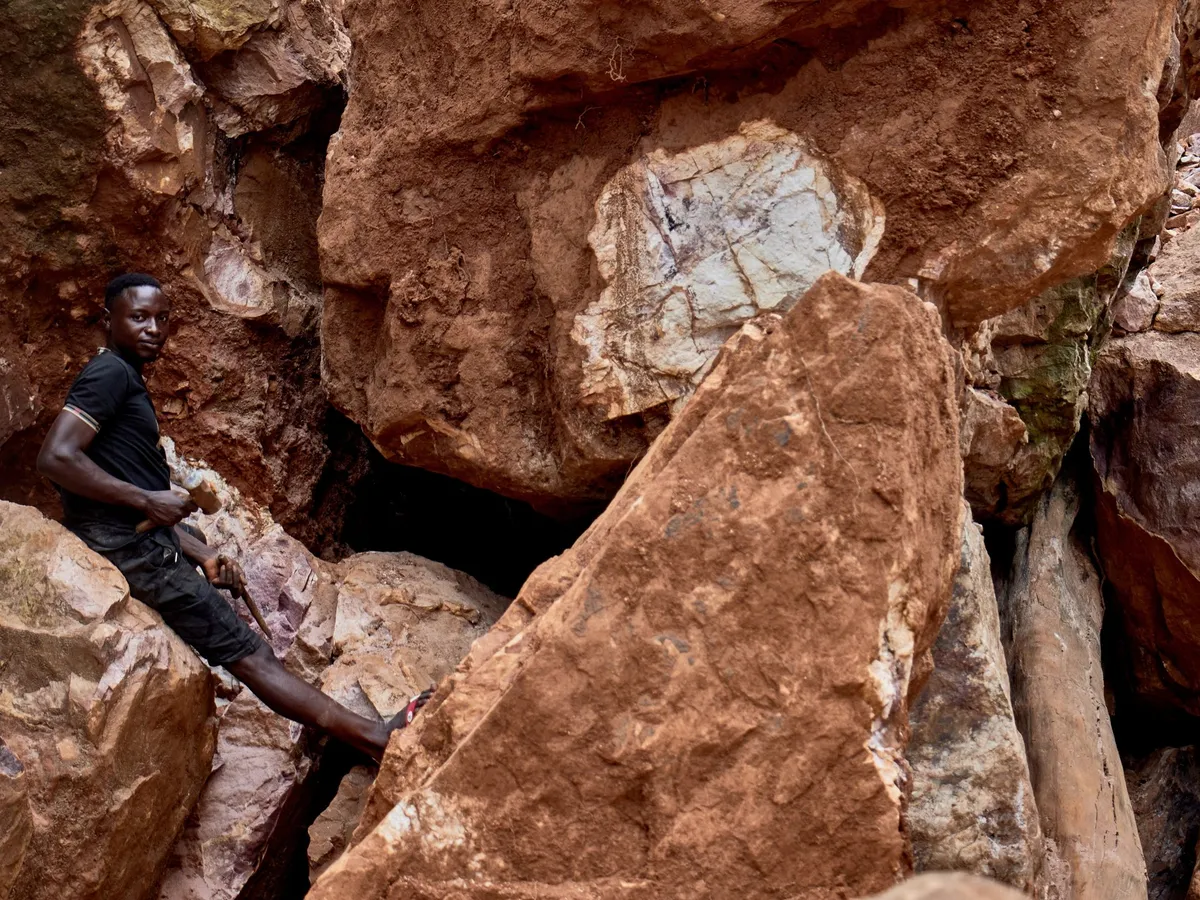
As delegations meet in Washington to discuss critical minerals, many in eastern DRC fear their country will gain little in the process.A Congolese artisanal miner rests while digging in an open-pit mine, in Mangaredjipa near Beni, North Kivu province of the Democratic Republic of the Congo [File: Gradel Muyisa Mumbere/Reuters]Published On 4 Feb 2026Goma, Democratic Republic of the Congo – In cities in the mineral-rich eastern Democratic Republic of the Congo (DRC), home to some of the world’s largest cobalt and copper reserves, eyes are on the outcome of a meeting happening thousands of kilometres away.In Washington, DC, on Wednesday, United States Secretary of State Marco Rubio will host the inaugural Critical Minerals Ministerial, where delegations from 50 countries including the DRC will discuss efforts to strengthen and diversify mineral supply chains as the US seeks to counter China’s global dominance in the sector.Recommended Stories list of 3 itemslist 1 of 3‘Modern plunderers’: Lobito Corridor plans bring fear, hesitation in DRClist 2 of 3Cobalt Miners: The human cost of clean energylist 3 of 3More than 200 killed in mine collapse in eastern DR Congoend of listAs part of a “resources-for-security” type deal agreed last year, the US signed a mining agreement with Kinshasa’s government to secure supplies of components essential to its technological innovation, economic power, and national security.While Congolese President Felix Tshisekedi has touted the economic benefits of the endeavour, many in the country’s mining epicentre – trapped between poverty and armed violence – see only further oppression on the horizon.“We are exploited in mineral extraction,” said Gerard Buunda, an economics student in Goma, the capital of North Kivu province, which is a significant source of the world’s coltan, tin and gold resouces. “There are investors who make us work; sometimes they chase us off our land and force us to work for them in their mines for their own selfish interests.“We don’t want to be exploited any more.”Buunda, 28, who was born not far from the mineral-rich city of Rubaya, condemns what he says are foreign multinationals exposing people to poverty and low wages, child exploitation, and environmental degradation – putting Congolese lives at risk.He fears that the Donald Trump administration’s voracity for critical minerals could heighten socio-political instability in many parts of the world.“Here in eastern DRC, the people who finance mineral exploitation, when they find new mines, buy land from local communities in collusion with our leaders and displace them, and this is the root cause of insecurity,” said Buunda.He called on African leaders, especially those in the DRC, to avoid being “the fall guys” and instead keep an eye on the future of their own rare earths.A miner holds newly extracted coltan ore in Rubaya, the Democratic Republic of the Congo [File: Moses Sawasawa/AP]‘They said: please come and take our minerals’With large deposits of cobalt and lithium – which are essential for electric vehicle batteries and renewable technologies – the Congolese authorities are promoting the DRC as a solution for the energy transition.The US has shown interest, including directly linking security guarantees to resource extraction when it mediated the signing of a peace deal between conflict-prone neighbours DRC and Rwanda last year.“I actually stopped the war with Congo and Rwanda,” Trump claimed in December. “And they said to me, ‘Please, please, we would love you to come and take our minerals.’ Which we’ll do.”Koko Buroko Gloire, a Congolese international affairs commentator based in Kenya, doubts the DRC will gain anything solid from the deal with the US. The market for critical minerals, he believes, is attracting the “covetousness” of major world powers who are lining up for an “increasingly geopolitical” battle.But at the end of the day, for the DRC, Koko says the benefits – or lack of them – will depend on the will of the Congolese leadership.“If this deal will allow us, the Congolese people, to have roads from point A to point B, to have clean water, to have hospitals, to have water, I think it’s a good deal,” he told Al Jazeera, urging Congolese leaders to make sure the DRC does not come out empty-handed.Before Trump came to office, former US President Joe Biden visited the region, in part to discuss the Lobito Corridor railway infrastructure project, which is currently in disrepair in DRC but will connect the country’s mining provinces to Angola, along the Atlantic Coast – a key port for the export of minerals from Africa to the US.According to satellite image analysis carried out by Global Witness, up to 6,500 people could be affected by displacement linked to the development of the Lobito corridor in the DRC.The campaign group said it conducted interviews with different social groups last year in DRC’s Kolwezi, and also visited the railway tracks that will be cleared during the rehabilitation.It said it had found that the railway line runs through vulnerable communities that have benefitted little from the mining boom in Kolwezi, highlighting a “complex” legal situation where the status of houses and buildings along the railway line was disputed, as was the size of the area to be cleared.For Global Witness, the Lobito corridor will be a “litmus test” for Western partners who claim that the project represents a more equitable model for resource exploitation.Miners work at the D4 Gakombe coltan mining quarry in Rubaya, DRC [File: Moses Sawasawa/AP]Local communities ‘negatively’ affectedGentil Mulume, 35, is an activist in Goma, working on matters of transparency and good governance. He emphasises that the Washington meeting is not a dinner party but a call to demonstrate seriousness, particularly with regard to compliance with environmental standards, transparency in mining governance, and industrialisation.He believes the importance of a mining agreement between the DRC and the US cannot be assessed solely in terms of its geopolitical or international economic significance.“This type of agreement risks continuing structurally unbalanced partnerships in which the DRC remains a mere supplier of strategic raw materials for the benefit of Western powers,” he suggests.John Katikomo, a Congolese environmental activist, says the foundations for a fair partnership between the DRC and the US are already off to a bad start, as the deal is “opaque” and authorities in Kinshasa have not disclosed details to citizens.“Many people are misinformed, and there is poor distribution of resources in relation to these critical minerals. Will the population benefit from this?” he asked.For Kuda Manjonjo, a Just Transition adviser with PowerShift Africa, a think tank based in Kenya, Africa holds a disproportionate share of the critical minerals essential to the energy transition, but remains marginalised in global value chains.“This disparity reflects an unfair exploitation model that hinders local development,” he said, stressing the importance of rebalancing the situation, calling for fairer governance, local investment in mineral processing and transformation, and better African representation in strategic decisions on these resources.Another resident of Goma, Daniel Mukamba, accused many multinationals of seeking to keep countries that are rich in natural resources burdened by the “resource curse” – which he believes becomes a “cancer” that is difficult to cure.“If you look at the examples of Walikale and Rubaya, these are cities that produce a lot of minerals, including coltan, gold, cassiterite, and tourmaline, but the population remains poor,” Mukamba told Al Jazeera.Both these resource-rich eastern cities are now held by the Rwanda-backed M23 rebel group, which seized control of much of the east of the country last year.
SRCAl Jazeera
LANGEN
LEANCenter
WORDS1 225
ENT10
WED · 2026-02-04 · 11:45 GMTBRIEF NSR-2026-0204-13278
NSR-2026-0204-13278News Report·EN·Economic Impact
‘We are exploited’: Congolese fear losing out as US makes minerals deals
As the US seeks to diversify its critical mineral supply chains and counter China's dominance, a meeting was held in Washington, D.C. involving delegations from 50 countries, including the Democratic Republic of Congo (DRC).
Prosper Heri NgororaAl JazeeraFiled 2026-02-04 · 11:45 GMTLean · CenterRead · 5 min
Al JazeeraFIG 01
Reading time
5min
Word count
1 225words
Sources cited
2cited
Entities identified
10entities
Quality score
100%
§ 01
Briefing Summary
AI-generatedNEWSAR · AI
As the US seeks to diversify its critical mineral supply chains and counter China's dominance, a meeting was held in Washington, D.C. involving delegations from 50 countries, including the Democratic Republic of Congo (DRC). The US has signed a mining agreement with the DRC to secure essential components for technology and security. However, many Congolese, particularly in the mineral-rich eastern DRC, fear exploitation. They worry that the deal will exacerbate existing issues like poverty, low wages, child exploitation, environmental degradation, and socio-political instability, without benefiting local communities. These concerns arise as the US increases its demand for minerals found in the DRC.
Confidence 0.90Sources 2Claims 5Entities 10
§ 02
Article analysis
Model · rule-basedFraming
Economic Impact
Human Rights
Tone
Measured
AI-assessed
CalmNeutralAlarmist
Factuality
0.70 / 1.00
Factual
LowHigh
Sources cited
2
Limited
FewMany
§ 03
Key claims
5 extracted01
The US seeks to counter China’s global dominance in the critical mineral sector.
factualArticle (Implied)
Confidence
1.00
02
We are exploited in mineral extraction.
quoteGerard Buunda, economics student
Confidence
1.00
03
US signed a mining agreement with Kinshasa’s government to secure supplies of components essential to its technological innovation.
factualArticle (Implied)
Confidence
1.00
04
Congolese artisanal miners fear their country will gain little from US mineral deals.
factualArticle (Implied)
Confidence
0.90
05
Foreign multinationals exposing people to poverty and low wages, child exploitation, and environmental degradation.
quoteGerard Buunda, economics student
Confidence
0.80
§ 04
Full report
5 min read · 1 225 words§ 05
Entities
10 identifiedKey playerOppositionContextPositiveNeutralNegative
§ 06
Keywords & salience
9 termscritical minerals
0.90
democratic republic of the congo
0.90
economic exploitation
0.80
united states
0.70
mineral extraction
0.70
supply chains
0.60
mining agreement
0.60
artisanal miner
0.50
foreign multinationals
0.50
§ 07
Topic connections
Interactive graph Network visualization showing 51 related topics
View Full Graph Person Organization Location Event|Click node to navigate|Edge numbers = shared articles