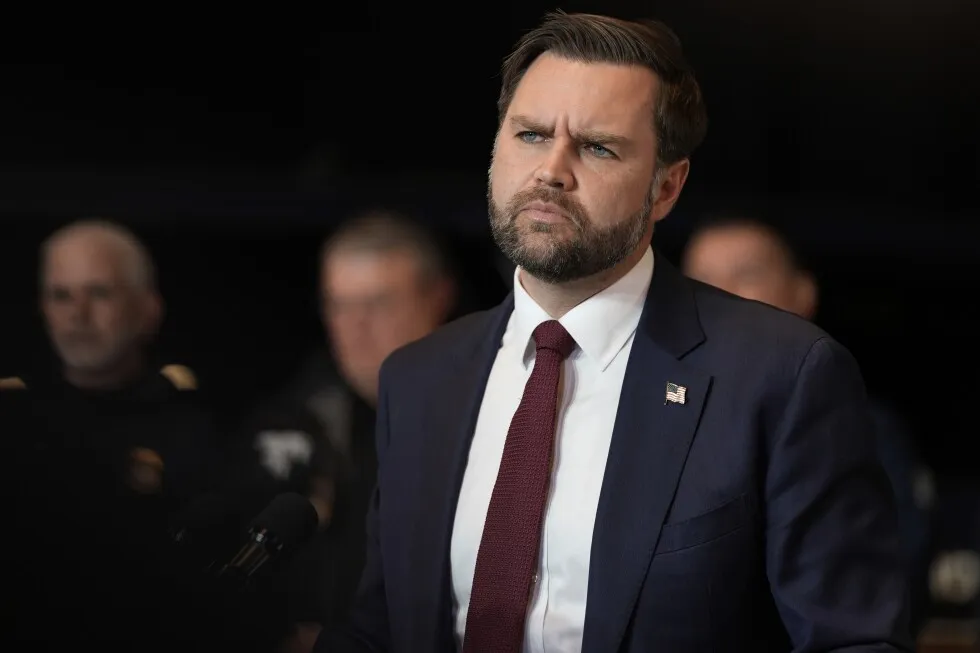
Vance says US seeks to create a critical minerals trading bloc with its allies to counter China 1 of 3 | Vice President JD Vance speaks during a news conference on Thursday, Jan. 22, 2026, in Minneapolis. (AP Photo/Angelina Katsanis) 2 of 3 | Workers use machinery to dig at a rare earth mine in Ganxian county in central China’s Jiangxi province on Dec. 30, 2010. (Chinatopix via AP, File) 3 of 3 | Secretary of State Marco Rubio, right, shakes hands with India’s External Affairs Minister Subrahmanyam Jaishankar at the State Department in Washington, Tuesday, Feb. 3, 2026. (AP Photo/Nathan Howard) 1 of 3 Vice President JD Vance speaks during a news conference on Thursday, Jan. 22, 2026, in Minneapolis. (AP Photo/Angelina Katsanis) Add AP News on Google Add AP News as your preferred source to see more of our stories on Google. 2 of 3 Workers use machinery to dig at a rare earth mine in Ganxian county in central China’s Jiangxi province on Dec. 30, 2010. (Chinatopix via AP, File) Add AP News on Google Add AP News as your preferred source to see more of our stories on Google. 3 of 3 Secretary of State Marco Rubio, right, shakes hands with India’s External Affairs Minister Subrahmanyam Jaishankar at the State Department in Washington, Tuesday, Feb. 3, 2026. (AP Photo/Nathan Howard) Add AP News on Google Add AP News as your preferred source to see more of our stories on Google. Updated [hour]:[minute] [AMPM] [timezone], [monthFull] [day], [year] Washington (AP) — The Trump administration wants to create a critical minerals trading bloc with its allies that will use tariffs to maintain price floors and defend against China’s tactic of flooding the market to undermine any potential competitors.Vice President JD Vance said Wednesday that the trade war over the past year exposed how dependent most countries are on the critical minerals that China has a stranglehold on.“We want members to form a trading bloc among allies and partners, one that guarantees American access to American industrial might while also expanding production across the entire zone,” Vance said at a meeting of foreign ministers at the State Department. “What is before all of us is an opportunity at self-reliance that we never have to rely on anybody else except for each other, for the critical minerals necessary to sustain our industries and to sustain growth.” Critical minerals are needed for everything from jet engines to smartphones. China dominates the market for those ingredients crucial to high-tech products. “I think a lot of us have learned the hard way in some ways over the last year, how much our economies depend on these critical minerals,” Vance said at the opening of a meeting that Secretary of State Marco Rubio is hosting with officials from several dozen European, Asian and African nations. Two days ago, President Donald Trump announced Project Vault, a plan for stockpile of rare elements to be funded with a $10 billion loan from the U.S. Export-Import Bank and nearly $1.67 billion in private capital. Trump’s Republican administration is making such bold moves after China, which controls 70% of the world’s rare earths mining and 90% of the processing, choked off the flow of the elements in response to Trump’s tariff war. The two global powers are in a one-year truce after Trump and Chinese President Xi Jinping met in October and agreed to pull back on high tariffs and stepped-up rare earth restrictions. But China’s limits remain tighter than they were before Trump took office. Xi spoke with Trump on Wednesday, according to Liu Pengyu, spokesperson for the Chinese embassy in Washington. Details were not immediately available.Vance said some countries have signed on the trading bloc, which is designed to ensure stable prices and will provide members access to financing and the critical minerals. He hoped others would agree after the meeting.Administration officials said this plan will help the West move beyond complaining about the problem of access to critical minerals to actually solving it. “Everyone here has a role to play, and that’s why we’re so grateful for you coming and being a part of this gathering that I hope will lead to not just more gatherings, but action,” Rubio said. Countering China’s dominance on critical mineralsIn addition to creating the stockpile, the government last week also made its fourth direct investment in an American critical minerals producer when it extended $1.6 billion to USA Rare Earth in exchange for stock and a repayment agreement. Seeking government funding these days is like meeting with private equity investors because officials are scrutinizing companies to ensure anyone they invest in can deliver, said Pini Althaus, who founded Oklahoma rare earth miner USA Rare Earth in 2019. He said the government is demanding terms designed to generate a return for taxpayers as loans are repaid and stock prices increase.Japan’s minister of state for foreign affairs, Iwao Horii, said at the meeting that Tokyo was fully on board with the U.S. initiative and would work with as many countries as possible to ensure it is a success.“Critical minerals and (their) stable supply is indispensable to the sustainable development of the global economy,” he said. The stockpile strategyThe Export-Import Bank’s board this week approved the $10 billion loan — the largest in its history — to help finance the setup of the U.S. Strategic Critical Minerals Reserve. It is tasked with ensuring access to critical minerals and related products for manufacturers, including battery maker Clarios, energy equipment manufacturer GE Vernova, digital storage company Western Digital and aerospace giant Boeing, according to the policy bank.The bank’s president and chairman, John Jovanovic, told CNBC that the project creates a public-private partnership formula that “is uniquely suited and puts America’s best foot forward.”“What it does is it creates a scenario where there are no free riders. Everybody pitches in to solve this huge problem,” he said. Manufacturers, which benefit the most from the reserve, are making a long-term financial commitment, Jovanovic said, while the government loan spurs private investments.The stockpile strategy may help spark a “more organic” pricing model that excludes China, which has used its dominance to flood the market with lower-priced products to squeeze out competitors, said Wade Senti, president of the U.S. permanent magnet company AML.The administration also has injected public money directly into the sector. The Pentagon has shelled out nearly $5 billion over the past year to help ensure its access to the materials after the trade war laid bare just how beholden the U.S. is to China. Efforts get some bipartisan supportA bipartisan group of lawmakers last month proposed creating an agency with $2.5 billion to spur production of rare earths and the other critical minerals. The lawmakers applauded the steps by the Trump administration.“It’s a clear sign that there is bipartisan support for securing a robust domestic supply of critical minerals that both reduces our reliance on China and stabilizes the market,” Sens. Jeanne Shaheen, D-N.H., and Todd Young, R-Ind., said in a joint statement.Building up a stockpile will help American companies weather future rare earth supply disruptions, but that will likely be a long-term effort because the materials are still scarce right now with China’s restrictions, said David Abraham, a rare earths expert who has followed the industry for decades and wrote the book “The Elements of Power.” The administration has focused on reinvigorating critical minerals production, but Abraham said it’s also important to encourage development of manufacturing that will use them. He noted that Trump’s decisions to cut incentives for electric vehicles and wind turbines have undercut demand for these elements in America. Tang joined the AP Washington bureau in 2023 after spending 11 years in Beijing as a China correspondent. She covers anything related to the Indo-Pacific region with a focus on U.S.-China competitions Funk is an Associated Press reporter who covers transportation including aviation safety and airlines along with all the major freight railroads. Funk also covers Warren Buffett’s Berkshire Hathaway, the impact of the ongoing bird flu outbreak, agriculture and other news out of the Midwest.
SRCAssociated Press (AP)
LANGEN
LEANCenter
WORDS1 344
ENT10
WED · 2026-02-04 · 14:53 GMTBRIEF NSR-2026-0204-13289
NSR-2026-0204-13289News Report·EN·Political Strategy
Vance says US seeks to create a critical minerals trading bloc with its allies to counter China
The Trump administration, led by Vice President JD Vance, announced plans in Washington to establish a critical minerals trading bloc with allied nations. The goal is to counter China's dominance in the market by ensuring access to these essential resources for member countries.
By
DIDI TANG, JOSH FUNK and MATTHEW LEEAssociated Press (AP)Filed 2026-02-04 · 14:53 GMTLean · CenterRead · 6 min
Associated Press (AP)FIG 01
Reading time
6min
Word count
1 344words
Sources cited
2cited
Entities identified
10entities
Quality score
100%
§ 01
Briefing Summary
AI-generatedNEWSAR · AI
The Trump administration, led by Vice President JD Vance, announced plans in Washington to establish a critical minerals trading bloc with allied nations. The goal is to counter China's dominance in the market by ensuring access to these essential resources for member countries. The proposed bloc would use tariffs to maintain price floors and prevent China from undercutting competitors through market flooding. This initiative aims to create self-reliance among allies for critical minerals, which are vital for various industries, including the production of jet engines and smartphones. The announcement followed concerns about the dependence of many countries on China for these resources, highlighted by recent trade tensions.
Confidence 0.90Sources 2Claims 5Entities 10
§ 02
Article analysis
Model · rule-basedFraming
Political Strategy
Economic Impact
Tone
Measured
AI-assessed
CalmNeutralAlarmist
Factuality
0.80 / 1.00
Factual
LowHigh
Sources cited
2
Limited
FewMany
§ 03
Key claims
5 extracted01
President Donald Trump announced Project Vault, a plan for stockpile of rare elements to be funded with a $10 billion loan.
factual
Confidence
1.00
02
The trade war over the past year exposed how dependent most countries are on the critical minerals that China has a stranglehold on.
quoteJD Vance
Confidence
1.00
03
US seeks to create a critical minerals trading bloc with its allies to counter China.
quoteJD Vance
Confidence
1.00
04
China dominates the market for those ingredients crucial to high-tech products.
factual
Confidence
0.90
05
Critical minerals are needed for everything from jet engines to smartphones.
factual
Confidence
0.90
§ 04
Full report
6 min read · 1 344 words§ 05
Entities
10 identifiedKey playerOppositionContextPositiveNeutralNegative
People3
§ 06
Keywords & salience
8 termscritical minerals
1.00
trading bloc
0.90
china
0.80
tariffs
0.70
rare earth minerals
0.60
supply chain
0.60
us allies
0.50
industrial might
0.40
§ 07
Topic connections
Interactive graph Network visualization showing 51 related topics
View Full Graph Person Organization Location Event|Click node to navigate|Edge numbers = shared articles