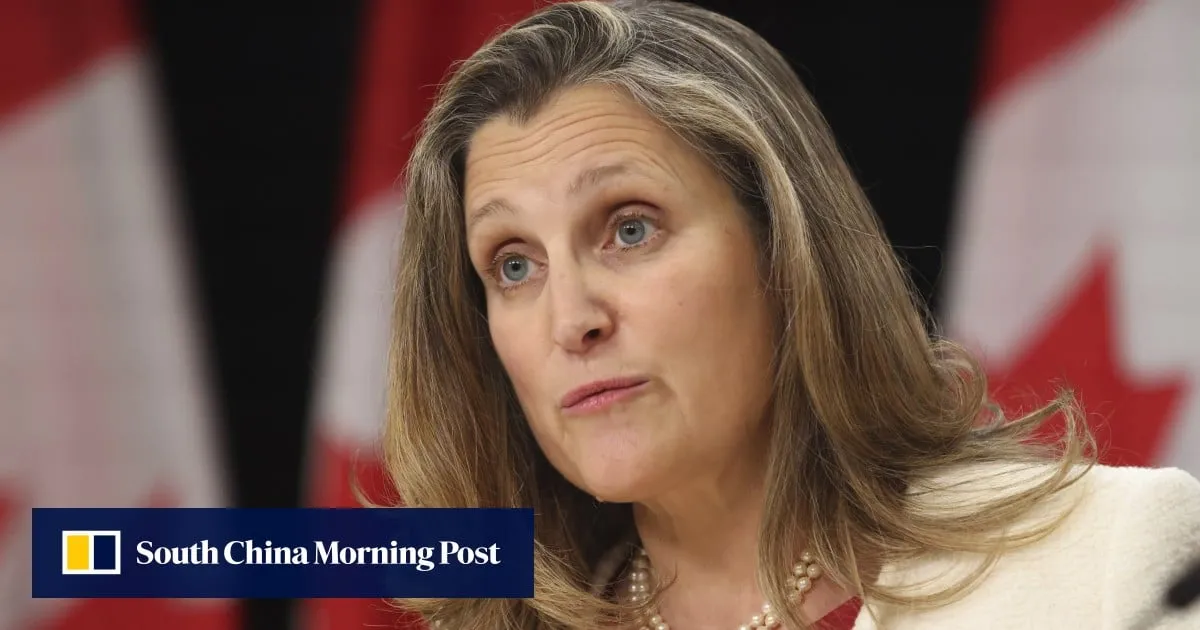
Countries having cautious reliance on China while maintaining constructive engagement is essential to the future of globalisation in a world where trade is increasingly used as a weapon, according to Canada’s former deputy prime minister.“In a world where the weaponisation of trade is real, we need to be thoughtful about where we’re building economic dependencies,” Chrystia Freeland told the Peterson Institute for International Economics during a discussion about the securitisation of trade and the future of globalisation on Wednesday.Freeland endorsed European Commission president Ursula von der Leyen’s on de-risking economic ties with China, expressing the need for a global economic system “in which China works” but other countries’ vulnerabilities are limited.“Seeking a constructive relationship with China, where possible, is the appropriate stance of the international community,” said Freeland, who is currently an adviser to Ukrainian President Volodymyr Zelensky.“Even in business, no business likes to be dependent on a single customer, even if the customer is your great friend. I think for all of us to de-risk is a good idea.”‘We have a deal’: Trump claims breakthrough after ‘12 out of 10’ talks with Xi Jinping‘We have a deal’: Trump claims breakthrough after ‘12 out of 10’ talks with Xi JinpingFreeland was Canada’s deputy prime minister from 2019 to 2024, serving the Liberal Party under then Prime Minister Justin Trudeau. She also served as Canada’s finance minister.
SRCSouth China Morning Post
LANGEN
LEANCenter-Right
WORDS226
ENT10
THU · 2026-02-05 · 00:02 GMTBRIEF NSR-2026-0205-13468
NSR-2026-0205-13468News Report·EN·Political Strategy
The future of globalisation? Less economic dependency on China, Canada’s Freeland hopes
Former Canadian Deputy Prime Minister Chrystia Freeland stated that the future of globalization requires countries to be cautious about economic dependency on China, particularly as trade is increasingly weaponized. Speaking at the Peterson Institute for International Economics, Freeland endorsed the idea of "de-risking" economic ties with China, advocating for a global economic system where China participates but other nations limit their vulnerabilities.
Lucy QuagginSouth China Morning PostFiled 2026-02-05 · 00:02 GMTLean · Center-RightRead · 1 min
South China Morning PostFIG 01
Reading time
1min
Word count
226words
Sources cited
1cited
Entities identified
10entities
Quality score
100%
§ 01
Briefing Summary
AI-generatedNEWSAR · AI
Former Canadian Deputy Prime Minister Chrystia Freeland stated that the future of globalization requires countries to be cautious about economic dependency on China, particularly as trade is increasingly weaponized. Speaking at the Peterson Institute for International Economics, Freeland endorsed the idea of "de-risking" economic ties with China, advocating for a global economic system where China participates but other nations limit their vulnerabilities. She emphasized the importance of maintaining a constructive relationship with China where possible, while also recognizing the need for diversification to avoid over-reliance on any single economic partner. Freeland, who also served as Canada's finance minister, highlighted that even businesses benefit from not being overly dependent on one customer. Her comments reflect growing concerns about the securitization of trade and the need for a more balanced global economic landscape.
Confidence 0.90Sources 1Claims 5Entities 10
§ 02
Article analysis
Model · rule-basedFraming
Political Strategy
Economic Impact
Tone
Measured
AI-assessed
CalmNeutralAlarmist
Factuality
0.70 / 1.00
Factual
LowHigh
Sources cited
1
Limited
FewMany
§ 03
Key claims
5 extracted01
Freeland endorsed Ursula von der Leyen’s on de-risking economic ties with China.
factual
Confidence
1.00
02
Seeking a constructive relationship with China is the appropriate stance.
quoteChrystia Freeland
Confidence
0.90
03
We need to be thoughtful about where we’re building economic dependencies.
quoteChrystia Freeland
Confidence
0.90
04
Countries need cautious reliance on China while maintaining constructive engagement.
quoteChrystia Freeland
Confidence
0.90
05
Trade is increasingly used as a weapon.
quoteChrystia Freeland
Confidence
0.80
§ 04
Full report
1 min read · 226 words§ 05
Entities
10 identifiedKey playerOppositionContextPositiveNeutralNegative
People6
Organizations2
§ 06
Keywords & salience
8 termsglobalisation
1.00
economic dependency
0.90
china
0.90
de-risking
0.80
trade weaponization
0.70
constructive engagement
0.60
economic ties
0.50
international community
0.40
§ 07
Topic connections
Interactive graph Network visualization showing 51 related topics
View Full Graph Person Organization Location Event|Click node to navigate|Edge numbers = shared articles