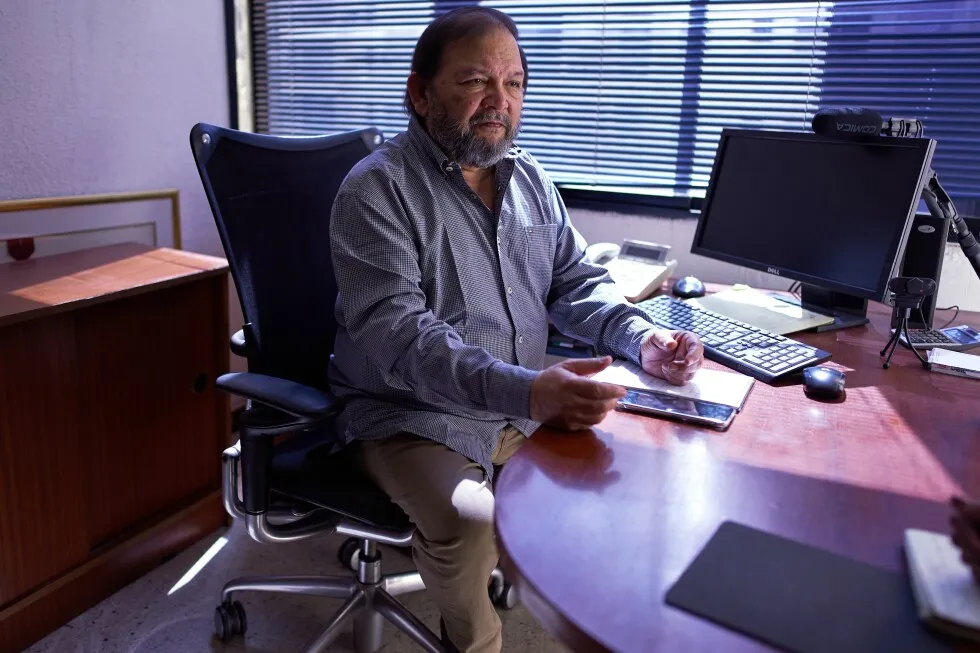
A glimmer of hope for democracy in Venezuela as opponents test the limits of free speech 1 of 3 | Opposition leader Andrés Velásquez sits at his office in Caracas, Venezuela, Saturday, Jan. 31, 2026. (AP Photo/Juan Pablo Arraez) 2 of 3 | El Helicoide, the headquarters of Venezuela’s intelligence service and detention center, stands in Caracas, Venezuela, Friday, Jan. 9, 2026, after National Assembly President Jorge Rodriguez said the government would release Venezuelan and foreign prisoners. (AP Photo/Ariana Cubillos) 3 of 3 | Opposition leader Andrés Velásquez is seen in his office in Caracas, Venezuela. (AP Photo/Juan Pablo Arraez) 1 of 3 Opposition leader Andrés Velásquez sits at his office in Caracas, Venezuela, Saturday, Jan. 31, 2026. (AP Photo/Juan Pablo Arraez) Add AP News on Google Add AP News as your preferred source to see more of our stories on Google. 2 of 3 El Helicoide, the headquarters of Venezuela’s intelligence service and detention center, stands in Caracas, Venezuela, Friday, Jan. 9, 2026, after National Assembly President Jorge Rodriguez said the government would release Venezuelan and foreign prisoners. (AP Photo/Ariana Cubillos) Add AP News on Google Add AP News as your preferred source to see more of our stories on Google. 3 of 3 Opposition leader Andrés Velásquez is seen in his office in Caracas, Venezuela. (AP Photo/Juan Pablo Arraez) Add AP News on Google Add AP News as your preferred source to see more of our stories on Google. Updated [hour]:[minute] [AMPM] [timezone], [monthFull] [day], [year] Caracas, Venezuela (AP) — Andrés Velásquez didn’t stick around to become one more government critic jailed after Venezuela’s 2024 presidential election.A former governor who had crisscrossed Venezuela stumping for then-President Nicolás Maduro’s opponent in the disputed race, he grew a thick beard, sent his children into exile and avoided public events that could expose him to arrest.But in the aftermath of Maduro’s overthrow by the U.S., he mustered the courage to speak out. First, on Jan. 19, Velásquez, with his new look, appeared in a video in which he expressed support for Maduro’s removal while calling for new elections. Then, a few days later, he stuck his neck out even further, shooting a short video outside the infamous Helicoide prison in the capital, Caracas, to demand the release of all political prisoners.“We must dismantle the entire repressive apparatus in the hands of the state,” Velásquez said in the video. “Venezuela will be free!” Velásquez isn’t alone. Since Maduro’s ouster, a number of prominent critics have started to emerge from hiding to test the limits of political speech after years of self-imposed silence driven by fear. Regular Venezuelans are also throwing off restraint, with families of jailed activists protesting outside prisons and those freed defying gag orders normally imposed as a condition for release. Meanwhile, media outlets have begun re-opening their airwaves to critical voices banished in recent years. A glasnost in Venezuela?The political liberalization, while still incipient, was likened by Velásquez to glasnost, referring to the era of reforms and freer public debate that preceded the collapse of the Soviet Union. But unlike that and other democratic openings, this one is taking place almost entirely under the tutelage of the Trump administration, which has used a combination of financial incentives and threats of additional military strikes to carry out the president’s seemingly improbable pledge to “run” Venezuela from Washington.The ultimate goal of the Trump administration’s maneuvers is still unknown. As the White House has heaped praise on acting President Delcy Rodríguez’s willingness to partner with the U.S. to open up Venezuela’s vast oil reserves, combat criminal networks and curb the influence of American adversaries Iran and Russia, the government’s opponents have expressed concern that its demands for elections and a restoration of democracy could be indefinitely delayed. Last week, Rodríguez, a longtime Maduro ally, announced plans for a general amnesty that could lead to the release of hundreds of opposition leaders, journalists and human rights activists detained for political reasons. She also announced the shutdown of Helicoide, vowing to transform the spiral-shaped building — a futuristic architectural icon transfigured into a symbol of Maduro’s dungeons — into a sports and cultural complex for police and residents of surrounding hillside slums. “May this law serve to heal the wounds left by the political confrontation fueled by violence and extremism,” she said at an event surrounded by ruling-party stalwarts. Pedro Vaca, the top freedom of expression expert for the Inter-American Commission on Human Rights, the region’s most respected rights watchdog, said the few “breadcrumbs” offered by Rodríguez’s administration are no substitute for an independent judiciary and law enforcement.“Venezuela’s civic space is still a desert,” said Vaca, who has been trying for months to secure permission from Venezuelan officials to lead an on-the-ground assessment mission to the country. “The few critical voices emerging are seeds breaking through hardened ground, surviving not because freedom exists, but because repression has loosened while remaining ever-present. Let us be clear: this does not mark a democratic turning point.” Self-censorship deepens after 2024 electionPolitical pluralism was severely eroded in Venezuela after Maduro took over the presidency from the late Hugo Chávez in 2013. Anti-government protests and episodes of civil unrest were regularly crushed by security forces whose loyalty to the self-proclaimed socialist leader proved unflinching if powerless against a far-superior U.S. military.The self-censorship deepened following the July 2024 elections, when Maduro launched a wave of repression marked by thousands of arbitrary detentions as he disavowed evidence showing he had lost the contested ballot to the opposition candidate, Edmundo González, by a more than two-to-one margin.Dissidents went into hiding, and the few remaining independent news outlets softened their already cautious coverage for fear of being unplugged.In an interview with the AP, Velásquez said he will continue to push the envelope of allowed political activity but remains wary because the state’s repressive apparatus continues to be entirely under the control of Rodríguez and her allies. “We must continue winning back lost terrain, challenging power. An opportunity has opened up and we can’t let it close again,” he said. “But the biggest obstacle we have to overcome is fear.”In the coming weeks, he’s looking to organize a public event with other government opponents who have recently come out of hiding. Among them is Delsa Solórzano, a former lawmaker who was also a fixture of the opposition’s 2024 presidential campaign. Solórzano last week resurfaced publicly at a rare press conference for her party, describing with tears how she had to take Vitamin D to compensate for the lack of sunlight while living clandestinely.“I didn’t hide because I committed any crime but because here fighting for freedom became an extremely high risk -- to your life, your freedom and your safety,” Solórzano said.Rodriguez allies resist political liberalization Media outlets have also started flexing more muscle.Venevision, which like most private networks dropped coverage critical of the government in recent years, has reopened its airwaves to anti-government voices, covering opposition leader Maria Corina Machado’s every move in Washington since Maduro’s capture.Meanwhile, Globovision, the nation’s largest private broadcaster, whose owner is sanctioned by the U.S. for his ties to Maduro, invited back prominent commentator Vladimir Villegas for the first time in years. Villegas earned a reputation for deftly navigating Venezuela’s already restricted airwaves by keeping the government’s most hardened opponents off his influential political talk show. But the show was abruptly canceled in 2020 when Villegas criticized Maduro for forcing DirecTV to carry state TV in violation of U.S. sanctions, a move that forced the satellite TV provider — and its assortment of international news outlets — to abandon the country. Rodríguez herself hasn’t embraced meaningful public debate of the nation’s problems other than announcing the creation of an advisory commission on political co-existence to be headed by Villegas’ brother, Culture Minister Ernesto Villegas. But already some of her allies seem intent on shutting down any criticism. Meanwhile, authorities have yet to restore full access to the social media platform X, which Maduro blocked after its billionaire owner, Elon Musk, accused him of stealing the 2024 vote.In response to Venevision’s coverage of Machado’s meeting in Washington with Secretary of State Marco Rubio, Interior Minister Diosdado Cabello — a hardliner wanted by the U.S. on a drug warrant — accused the media of playing into a plot by the Nobel Prize winner to sow chaos in Venezuela.“Without media attention, her notoriety fades away. Without headlines, she simply disappears,” Cabello warned on state TV, singling out Venevision’s coverage.But even on state TV — long a bastion of pro-government propaganda and ideological control — cracks have started to appear. Case in point: Rodríguez’s recent tour of a university campus in Caracas in which she was confronted by a small group of student protesters. While state TV made no mention of the students’ demands, the scene itself — in which a Rodríguez was shown calmly separating from her security entourage to “exchange ideas” with what the broadcaster called activists from “extremist parities” — would have been unthinkable a few weeks ago.Under Maduro, even the mildest of criticism was buried on state TV and broadcasts of the president’s frequent rallies and outdoor events stopped airing live after a series of embarrassing disruptions, including a 2016 visit to Margarita Island in which he was driven away by a group of angry, pot-banging protesters.Drawing inspiration from jailed activistsWhile the outlook for an eventual democratic transition in Venezuela remains unknown, government opponents hope Rodriguez is unleashing forces that are beyond her control. Meanwhile, they continue to draw inspiration from those who suffered repression firsthand. Journalist and political activist Carlos Julio Rojas spent 638 days in a Venezuelan prison where, like dozens of other prisoners, he said he was repeatedly handcuffed, denied sunlight and confined to a tiny cell with no bed — sometimes for weeks at a time. When he was released last month as part of a goodwill gesture announced by Rodríguez, he says he was instructed to never discuss the abuse. His mandated silence lasted barely 15 days.“For me, not speaking meant I still felt imprisoned. Not speaking was a form of torture,” said Rojas, who was accused without proof of participating in a 2024 assassination plot against Maduro. “So, today, I decided to remove the gag and speak.”—-Goodman reported from Washington___Follow AP’s coverage of Latin America and the Caribbean at https://apnews.com/hub/latin-america___This story is part of an ongoing collaboration between The Associated Press and FRONTLINE (PBS) that includes an upcoming documentary. Goodman is a Miami-based investigative reporter who writes about the intersection of crime, corruption, drug trafficking and politics in Latin America. He previously spent two decades reporting from South America.
SRCAssociated Press (AP)
LANGEN
LEANCenter
WORDS1 767
ENT7
THU · 2026-02-05 · 15:53 GMTBRIEF NSR-2026-0205-13664
NSR-2026-0205-13664News Report·EN·Political Strategy
A glimmer of hope for democracy in Venezuela as opponents test the limits of free speech
Following the U.S. overthrow of Nicolás Maduro in Venezuela after the disputed 2024 presidential election, opposition leader Andrés Velásquez is testing the limits of free speech.
By
REGINA GARCIA CANO and JOSHUA GOODMANAssociated Press (AP)Filed 2026-02-05 · 15:53 GMTLean · CenterRead · 8 min
Associated Press (AP)FIG 01
Reading time
8min
Word count
1 767words
Sources cited
2cited
Entities identified
7entities
Quality score
100%
§ 01
Briefing Summary
AI-generatedNEWSAR · AI
Following the U.S. overthrow of Nicolás Maduro in Venezuela after the disputed 2024 presidential election, opposition leader Andrés Velásquez is testing the limits of free speech. Velásquez, who previously avoided public life and sent his children into exile to avoid imprisonment, has begun speaking out. He appeared in a video on January 19, 2026, expressing support for Maduro's removal and calling for new elections. Days later, he filmed a video outside the Helicoide prison in Caracas demanding the release of all political prisoners and the dismantling of the state's repressive apparatus. These actions signal a potential shift in the political landscape and a challenge to the existing power structures in Venezuela.
Confidence 0.90Sources 2Claims 5Entities 7
§ 02
Article analysis
Model · rule-basedFraming
Political Strategy
Human Rights
Tone
Measured
AI-assessed
CalmNeutralAlarmist
Factuality
0.70 / 1.00
Factual
LowHigh
Sources cited
2
Limited
FewMany
§ 03
Key claims
5 extracted01
Maduro was overthrown by the U.S.
factualAP
Confidence
1.00
02
National Assembly President Jorge Rodriguez said the government would release Venezuelan and foreign prisoners.
quoteJorge Rodriguez
Confidence
1.00
03
Andrés Velásquez expressed support for Maduro’s removal while calling for new elections.
factualAP
Confidence
1.00
04
Since Maduro’s ouster, a number of prominent critics have started to emerge from hiding.
factualAP
Confidence
0.90
05
Media outlets have begun re-opening their airwaves to critical voices banished.
factualAP
Confidence
0.80
§ 04
Full report
8 min read · 1 767 words§ 05
Entities
7 identifiedKey playerOppositionContextPositiveNeutralNegative
Organizations1
§ 06
Keywords & salience
10 termsvenezuela
1.00
democracy
0.80
andrés velásquez
0.80
free speech
0.70
opposition leader
0.70
political prisoners
0.60
nicolás maduro
0.60
elections
0.50
el helicoide
0.50
repression
0.40
§ 07
Topic connections
Interactive graph Network visualization showing 51 related topics
View Full Graph Person Organization Location Event|Click node to navigate|Edge numbers = shared articles