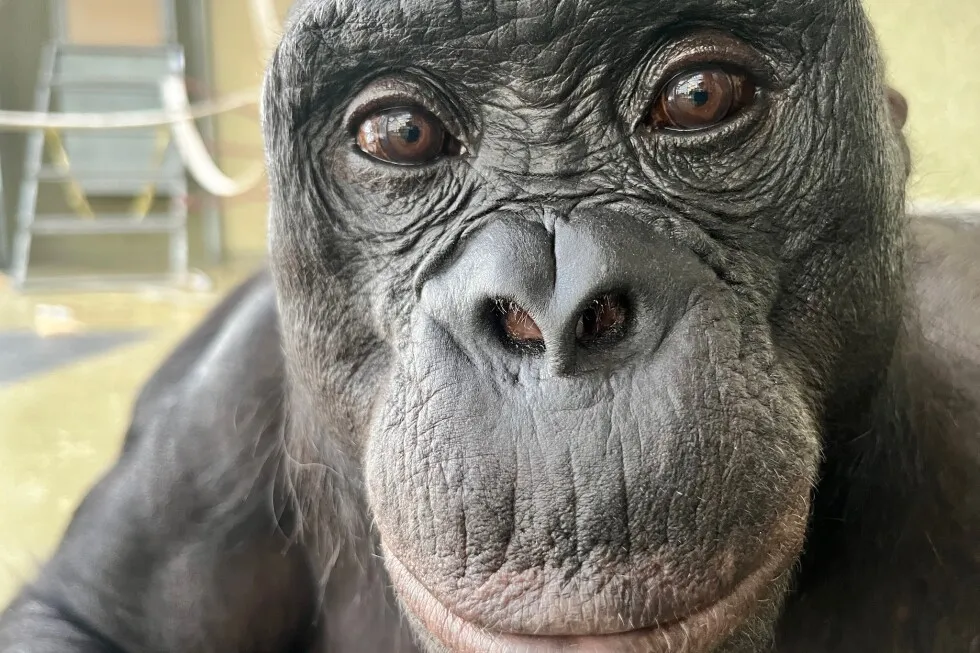
Can apes play pretend? Scientists use an imaginary tea party to find out 1 of 3 | This undated photo provided by the Ape Initiative shows Kanzi, a bonobo who learned to communicate with humans, in Des Moines, Iowa. (Ape Initiative via AP) 2 of 3 | This undated photo provided by the Ape Initiative shows Kanzi, a bonobo who learned to communicate with humans, in Des Moines, Iowa. (Ape Initiative via AP) 3 of 3 | This undated photo provided by the Ape Initiative shows Nyota with Kanzi, a bonobo who learned to communicate with humans, in Des Moines, Iowa. (Ape Initiative via AP) 1 of 3 This undated photo provided by the Ape Initiative shows Kanzi, a bonobo who learned to communicate with humans, in Des Moines, Iowa. (Ape Initiative via AP) Add AP News on Google Add AP News as your preferred source to see more of our stories on Google. 2 of 3 This undated photo provided by the Ape Initiative shows Kanzi, a bonobo who learned to communicate with humans, in Des Moines, Iowa. (Ape Initiative via AP) Add AP News on Google Add AP News as your preferred source to see more of our stories on Google. 3 of 3 This undated photo provided by the Ape Initiative shows Nyota with Kanzi, a bonobo who learned to communicate with humans, in Des Moines, Iowa. (Ape Initiative via AP) Add AP News on Google Add AP News as your preferred source to see more of our stories on Google. Updated [hour]:[minute] [AMPM] [timezone], [monthFull] [day], [year] NEW YORK (AP) — By age 2, most kids know how to play pretend. They turn their bedrooms into faraway castles and hold make-believe tea parties.The ability to make something out of nothing may seem uniquely human — a bedrock of creativity that’s led to new kinds of art, music and more.Now, for the first time, an experiment hints that an ape in captivity can have an imagination. “What’s really exciting about this work is that it suggests that the roots of this capacity for imagination are not unique to our species,” said study co-author Christopher Krupenye with Johns Hopkins University. Enter Kanzi, a bonobo who was raised in a lab and became a whiz at communicating with humans using graphic symbols. He combined different symbols to make them mean new things and learned how to create simple stone tools.Scientists wondered whether Kanzi had the capacity to play pretend — that is, act like something is real while knowing it’s not. They’d heard reports of female chimpanzees in the wild holding sticks as though they were babies and chimps in captivity dragging imaginary blocks on the ground after playing with real ones. But imagination is abstract, so it’s hard to know what’s going on in the apes’ heads. They could just be imitating researchers or mistaking imaginary objects for the real thing. Researchers adapted the playbook for studying young children to stage a juice party for Kanzi. They poured imaginary juice from a pitcher into two cups, then pretended to empty just one. They asked Kanzi which cup he wanted and he pointed to the cup still containing pretend juice 68% of the time. To make sure Kanzi wasn’t confusing real with fake, they also ran a test with actual juice. Kanzi chose the real juice over the pretend almost 80% of the time, “which suggests that he really can tell the difference between real juice and imaginary juice,” said Amalia Bastos, a study co-author from the University of St. Andrews in Scotland. A third experiment placing fake grapes into two jars had similar positive results.But not all scientists are convinced that Kanzi is playing pretend like humans do. There’s a difference between envisioning juice being poured into a cup and maintaining the pretense that it’s real, said Duke University comparative psychologist Michael Tomasello. “To be convinced of that I would need to see Kanzi actually pretend to pour water into a container himself,” Tomasello wrote in an email. He had no role in the study, which was published Thursday in the journal Science.Kanzi grew up among humans, so it’s hard to say whether his abilities extend to all apes or are because of his special upbringing. He died last year at the age of 44.Many great ape species in the wild are critically endangered and it’ll take more research to understand what their minds are capable of.“Kanzi opened this path for a lot of future studies,” Bastos said.___The Associated Press Health and Science Department receives support from the Howard Hughes Medical Institute’s Department of Science Education and the Robert Wood Johnson Foundation. The AP is solely responsible for all content. Ramakrishnan is a science reporter for The Associated Press, based in New York. She covers research and new developments related to space, early human history and more.
SRCAssociated Press (AP)
LANGEN
LEANCenter
WORDS809
ENT7
THU · 2026-02-05 · 19:23 GMTBRIEF NSR-2026-0205-13710
NSR-2026-0205-13710News Report·EN·Human Interest
Can apes play pretend? Scientists use an imaginary tea party to find out
A new study explores whether apes possess the capacity for imagination, a trait previously considered uniquely human. Researchers conducted an experiment involving Kanzi, a bonobo at the Ape Initiative in Des Moines, Iowa, who is known for his communication skills using graphic symbols.
By
ADITHI RAMAKRISHNANAssociated Press (AP)Filed 2026-02-05 · 19:23 GMTLean · CenterRead · 4 min
Associated Press (AP)FIG 01
Reading time
4min
Word count
809words
Sources cited
1cited
Entities identified
7entities
Quality score
100%
§ 01
Briefing Summary
AI-generatedNEWSAR · AI
A new study explores whether apes possess the capacity for imagination, a trait previously considered uniquely human. Researchers conducted an experiment involving Kanzi, a bonobo at the Ape Initiative in Des Moines, Iowa, who is known for his communication skills using graphic symbols. The experiment aimed to determine if Kanzi could engage in pretend play, specifically an imaginary tea party. The findings suggest that Kanzi may indeed have the ability to act as if something is real while understanding it is not, indicating that the roots of imagination may not be exclusive to humans. This research could provide insights into the evolution of creativity and cognitive abilities.
Confidence 0.90Sources 1Claims 5Entities 7
§ 02
Article analysis
Model · rule-basedFraming
Human Interest
Technology
Tone
Measured
AI-assessed
CalmNeutralAlarmist
Factuality
0.70 / 1.00
Factual
LowHigh
Sources cited
1
Limited
FewMany
§ 03
Key claims
5 extracted01
Researchers adapted the playbook for studying young children to stage a juice party for Kanzi.
factualAP
Confidence
1.00
02
Scientists wondered whether Kanzi had the capacity to play pretend.
factualAP
Confidence
1.00
03
Kanzi, a bonobo, was raised in a lab and became a whiz at communicating with humans using graphic symbols.
factualAP
Confidence
1.00
04
What’s really exciting about this work is that it suggests that the roots of this capacity for imagination are not unique to our species.
quoteChristopher Krupenye, Johns Hopkins University
Confidence
0.90
05
An experiment hints that an ape in captivity can have an imagination.
factualAP
Confidence
0.80
§ 04
Full report
4 min read · 809 words§ 05
Entities
7 identifiedKey playerOppositionContextPositiveNeutralNegative
§ 06
Keywords & salience
8 termsplay pretend
1.00
kanzi
0.90
apes
0.90
imagination
0.80
bonobo
0.70
tea party
0.60
captivity
0.50
communication
0.40
§ 07
Topic connections
Interactive graph No topic relationship data available yet. This graph will appear once topic relationships have been computed.