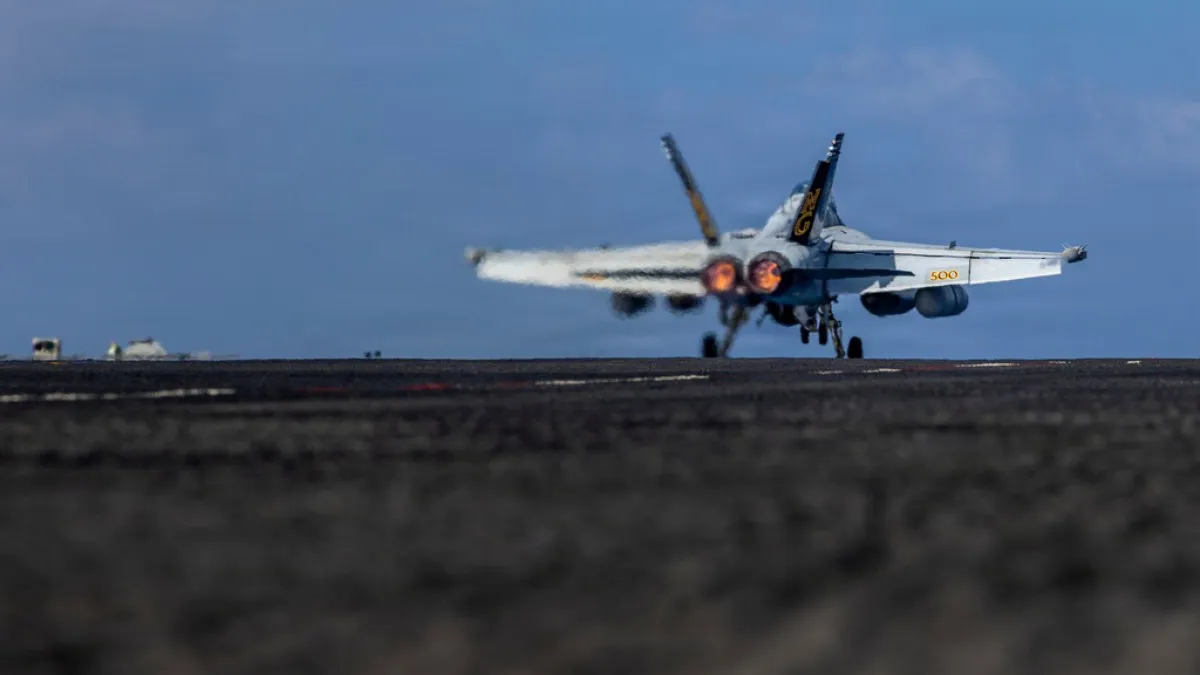
Tensions between the US and Iran continue to grow as Donald Trump warns of US military strikes, absent concessions from Tehran.An EA-18G Growler jet launches from the flight deck of the USS Abraham Lincoln in the Indian Ocean on January 23 [Daniel Kimmelman/US Navy via AP]Published On 10 Feb 2026United States President Donald Trump has continued to threaten Iran with possible military attacks if Tehran does not accede to his demands on issues ranging from nuclear enrichment to ballistic missiles.In comments to the Israeli outlet Channel 12, published on Tuesday, Trump hinted at aggressive actions if no deal comes together with Iran.Recommended Stories list of 3 itemslist 1 of 3Iran’s top security official in Oman following nuclear talks with USlist 2 of 3Iran shuts down private businesses after protests as economy slumpslist 3 of 3Netanyahu says he’ll present ‘principles’ for Iran talks to Trumpend of list“Either we reach a deal, or we’ll have to do something very tough,” Trump told the news outlet.The remarks come as Iran’s security chief Ali Larijani meets with the sultan of Oman, Haitham bin Tariq Al Said, to discuss the results of talks between US and Iranian officials last week.In recent weeks, Trump has touted an increase in US military forces in the region, having sent a “massive armada” to nearby waters. That deployment includes the USS Abraham Lincoln, an aircraft carrier.Channel 12 and the news outlet Axios reported on Tuesday that Trump is also thinking about sending a second aircraft carrier to the Middle East.That military build-up has spurred fears of an impending US strike against Iran. Critics fear such an attack could destabilise the region.Already, on Monday, the US has issued guidelines to US-flagged commercial ships, warning them to stay “as far as possible” from Iranian territorial waters.Heightened demandsSince January, Trump has heightened US pressure on Iran, warning that his country’s military is “locked and loaded and ready to go”.Trump has also compared Iran’s situation to that of Venezuela, where a US military operation on January 3 resulted in the abduction and removal of deposed President Nicolas Maduro.“Like with Venezuela, [the US military] is ready, willing, and able to rapidly fulfill its mission, with speed and violence, if necessary. Hopefully Iran will quickly ‘Come to the Table’ and negotiate a fair and equitable deal,” Trump wrote on social media on January 28.Late last month, the Trump administration issued Iran three overarching demands. They include an end to Iran’s uranium enrichment, a requirement to sever ties with regional proxies, and limits on the country’s ballistic missile stockpiles, a goal long sought by Israel.On Tuesday, Trump reiterated his position that Iran should comply with his demands, telling the news outlet Fox Business it would be “foolish” not to.During his first term, the US president pulled his country out of a 2015 deal that placed strict limits on Iran’s nuclear activities, in exchange for sanctions relief.Since taking office for a second term in January 2025, Trump has resumed his “maximum pressure” campaign against Iran.That push has included severe sanctions and pressure to dismantle Iran’s nuclear programme, which Tehran insists is for civilian energy purposes only.Already, last June, Trump authorised a military strike on three Iranian nuclear facilities, as part of a 12-day war between Iran and Israel.Responding to anti-government protestsTrump’s renewed threats in January have coincided with a recent wave of anti-government protests in Iran.The government in Tehran reacted to those demonstrations with a violent crackdown that reportedly killed thousands of people, drawing widespread condemnation from rights groups.Reports have found that state security forces opened fire on crowds of protesters as the country was under an internet blackout.On January 2 — one day before his military operation in Venezuela — Trump threatened to intervene on behalf of the protesters and “come to their rescue“, although he ultimately declined to do so.Some analysts have pointed out that the proposed strikes on Iran would do little to aid the protesters, but would align with longstanding US and Israeli goals of reducing Iran’s military capacity.The Iranian government has argued that the protests included the violent targeting of security forces by armed groups, resulting in the deaths of hundreds of officers. It has also accused outside powers like the US and Israel of backing the anti-government demonstrations.Details around the protests and their crackdown remain difficult to verify, but Iranian officials have conceded that the government’s response killed thousands of people.‘Chaotic wars of choice’The prospect that the US might intervene in Iran, however, has prompted pushback domestically for Trump.On Tuesday, a coalition of 25 advocacy groups called on the US Congress to assert greater oversight over Trump’s use of the military, in the face of his threats against Iran.Their letter was coincided with a new war powers resolution introduced by senators Tim Kaine and Rand Paul on January 29.The bill calls for the US military to be removed “from hostilities within or against the Islamic Republic of Iran”, unless authorised by Congress to take action.The advocacy groups urged other Congress members to support the bill and ensure its passage.“Iran has not attacked the United States nor threatened an offensive strike, and Congress has not authorized any military action against Iran,” their letter said.“As a coalition of groups concerned with reckless military escalation, we urge Congress to represent its constituents, assert its Constitutional role and block an unauthorized war with Iran.”The Center for International Policy, J Street, CODEPINK, and Common Defense were among the letter’s signatories.Previous war powers resolutions, however, have failed to pass. In June, after the US strikes on Iranian nuclear sites, lawmakers failed to advance a similar bill that sought to prohibit further “unauthorized hostilities” against Iran.Legislation to limit Trump’s military actions in Venezuela also faced defeat last month.Ordinarily, Congress has the sole power to authorise war and similar military actions under the US Constitution. But critics say that presidents in recent decades have exerted ever-growing control over the country’s military.Ryan Costello, the policy director at the National Iranian American Council Action (NIAC), told Al Jazeera that a war powers resolution on Iran could face a tough path forward. His organisation was among the groups that signed onto Tuesday’s letter.Still, Costello expressed optimism. He pointed out that Congress had passed such resolutions during Trump’s first term — once in 2019 and again in 2020 — though the Republican president ultimately vetoed both bills.Congress should take action again, given the high stakes of a war between the US and Iran, according to Costello.“The messiness and bloodiness of a new war with Iran, combined with the prospect of pressure from Congress on war powers resolutions, likely makes diplomatic off-ramps look much more attractive,” said Costello.“While it is a high bar to pass war powers resolutions, Congress did so in Trump’s first term and forced him to exercise a rare veto. We hope they keep the pressure up and do what their voters want, which is to keep the US out of new, chaotic wars of choice.”
SRCAl Jazeera
LANGEN
LEANCenter
WORDS1 155
ENT12
TUE · 2026-02-10 · 21:13 GMTBRIEF NSR-2026-0210-15128
NSR-2026-0210-15128News Report·EN·Conflict
Trump threatens Iran with ‘something very tough’ if US demands are not met
In February 2026, US President Donald Trump threatened Iran with potential military action if it does not meet US demands regarding its nuclear program and ballistic missiles. These remarks were made to an Israeli news outlet as Iranian and US officials held talks in Oman.
By News AgenciesAl JazeeraFiled 2026-02-10 · 21:13 GMTLean · CenterRead · 5 min
Al JazeeraFIG 01
Reading time
5min
Word count
1 155words
Sources cited
5cited
Entities identified
12entities
Quality score
100%
§ 01
Briefing Summary
AI-generatedNEWSAR · AI
In February 2026, US President Donald Trump threatened Iran with potential military action if it does not meet US demands regarding its nuclear program and ballistic missiles. These remarks were made to an Israeli news outlet as Iranian and US officials held talks in Oman. The US has increased its military presence in the region, including deploying the USS Abraham Lincoln aircraft carrier, raising concerns about a possible US strike against Iran. The US also issued warnings to US-flagged ships to avoid Iranian waters. Since January, Trump has increased pressure on Iran, stating the US military is prepared for rapid deployment and comparing the situation to Venezuela. The Trump administration issued Iran three demands late last month.
Confidence 0.90Sources 5Claims 5Entities 12
§ 02
Article analysis
Model · rule-basedFraming
Conflict
National Security
Tone
Mixed Tone
AI-assessed
CalmNeutralAlarmist
Factuality
0.80 / 1.00
Factual
LowHigh
Sources cited
5
Well sourced
FewMany
§ 03
Key claims
5 extracted01
The Trump administration issued Iran three overarching demands including an end to Iran’s uranium enrichment.
factualArticle
Confidence
1.00
02
The US has issued guidelines to US-flagged commercial ships, warning them to stay “as far as possible” from Iranian territorial waters.
factualArticle
Confidence
1.00
03
Trump has heightened US pressure on Iran, warning that his country’s military is “locked and loaded and ready to go”.
quoteTrump
Confidence
0.90
04
Trump hinted at aggressive actions if no deal comes together with Iran.
quoteTrump
Confidence
0.90
05
Trump threatens Iran with possible military attacks if Tehran does not accede to his demands.
factualArticle
Confidence
0.90
§ 04
Full report
5 min read · 1 155 words§ 05
Entities
12 identifiedKey playerOppositionContextPositiveNeutralNegative
People4
§ 06
Keywords & salience
10 termsus-iran tensions
0.90
military strikes
0.80
donald trump
0.80
tehran
0.70
us military
0.70
aircraft carrier
0.60
ballistic missiles
0.60
nuclear enrichment
0.60
us demands
0.60
middle east
0.50
§ 07
Topic connections
Interactive graph Network visualization showing 51 related topics
View Full Graph Person Organization Location Event|Click node to navigate|Edge numbers = shared articles