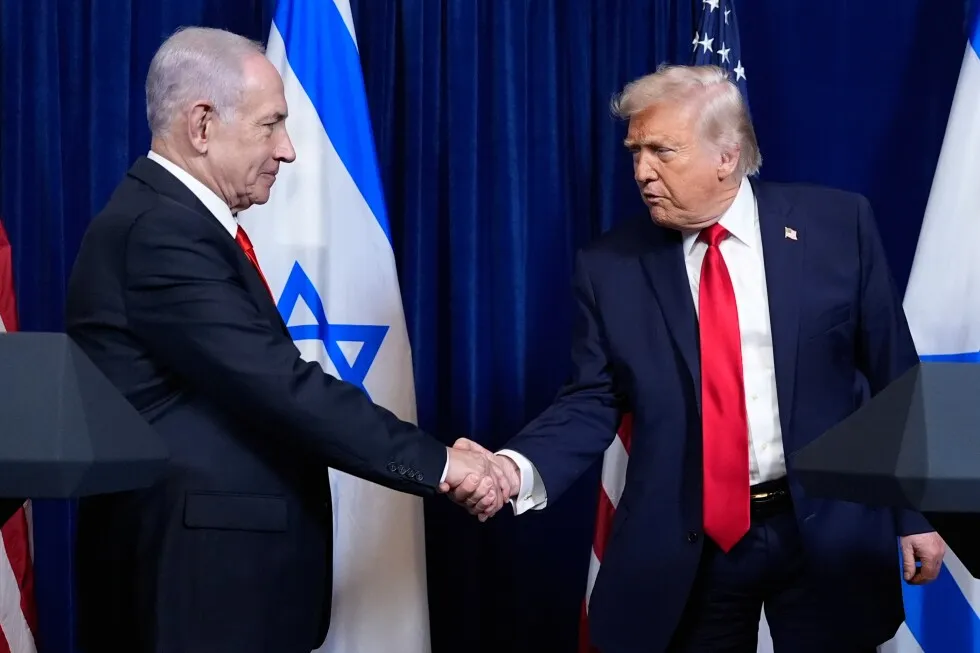
Netanyahu to urge expanded Iran talks during White House meeting as Trump says Tehran wants a deal 1 of 3 | Heading to Washington to meet with US President Donald Trump, Israeli Prime Minister Benjamin Netanyahu on Tuesday said he will present the American leader with Israel’s “principles” regarding negotiations with Iran. 2 of 3 | President Donald Trump shakes hands with Israel’s Prime Minister Benjamin Netanyahu at the end of a news conference at Mar-a-Lago, Dec. 29, 2025, in Palm Beach, Fla. (AP Photo/Alex Brandon, File) 3 of 3 | President Donald Trump answers a question from a reporter at the end of a news conference with Israel’s Prime Minister Benjamin Netanyahu at Mar-a-Lago, Dec. 29, 2025, in Palm Beach, Fla. (AP Photo/Alex Brandon, file) 1 of 3 Heading to Washington to meet with US President Donald Trump, Israeli Prime Minister Benjamin Netanyahu on Tuesday said he will present the American leader with Israel’s “principles” regarding negotiations with Iran. Add AP News on Google Add AP News as your preferred source to see more of our stories on Google. 2 of 3 President Donald Trump shakes hands with Israel’s Prime Minister Benjamin Netanyahu at the end of a news conference at Mar-a-Lago, Dec. 29, 2025, in Palm Beach, Fla. (AP Photo/Alex Brandon, File) Add AP News on Google Add AP News as your preferred source to see more of our stories on Google. 3 of 3 President Donald Trump answers a question from a reporter at the end of a news conference with Israel’s Prime Minister Benjamin Netanyahu at Mar-a-Lago, Dec. 29, 2025, in Palm Beach, Fla. (AP Photo/Alex Brandon, file) Add AP News on Google Add AP News as your preferred source to see more of our stories on Google. Updated [hour]:[minute] [AMPM] [timezone], [monthFull] [day], [year] Washington (AP) — With President Donald Trump saying he believes Iran wants to make a deal on its nuclear program, Israeli Prime Minister Benjamin Netanyahu is expected to arrive at the White House on Wednesday with his own urgent message: Expand the talks further. The visit from Netanyahu — their seventh meeting in Trump’s second term — comes as both Tehran and Washington are projecting cautious optimism after holding indirect talks in Oman on Friday about how once again to approach negotiations over Iran’s nuclear program.“We’ll see what happens. I think they want to make a deal,” Trump said in an interview Tuesday with Fox Business Network’s Larry Kudlow. “I think they’d be foolish if they didn’t. We took out their nuclear power last time, and we’ll have to see if we take out more this time.”He added, ”It’s got to be a good deal. No nuclear weapons, no missiles.” Netanyahu pushes for more in Iran talksNetanyahu’s office has said he wants those talks to include limits on Iran’s ballistic missile program and support for militant groups like the Palestinian Hamas and Lebanon’s Hezbollah.“I will present to the president our outlook regarding the principles of these negotiations — the essential principles which, in my opinion, are important not only to Israel, but to everyone around the world who wants peace and security in the Middle East,” Netanyahu said Tuesday before departing Israel. It remains unclear how much influence Netanyahu will have over Trump’s approach toward Iran. Trump initially threatened to take military action over Iran’s bloody crackdown on nationwide protests in January, then shifted to a pressure campaign in recent weeks to try to get Tehran to make a deal over its nuclear program. Iran’s is still reeling from the 12-day war with Israel this past June. The devastating series of airstrikes, including the U.S. bombing several Iranian nuclear sites, killed nearly 1,000 people in Iran and almost 40 in Israel. Trump, at the time, said the U.S. action had “obliterated” Iran’s nuclear capabilities, though the amount of damage remains unclear. Satellite photos of nuclear sites have recently captured activity, prompting concern Iran could be attempting to salvage or assess damage at the sites. Israel has long called for Iran to cease all uranium enrichment, dial back its ballistic missile program and cut ties to militant groups across the region. Iran has always rejected those demands, saying it would only accept some limits on its nuclear program in return for sanctions relief. “There’s probably a degree of concern (for the Israelis) over the Iranians using any negotiation process to deflect some of the pressure,” said Naysan Rafati, senior Iran analyst at the Washington-based International Crisis Group. He added that Netanyahu will likely stress to Trump that there “shouldn’t be an open-ended negotiation for the sake of negotiation, but to have the kind of parameters where the West should be willing to walk away from the table.” To that end, the U.S. has built up military forces in the region, sending an aircraft carrier, guided-missile destroyers, air defense assets and more to supplement its presence. Arab and Islamic countries, including Turkey and Qatar, have been urging both sides to show restraint, warning that any strike or retaliation could have destabilizing consequences for a region already strained by the Israel-Hamas war in Gaza. Gaza is likely to come upThat conflict is sure to come up on Wednesday as Trump plans to hold the first meeting next week of the Board of Peace, which was initially framed to oversee future steps of the U.S.-brokered Gaza ceasefire plan but has taken shape with Trump’s ambitions of resolving other global crises.On Iran, Trump said Friday that his special envoy Steve Witkoff and son-in-law Jared Kushner had “very good” talks on Iran and more were planned for this week. But the Republican president kept up the pressure, warning that if the country didn’t make a deal over its nuclear program, “the consequences are very steep.”Iranian Foreign Minister Abbas Araghchi made similar comments, saying there will be consultations on “next steps” but cautioning that the level of mistrust between the two longtime adversaries remains a “serious challenge facing the negotiations.” He also signaled that Iran would stick to its position that it must be able to enrich uranium — a major point of contention with Trump.“The readouts from both President Trump and from the Iranians has been cautiously optimistic, not so much as there’s light at the end of the tunnel, but they may be able to build a tunnel,” Rafati said. Netanyahu met with Witkoff and Kushner shortly after arriving in Washington on Tuesday evening and they gave him an update on the talks held with Iran in Oman, the prime minister’s office said. He was to meet with Secretary of State Marco Rubio on Wednesday morning, the State Department said. Araghchi said in November that Iran was no longer enriching uranium due to the damage from last year’s war. Before the June war, Iran had been enriching uranium up to 60% purity, a short, technical step away from weapons-grade levels. The U.N. nuclear watchdog — the International Atomic Energy Agency — had said Iran was the only country in the world to enrich to that level that wasn’t armed with the bomb.Iran has been refusing requests by the IAEA to inspect the sites bombed in the June war. Even before that, Iran has restricted IAEA inspections since Trump’s decision in 2018 to unilaterally withdraw the U.S. from Iran’s 2015 nuclear deal with world powers.___Amiri reported from New York. Amiri covers foreign policy and the United Nations as a correspondent for The Associated Press, based in New York. Lidman is an Associated Press reporter based in Tel Aviv, Israel.
SRCAssociated Press (AP)
LANGEN
LEANCenter
WORDS1 252
ENT8
WED · 2026-02-11 · 09:53 GMTBRIEF NSR-2026-0211-15299
NSR-2026-0211-15299News Report·EN·Diplomatic
Netanyahu to urge expanded Iran talks during White House meeting as Trump says Tehran wants a deal
Israeli Prime Minister Benjamin Netanyahu is scheduled to meet with US President Donald Trump in Washington to discuss Iran. Trump believes Iran is interested in making a deal regarding its nuclear program, following indirect talks between Tehran and Washington in Oman.
By
FARNOUSH AMIRI and MELANIE LIDMANAssociated Press (AP)Filed 2026-02-11 · 09:53 GMTLean · CenterRead · 6 min
Associated Press (AP)FIG 01
Reading time
6min
Word count
1 252words
Sources cited
3cited
Entities identified
8entities
Quality score
100%
§ 01
Briefing Summary
AI-generatedNEWSAR · AI
Israeli Prime Minister Benjamin Netanyahu is scheduled to meet with US President Donald Trump in Washington to discuss Iran. Trump believes Iran is interested in making a deal regarding its nuclear program, following indirect talks between Tehran and Washington in Oman. Netanyahu plans to present Trump with Israel's "principles" for negotiations with Iran, urging for expanded talks. This meeting marks the seventh between Netanyahu and Trump during Trump's second term. The discussions come amid cautious optimism from both Tehran and Washington regarding potential negotiations on Iran's nuclear program.
Confidence 0.90Sources 3Claims 5Entities 8
§ 02
Article analysis
Model · rule-basedFraming
Diplomatic
National Security
Tone
Measured
AI-assessed
CalmNeutralAlarmist
Factuality
0.80 / 1.00
Factual
LowHigh
Sources cited
3
Well sourced
FewMany
§ 03
Key claims
5 extracted01
Netanyahu wants Iran talks to include limits on Iran’s ballistic missile program and support for militant groups.
factualNetanyahu's office
Confidence
1.00
02
Trump believes Iran wants to make a deal on its nuclear program.
quoteDonald Trump
Confidence
1.00
03
Netanyahu will present Trump with Israel’s “principles” regarding negotiations with Iran.
quoteBenjamin Netanyahu
Confidence
1.00
04
Tehran and Washington held indirect talks in Oman on Friday.
factualAP
Confidence
0.90
05
Netanyahu is expected to arrive at the White House on Wednesday.
factualAP
Confidence
0.90
§ 04
Full report
6 min read · 1 252 words§ 05
Entities
8 identifiedKey playerOppositionContextPositiveNeutralNegative
Organizations1
§ 06
Keywords & salience
9 termsiran talks
1.00
benjamin netanyahu
0.90
donald trump
0.90
nuclear program
0.80
white house meeting
0.70
negotiations
0.70
israel
0.60
deal
0.50
oman
0.40
§ 07
Topic connections
Interactive graph Network visualization showing 51 related topics
View Full Graph Person Organization Location Event|Click node to navigate|Edge numbers = shared articles