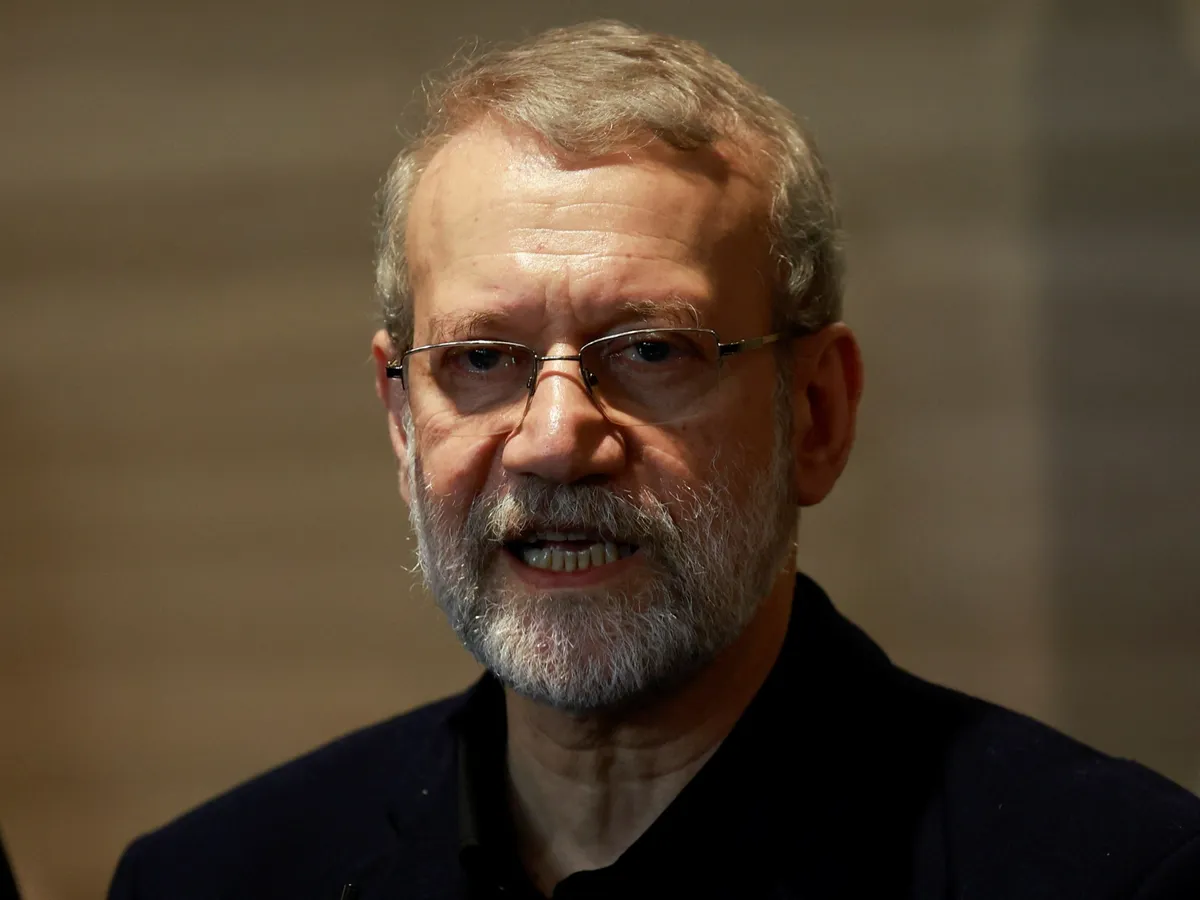
Tehran’s security chief says Israel is attempting to derail talks with Washington and provoke war in the region.Iran's security chief Ali Larijani has accused Israel of trying to sabotage negotiations with Washington [File: Thaier Al-Sudani/Reuters]Published On 12 Feb 2026Iran’s security chief Ali Larijani has accused Israel of attempting to sabotage negotiations with the United States over Tehran’s nuclear programme, so it can ignite a new war that would destabilise the region.In an interview with Al Jazeera Arabic during his visit to Doha, Qatar, where he met top officials on Wednesday, Larijani, secretary of Iran’s Supreme National Security Council, said Israel had been fabricating pretexts to try to derail the negotiations with Washington, as the renewed talks were at a delicate stage.Recommended Stories list of 4 itemslist 1 of 4Trump threatens Iran with ‘something very tough’ if US demands are not metlist 2 of 4Iran’s leaders rail against US, ‘sedition’ in 1979 revolution celebrationslist 3 of 4Iran says missile programme non-negotiable as Tehran, Washington eye talkslist 4 of 4‘Nothing definitive’ reached about Iran during Netanyahu’s visit with Trumpend of list“Our negotiations are exclusively with the United States – we are not engaged in any talks with Israel,” he said.“However, Israel has inserted itself into this process, with their intent on undermining and sabotaging these negotiations.”He said Israel’s strategy was “to destabilise the region”, and that its agenda “extends beyond its alleged concerns about Iran”, as was evidenced by its attack on the Qatari capital targeting Hamas officials in September.“They are gambling not only with Iran, but also Qatar, Saudi Arabia and Turkiye,” he said, calling on regional leaders to “be aware of this.”Israel’s attack on Iran in June came as Tehran and Washington were engaged in talks and effectively torpedoed the negotiations, which were several rounds in.Netanyahu meets with TrumpIran and the US held a round of indirect negotiations in Muscat, Oman, on Friday, seeking to negotiate a resolution to the nuclear dispute, amid a US military buildup in the region and Trump’s ongoing threats to strike Iran if it does not accede to his demands.Amid plans for a second round of talks – the timing of which is currently under discussion, Larijani said – Israeli Prime Minister Benjamin Netanyahu travelled to Washington on Wednesday for urgent talks with Trump, where he presented the US leader with “principles” for negotiating with Iran.After the meeting, Trump said “nothing definitive” had been reached, “other than I insisted that negotiations with Iran continue to see whether or not a Deal can be consummated”.‘Common ground’Larijani told Al Jazeera that Tehran had not yet received a specific proposal from Washington in the negotiations, and that the talks in Muscat had consisted of an exchange of messages.He said that Tehran was taking a positive position towards the negotiations, and that Washington, too, appeared to have concluded that negotiations were the preferred option.He said there was common ground between Tehran and Washington regarding Iran not possessing a nuclear weapon, which it insists it is not pursuing.Missiles, zero enrichment off the tableHowever, Larijani reiterated that the negotiations would be limited to Iran’s nuclear programme, with issues such as Iran’s missile programme – which the US has pushed to address in the talks, and is a key concern for Israel – not up for discussion.“When we met at the negotiating table, a clear boundary was drawn … our talks centred solely on the nuclear issue,” he said, adding that this was a “logical” approach.“Our missile program stands entirely separate from the nuclear one. It is a domestic matter, basically linked to our national security. As such, it cannot be part of these negotiations.”Similarly, he said, the notion of Iran reducing its uranium enrichment to zero was “not on the table”.“It is impractical for a country that has already mastered this technology to reduce it to zero,” he said, citing the need for enriched uranium for peaceful civilian purposes such as in cancer treatment.“Meanwhile, we are open to verification, and anybody is welcome to come and see [our facilities] for themselves.”If the US did opt to attack Iran, as it did in a series of strikes targeting the country’s nuclear facilities in June as part of a 12-day war, then Tehran would respond by attacking US military bases in the region, Larijani said.Before leaving Doha, Larijani also met with Muhammad Darwish, the head of Hamas’s Leadership Council, along with a senior delegation from the Palestinian group, to discuss the latest political developments in the region and Israel’s war on Gaza, Lebanon’s Al-Manar reported.
SRCAl Jazeera
LANGEN
LEANCenter
WORDS752
ENT12
THU · 2026-02-12 · 07:18 GMTBRIEF NSR-2026-0212-15576
NSR-2026-0212-15576News Report·EN·Political Strategy
Iran’s Larijani accuses Israel of trying to sabotage US negotiations
Iranian security chief Ali Larijani accused Israel of attempting to sabotage nuclear negotiations between Iran and the United States. Larijani made the accusation during a visit to Doha, Qatar, on February 12, 2026, stating that Israel aims to destabilize the region and provoke war.
Al Jazeera StaffAl JazeeraFiled 2026-02-12 · 07:18 GMTLean · CenterRead · 4 min
Al JazeeraFIG 01
Reading time
4min
Word count
752words
Sources cited
3cited
Entities identified
12entities
Quality score
100%
§ 01
Briefing Summary
AI-generatedNEWSAR · AI
Iranian security chief Ali Larijani accused Israel of attempting to sabotage nuclear negotiations between Iran and the United States. Larijani made the accusation during a visit to Doha, Qatar, on February 12, 2026, stating that Israel aims to destabilize the region and provoke war. He claimed Israel's actions, including a past attack on Qatar, are intended to undermine the talks, which are at a sensitive stage. Larijani emphasized that Iran is only negotiating with the U.S., while Israel is trying to insert itself into the process. The accusation comes as Iran and the U.S. engage in indirect negotiations in Oman, and as Israeli Prime Minister Netanyahu met with U.S. President Trump to discuss principles related to Iran.
Confidence 0.90Sources 3Claims 5Entities 12
§ 02
Article analysis
Model · rule-basedFraming
Political Strategy
National Security
Tone
Mixed Tone
AI-assessed
CalmNeutralAlarmist
Factuality
0.70 / 1.00
Factual
LowHigh
Sources cited
3
Well sourced
FewMany
§ 03
Key claims
5 extracted01
Iran and the US held a round of indirect negotiations in Muscat, Oman, on Friday.
factualArticle (reporting)
Confidence
1.00
02
Netanyahu travelled to Washington for urgent talks with Trump, where he presented the US leader with “principles” for negotiating with Iran.
factualArticle (reporting)
Confidence
1.00
03
Israel attacked the Qatari capital targeting Hamas officials in September.
factualArticle (unclear if attributed)
Confidence
0.90
04
Iran's security chief Ali Larijani accused Israel of trying to sabotage negotiations with the United States.
quoteAli Larijani
Confidence
0.90
05
Israel's strategy was “to destabilise the region”.
quoteAli Larijani
Confidence
0.80
§ 04
Full report
4 min read · 752 words§ 05
Entities
12 identifiedKey playerOppositionContextPositiveNeutralNegative
People3
Organizations3
§ 06
Keywords & salience
6 termsiran-us negotiations
0.80
israel's sabotage
0.70
regional destabilization
0.60
middle east conflict
0.50
nuclear programme
0.50
us military buildup
0.40
§ 07
Topic connections
Interactive graph Network visualization showing 51 related topics
View Full Graph Person Organization Location Event|Click node to navigate|Edge numbers = shared articles