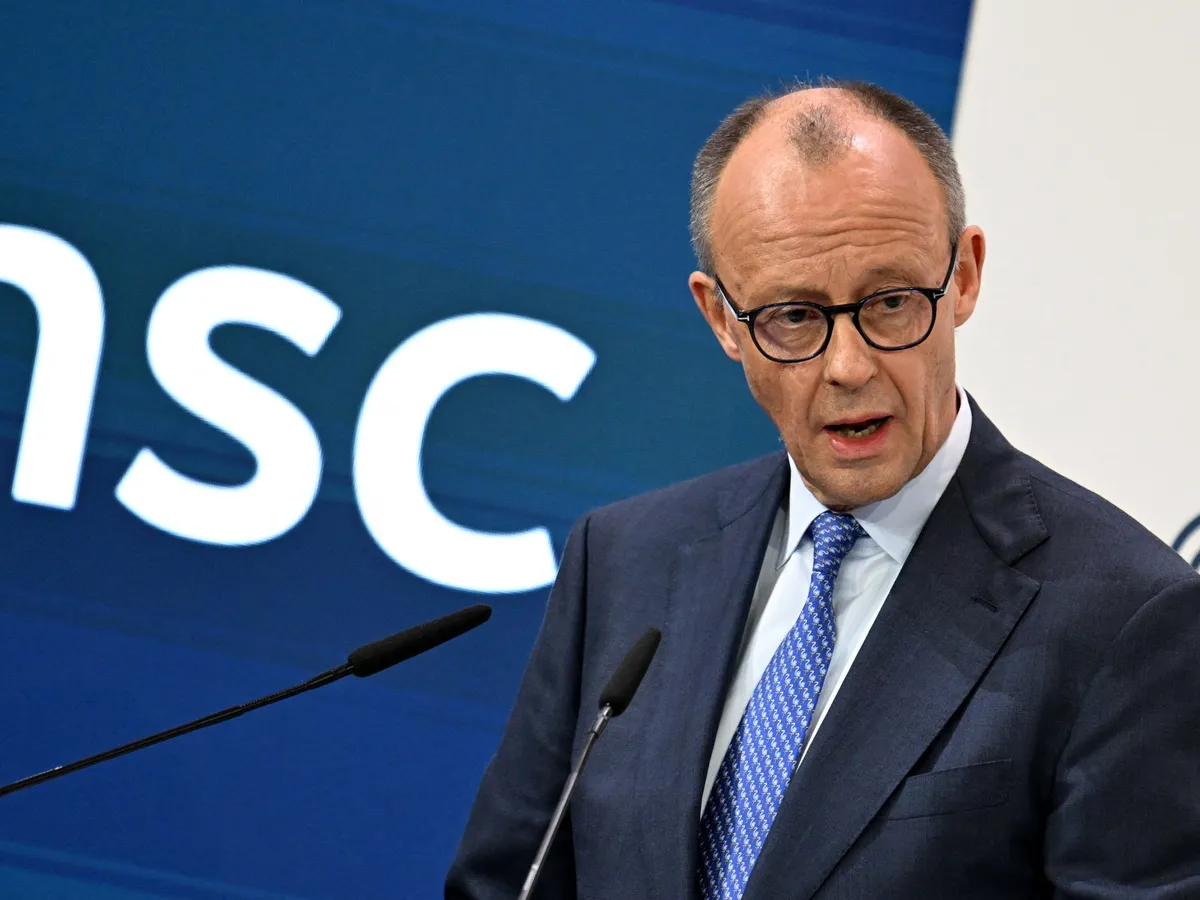
German leader seeks to set tone of unity at Munich Security Council, as top US diplomat says ‘new era in geopolitics’.German Chancellor Friedrich Merz speaks at the 62nd Munich Security Conference in Munich, southern Germany [AFP]Published On 13 Feb 2026German Chancellor Friedrich Merz has called on the United States and Europe to “repair and revive transatlantic trust together” during an address at the Munich Security Conference.Merz began his remarks on Friday at the annual meeting of top global security figures with an appeal for unity, arguing that Washington also benefits from its role in the North Atlantic Treaty Organization (NATO).Recommended Stories list of 3 itemslist 1 of 3US strikes civil nuclear agreement with Armenia, Russia’s former close allylist 2 of 3Macron warns US trade ‘threats, intimidation’ towards EU not overlist 3 of 3Trump is the ‘elephant in the room’ as the African Union holds new summitend of listThe statement contrasted remarks by US Vice President JD Vance last year, who used his appearance at the event, just weeks after taking office, to chastise European leaders for their funding commitments to NATO and to criticise the state of democracy on the continent.“Let me begin with the uncomfortable truth: A rift, a deep divide has opened between Europe and the United States,” Merz said.“Vice President JD Vance said this a year ago here in Munich. He was right in his description,” Merz said, as he called for a “new transatlantic partnership”.Referencing Trump’s Make America Great Again (MAGA) movement, Merz also warned that Europe did not need to move in the same political direction as the US, saying the “culture war of the MAGA movement is not ours”.Directly appealing to the Trump administration, he added: “In the era of great power rivalry, even the United States will not be powerful enough to go it alone.“Being a part of NATO is not only Europe’s competitive advantage. It is also the United States’ competitive advantage. So let’s repair and revive transatlantic trust together. Europe is doing its part.”‘A new era in geopolitics’It remained unclear how receptive Washington would be to the message after a year of confrontational policies that have roiled traditional European allies.That has included the increased pressure for more NATO funding, whiplash efforts to end Russia’s war in Ukraine and Trump’s threats to seize Greenland, an autonomous territory of NATO-member Denmark.The administration has also put renewed emphasis on what it has called Europe’s “civilizational self-confidence and Western identity”, calling on countries on the continent to stem migration, while accusing them of stifling right-wing voices.Critics have said the messaging has racist undertones.Leaving for Germany late Thursday, US Secretary of State Marco Rubio said the US is “very tightly linked together with Europe”, adding that “most people in this country can trace both, either their cultural or their personal heritage back to Europe. So, we just have to talk about that.“We live in a new era in geopolitics, and it’s going to require all of us to reexamine what that looks like,” said Rubio, who is set to speak on Friday.The visit comes as Trump’s Republican Party prepares for the midterm elections in November, which will decide control of the US House of Representatives and Senate.A slate of recent polls has suggested tanking support for Trump on several domestic issues, including his hardline immigration policy.Polls have also shown voter disquiet over Trump’s actions abroad, including the US military abduction of Venezuelan leader Nicolas Maduro and Trump’s push to take control of Greenland.A new poll released on Friday suggested seven in 10 US adults disapprove of how Trump is handling the issue of Greenland.The rate is higher than the overall disapproval of Trump’s foreign policy approach.‘European nuclear deterrence’Speaking on Friday, Germany’s Merz also confirmed he was holding talks with French President Emmanuel Macron on “European nuclear deterrence”.Calls for a so-called European nuclear umbrella have gained new momentum amid the wider US strategic pivot away from Europe.Under NATO’s existing arrangement, US nuclear weapons stationed in Europe can be deployed by aircraft from allied countries in the event of an emergency. US nuclear bombs are believed to be stored in northern Italy, Belgium, the Netherlands and western Germany.For its part, Germany has been required to renounce the manufacture, possession and control of nuclear, biological and chemical weapons as part of a 1990 agreement on the country’s reunification.Merz said any new policy would be in line with Berlin’s legal commitments.Following the United Kingdom’s exit from the European Union in 2020, France became the only nuclear-armed member of the bloc.
SRCAl Jazeera
LANGEN
LEANCenter
WORDS750
ENT12
FRI · 2026-02-13 · 14:58 GMTBRIEF NSR-2026-0213-15993
NSR-2026-0213-15993News Report·EN·Diplomatic
US and Europe must ‘repair and revive transatlantic ties’: Germany’s Merz
At the Munich Security Conference on February 13, 2026, German Chancellor Friedrich Merz urged the US and Europe to rebuild transatlantic trust. Merz acknowledged a growing divide, referencing past criticism from US Vice President JD Vance regarding NATO funding and European democracy.
Al Jazeera StaffAl JazeeraFiled 2026-02-13 · 14:58 GMTLean · CenterRead · 3 min
Al JazeeraFIG 01
Reading time
3min
Word count
750words
Sources cited
4cited
Entities identified
12entities
Quality score
100%
§ 01
Briefing Summary
AI-generatedNEWSAR · AI
At the Munich Security Conference on February 13, 2026, German Chancellor Friedrich Merz urged the US and Europe to rebuild transatlantic trust. Merz acknowledged a growing divide, referencing past criticism from US Vice President JD Vance regarding NATO funding and European democracy. He emphasized that NATO membership benefits both Europe and the US, appealing to the Trump administration to recognize the value of partnership amidst global power rivalries. Merz also cautioned against Europe mirroring the MAGA movement's political direction. His call for unity comes after a year of confrontational US policies that have strained relations with European allies.
Confidence 0.90Sources 4Claims 5Entities 12
§ 02
Article analysis
Model · rule-basedFraming
Diplomatic
Political Strategy
Tone
Measured
AI-assessed
CalmNeutralAlarmist
Factuality
0.70 / 1.00
Factual
LowHigh
Sources cited
4
Well sourced
FewMany
§ 03
Key claims
5 extracted01
US Vice President JD Vance chastised European leaders for their funding commitments to NATO last year.
factualnull
Confidence
1.00
02
US Secretary of State Marco Rubio said the US is “very tightly linked together with Europe”.
quoteMarco Rubio
Confidence
1.00
03
German Chancellor Friedrich Merz has called on the United States and Europe to “repair and revive transatlantic trust together”.
quoteFriedrich Merz
Confidence
1.00
04
A rift, a deep divide has opened between Europe and the United States.
quoteFriedrich Merz
Confidence
0.90
05
Being a part of NATO is not only Europe’s competitive advantage. It is also the United States’ competitive advantage.
quoteFriedrich Merz
Confidence
0.80
§ 04
Full report
3 min read · 750 words§ 05
Entities
12 identifiedKey playerOppositionContextPositiveNeutralNegative
People3
Locations6
§ 06
Keywords & salience
8 termstransatlantic ties
1.00
us-europe relations
0.90
nato
0.80
munich security conference
0.70
german chancellor friedrich merz
0.60
jd vance
0.50
great power rivalry
0.50
maga movement
0.40
§ 07
Topic connections
Interactive graph Network visualization showing 41 related topics
View Full Graph Person Organization Location Event|Click node to navigate|Edge numbers = shared articles