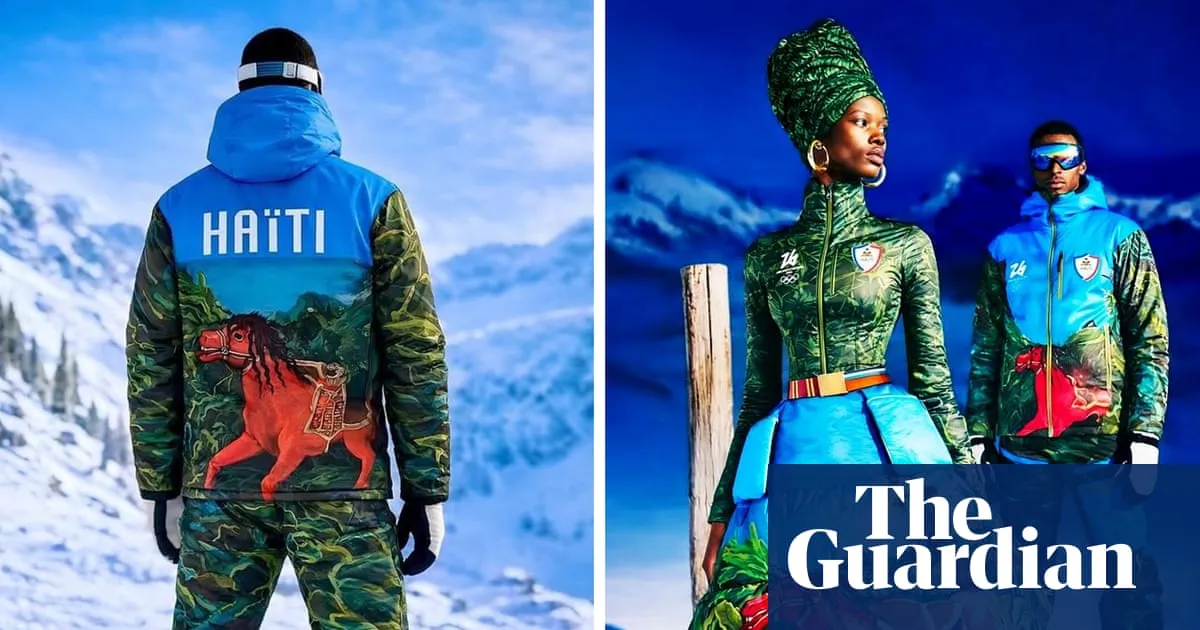
The designer behind the Haitian team’s uniform for the 2026 Winter Olympics has said she had to redesign their ski suits for the opening ceremony after being told they did not comply with the guidelines on athlete expression by the International Olympic Committee.The uniforms, designed by the Haitian-Italian designer Stella Jean, were based on a 2006 painting of the formerly enslaved revolutionary Toussaint Louverture riding a horse by the Haitian artist Edouard Duval-Carrié. Louverture, who led the successful revolt that established the world’s first Black republic in 1804, had been central to Jean’s initial design.It follows the skeleton racer Vladyslav Heraskevych being barred from the Games because of his “helmet of memory” in honour of Ukraine’s war dead. The IOC guidelines stipulate: “No kind of demonstration or political, religious, or racial propaganda is permitted in any Olympic sites, venues or other areas.”The two-man Haitian delegation only received their uniforms the night before the opening ceremony. The kit had arrived straight from a workshop, where Italian artisans had been working around the clock to hand-paint the design on to technical sports fabric.Vladyslav Heraskevych was barred from competing because of his helmet honouring Ukrainian athletes killed in Russia’s invasion. Photograph: Alessandra Tarantino/AP“The uniforms are not just an exercise of style but an exercise of responsibility,” Jean said. “We had to concentrate positive messages about Haiti, our art, culture and history, within a few metres [of fabric].”The response to the ruling was swift and far-reaching. Images of the uniform spread quickly online, prompting messages of pride from the Haitian diaspora.Rather than abandoning the concept, Jean and her team returned the uniforms to the workshop and quickly repainted the garments to reference the painting – minus Louverture. The IOC approved the revised design just in time, featuring a riderless horse and a bright blue sky. “For 24 hours, I was in total despair – we had no budget, no time and this was our only chance to show Haiti in a positive light,” she says. “His absence spoke louder than his presence.”Jean refuses to be downbeat about the IOC’s decision to block her initial design. “The IOC did not lower the bar, it raised it and changed everything,” she says. “If it wasn’t for the rules, we would not have applied a higher degree of creativity or resilience.”Team Haiti cross-country skier Stevenson Savart competing in the men’s sprint classic qualification. Photograph: Alex Slitz/Getty ImagesOther unique features of the kit’s design include the tignon, a women’s headwrap originating in west Africa that references how enslaved women were forced by colonisers to cover their hair. Jewellery is based on Creole earrings, which were among the few personal items enslaved people were permitted to carry from Africa. Large pockets nodded to the merchant culture of Haiti, where markets are the backbone of the economy.The uniforms are believed to be the only fully hand-painted ensemble at this year’s games. With rain forecast on the night of the ceremony, there were concerns about how the paint would hold. “We truly feared that during the ceremony, the paint might dissolve and reveal Toussaint’s face beneath, which made us laugh, but also made us reflect on the idea of our ancestors making themselves heard,” Jean said.“When we talk about Haiti, it’s immediately poverty,” Jean said. “We want to tell the world that we still exist, behind the earthquake, behind the disaster and the crisis that we are living in. We are so much more than this.” Now, she said: “If you search Haiti on the internet, the first images are our athletes and art, not the violent images that we usually find.”The cross-country skier Stevenson Savart said this week: “I felt so proud that it is difficult to describe. Walking in these clothes in front of the world and representing my small country was so amazing.”Richardson Viano, who competes in giant slalom and slalom, in 2022. Photograph: Piero Cruciatti/AFP/Getty ImagesRichardson Viano, an alpine skier, described the reference to Louverture as “a courageous message to send”. Adopted from an orphanage in Haiti, he said the uniform symbolised his “journey to the Olympic mountains”, adding that he hoped the country would be remembered for “its strength, resilience and values”.For Jean, the symbolism of their presence outweighed the results. “In the Olympic arena, we were all equal,” she said. “Haiti was no longer the poorest nation. That night, we stood with our heads held high, side by side with the giants of the world.”
SRCThe Guardian - World News
LANGEN
LEANCenter-Left
WORDS740
ENT10
FRI · 2026-02-13 · 16:00 GMTBRIEF NSR-2026-0213-16063
NSR-2026-0213-16063News Report·EN·Human Interest
Haiti’s Winter Olympics kit redesigned at last minute to fit IOC guidelines
Haiti's Winter Olympics team uniform for the 2026 opening ceremony was redesigned at the last minute after the IOC deemed the original design non-compliant with guidelines on athlete expression. Haitian-Italian designer Stella Jean's initial design featured a painting of Haitian revolutionary Toussaint Louverture, but the IOC prohibits political, religious, or racial propaganda at Olympic sites.
Sundus AbdiThe Guardian - World NewsFiled 2026-02-13 · 16:00 GMTLean · Center-LeftRead · 3 min
The Guardian - World NewsFIG 01
Reading time
3min
Word count
740words
Sources cited
2cited
Entities identified
10entities
Quality score
100%
§ 01
Briefing Summary
AI-generatedNEWSAR · AI
Haiti's Winter Olympics team uniform for the 2026 opening ceremony was redesigned at the last minute after the IOC deemed the original design non-compliant with guidelines on athlete expression. Haitian-Italian designer Stella Jean's initial design featured a painting of Haitian revolutionary Toussaint Louverture, but the IOC prohibits political, religious, or racial propaganda at Olympic sites. The uniforms, created by Italian artisans, arrived the night before the ceremony. Jean's team quickly repainted the garments, removing Louverture and replacing him with a riderless horse, which the IOC approved. The redesigned uniforms were well-received, showcasing Haitian art, culture, and history within the IOC's guidelines.
Confidence 0.90Sources 2Claims 5Entities 10
§ 02
Article analysis
Model · rule-basedFraming
Human Interest
Political Strategy
Tone
Measured
AI-assessed
CalmNeutralAlarmist
Factuality
0.80 / 1.00
Factual
LowHigh
Sources cited
2
Limited
FewMany
§ 03
Key claims
5 extracted01
The uniforms are not just an exercise of style but an exercise of responsibility.
quoteStella Jean
Confidence
1.00
02
The redesigned uniform features a riderless horse and a bright blue sky.
factual
Confidence
1.00
03
The IOC guidelines prohibit political, religious, or racial propaganda at Olympic sites.
factual
Confidence
1.00
04
The initial uniform design featured Toussaint Louverture, a key figure in Haitian history.
factual
Confidence
1.00
05
Haiti's Winter Olympics kit was redesigned at the last minute to comply with IOC guidelines on athlete expression.
factual
Confidence
1.00
§ 04
Full report
3 min read · 740 words§ 05
Entities
10 identifiedKey playerOppositionContextPositiveNeutralNegative
People4
Organizations1
Locations4
§ 06
Keywords & salience
9 termshaiti
0.90
winter olympics
0.90
ioc guidelines
0.80
uniform design
0.80
stella jean
0.70
athlete expression
0.70
toussaint louverture
0.60
political expression
0.60
cultural representation
0.50
§ 07
Topic connections
Interactive graph No topic relationship data available yet. This graph will appear once topic relationships have been computed.