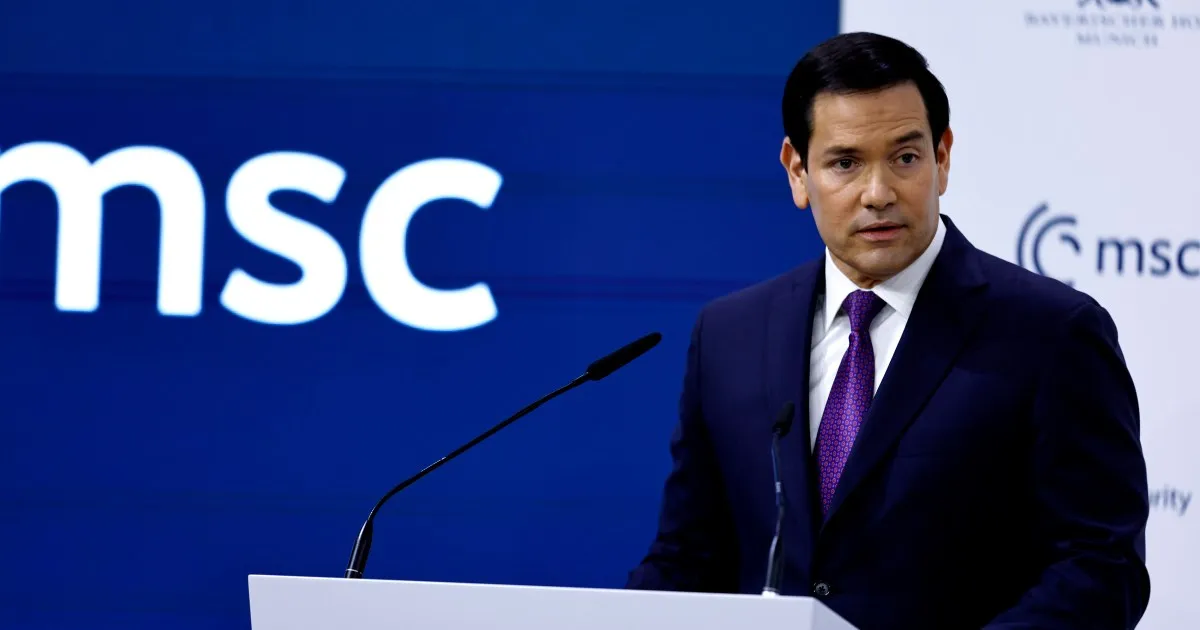
EXPLAINEREurope is facing a great dilemma: continue with liberalist values or embrace Trump’s defence of ‘Western civilisation’?Published On 16 Feb 2026Speaking at the annual Munich Security Conference on Saturday, United States Secretary of State Marco Rubio urged European countries to collaborate with the US to build a “new Western century”, describing US-Europe ties as “civilisational”.“We are part of one civilisation – Western civilisation,” he said.Recommended Stories list of 4 itemslist 1 of 4Rubio at Munich Security Conference: US wants Europe to be ‘strong’list 2 of 4Rubio slams European policies on climate, migration as he calls for unitylist 3 of 4Merz, Macron to address Munich Security Conference amid disputes with USlist 4 of 4US and Europe must ‘repair and revive transatlantic ties’: Germany’s Merzend of listHis rallying speech comes after more than a year of President Donald Trump’s rhetoric about mass immigration in Europe and his administration’s latest National Security Strategy, which warns of “civilisational erasure” in Europe.Last year, US Vice President JD Vance also lambasted European “liberal values” in his first address at the security conference.As European leaders grapple with the rise of far-right political parties, how will they respond to this new demand from the US, and what does it mean for the future of transatlantic relations?US Secretary of State Marco Rubio, centre, arrives for the Munich Security Conference in Germany, February 13, 2026 [Michael Probst/AP Photo]What did Rubio say?The top US diplomat focused on several key areas he views as imperative for Europe to address, which included ending “liberalist” policies the Trump administration views as responsible for Europe’s “post-war decline”, creating new supply chains to reduce reliance on countries such as China, and ending mass migration, which he said is leading to the erasure of Western “civilisation”.“The work of this new alliance,” Rubio said, “should not be focused just on military cooperation and reclaiming the industries of the past. It should also be focused on, together, advancing our mutual interests and new frontiers, unshackling our ingenuity, our creativity, and the dynamic spirit to build a new Western century.”Liberalism and mass migrationRubio argued that the “euphoria” of the Western victory in the Cold War had led to a “dangerous delusion that we had entered ‘the end of history’”, where every nation would be a liberal democracy and “live in a world without borders, where everyone became a citizen of the world”.He used this as a plank to lash out against opening “doors to an unprecedented wave of mass migration that threatens the cohesion of our societies, the continuity of our culture, and the future of our people”.“Mass migration is not, was not, isn’t some fringe concern of little consequence. It was and continues to be a crisis which is transforming and destabilising societies all across the West,” he said.Taking aim at liberalist policies, he added that, to “appease a climate cult, we have imposed energy policies on ourselves that are impoverishing our people”.New supply chainsRubio said the US and its allies should bring more industry and jobs back home, not just to build weapons but to lead in new, high‑tech fields.He added that the West should control key minerals and supply chains, invest in space travel and artificial intelligence, and work together to win markets in the Global South.In particular, he said, is the need for a “Western supply chain for critical minerals not vulnerable to extortion from other powers”.Earlier this month, Trump hosted ministers from dozens of countries for a critical minerals conference in Washington. The meeting was the first of a new Critical Minerals Ministerial, a US initiative to build alliances aimed at countering China’s control over critical mineral supply chains around the world.What does a ‘new Western century’ mean?While the overarching message of Rubio’s speech was that the US still seeks a partnership with Europe, said Trita Parsi, executive vice president of think tank Quincy Institute for Responsible Statecraft, his remarks revealed, “The US will entirely set the parameters of that partnership and that it will be based on ideas Europe long has abandoned: An embrace of empire and colonisation.”Rubio’s remarks at the conference suggest that the US under Trump wants Europe to accept “a civilisational divide of the world in which the ‘West’ must restore its dominance over other civilisations”, Parsi told Al Jazeera.“In essence, Rubio listed the criteria for how Europe can become well-behaved vassals of the United States,” he said.How did European leaders react to Rubio’s speech?European leaders appeared to welcome Rubio’s speech at the conference; it was followed by a standing ovation. However, while lauding his call for stronger ties with the US, they notably did not address his comments about migration and liberal values.European Commission President Ursula von der Leyen told reporters on the sidelines of the Munich Security Conference: “We know that in the [Trump] administration, some have a harsher tone on these topics. But the secretary of state was very clear. He said, ‘We want [a] strong Europe in the alliance’, and this is what we are working for intensively in the European Union.”French Foreign Minister Jean-Noel Barrot responded to Rubio’s speech: “Referring to [our] common legacy can only be welcomed with applause in Europe.”“We will deliver a strong and independent Europe,” he said. “Independent, of course, irrespective of the speeches that we hear at the Munich Security Conference, however right they may be.”Calling Rubio a “true partner”, German Foreign Minister John Wadephul said: “[It was] a very clear message from Secretary Rubio that we have … to stay and stick to our international rules-based order, which is, of course, in [the] first line the United Nations. This is our Board of Peace. We have to make it more effective, as Rubio said this morning.”Finnish Foreign Minister Elina Valtonen said she was “very satisfied with the tone” and the content of Rubio’s speech.What does this mean for Europe?European leaders have been facing a dilemma – particularly over migration and defence – for some time, for a number of reasons. The mass migration crisis prompted by unrest in other parts of the world has already caused far-right parties to surge in popularity. Now, the Trump administration has voiced support for many of these parties and is also urging Europe to take stronger action on migration and defence.Therefore, many European leaders have already started taking action in these areas.For instance, most European countries are already working on boosting their defences and cracking down on migration.Last year, the United Kingdom announced plans for a big boost in defence spending in advance of Prime Minister Keir Starmer’s meeting with Trump early last year amid fears the US would withdraw support for Ukraine in its war with Russia. Notably, Rubio skipped a meeting about Ukraine with European leaders at the Munich conference.Many countries have also tightened controls over immigration. Denmark has led the way in implementing increasingly restrictive policies in its immigration and asylum system, with top leaders aiming for “zero asylum seekers” arriving in the country. Recently, the UK said it was studying the Danish model as well.Europe is also working to make its energy and technology supply chains more sovereign, reducing dependence on foreign suppliers, particularly in the face of Trump’s trade war, which has seen him impose reciprocal trade tariffs on many countries around the world.Many European leaders have come under increasing pressure from the rise in popularity of far-right parties calling for greater restrictions on immigration, as well.In recent years, far-right, anti-immigration sentiment has been increasing in countries like the United Kingdom, the Netherlands, and France. In 2023, the far-right Party for Freedom (PVV), led by Geert Wilders, won the election in the Netherlands. France’s National Rally (RN), led by Marine Le Pen, won the snap election in 2024. The same year, Nigel Farage’s right-wing Reform UK party made significant inroads in the general elections and, last year, a YouGov poll placed Reform as the UK’s most popular political party.
SRCAl Jazeera
LANGEN
LEANCenter
WORDS1 310
ENT6
MON · 2026-02-16 · 09:29 GMTBRIEF NSR-2026-0216-16631
NSR-2026-0216-16631News Report·EN·Political Strategy
Marco Rubio wants to build a ‘new Western century’. Will Europe join?
At the 2026 Munich Security Conference, US Secretary of State Marco Rubio urged European nations to join the US in building a "new Western century," emphasizing shared "civilizational" ties. This call for unity follows President Trump's rhetoric on immigration and warnings of "civilizational erasure" in Europe.
Sarah Shamim,Yashraj SharmaAl JazeeraFiled 2026-02-16 · 09:29 GMTLean · CenterRead · 6 min
Al JazeeraFIG 01
Reading time
6min
Word count
1 310words
Sources cited
3cited
Entities identified
6entities
Quality score
100%
§ 01
Briefing Summary
AI-generatedNEWSAR · AI
At the 2026 Munich Security Conference, US Secretary of State Marco Rubio urged European nations to join the US in building a "new Western century," emphasizing shared "civilizational" ties. This call for unity follows President Trump's rhetoric on immigration and warnings of "civilizational erasure" in Europe. Rubio specifically called for an end to "liberalist" policies, the creation of new supply chains independent of countries like China, and a halt to mass migration. He argued these changes are necessary to reverse Europe's "post-war decline" and advance mutual interests. The speech raises questions about how European leaders, grappling with the rise of far-right parties, will respond to this US demand and what it means for transatlantic relations.
Confidence 0.90Sources 3Claims 9Entities 6
§ 02
Article analysis
Model · rule-basedFraming
Political Strategy
National Security
Tone
Mixed Tone
AI-assessed
CalmNeutralAlarmist
Factuality
0.60 / 1.00
Mixed
LowHigh
Sources cited
3
Well sourced
FewMany
§ 03
Key claims
9 extracted01
Rubio believes ending mass migration is imperative for Europe.
factualArticle states Rubio's view.
Confidence
1.00
02
JD Vance lambasted European “liberal values” at the security conference last year.
factualArticle states Vance made this statement.
Confidence
1.00
03
Trump's administration warns of “civilisational erasure” in Europe.
factualArticle references Trump administration's National Security Strategy.
Confidence
1.00
04
Rubio described US-Europe ties as “civilisational”.
quoteArticle states Rubio said this at the Munich Security Conference.
Confidence
1.00
05
Marco Rubio urged European countries to collaborate with the US to build a “new Western century”.
quoteArticle states Rubio said this at the Munich Security Conference.
Confidence
1.00
06
Rubio argued mass migration is a crisis transforming and destabilising societies across the West.
quoteArticle quotes Rubio's argument
Confidence
1.00
07
Rubio focused on ending “liberalist” policies and ending mass migration.
factualArticle states Rubio focused on these issues
Confidence
1.00
08
Trump's administration's latest National Security Strategy warns of “civilisational erasure” in Europe.
factualArticle references the Trump administration's strategy
Confidence
1.00
09
Marco Rubio urged European countries to collaborate with the US to build a “new Western century”.
quoteArticle states Rubio said this at the Munich Security Conference
Confidence
1.00
§ 04
Full report
6 min read · 1 310 words§ 05
Entities
6 identifiedKey playerOppositionContextPositiveNeutralNegative
§ 06
Keywords & salience
10 termswestern civilization
1.00
transatlantic relations
0.80
marco rubio
0.70
munich security conference
0.70
us-europe ties
0.60
liberal values
0.60
mass migration
0.60
trump administration
0.50
new western century
0.50
supply chains
0.40
§ 07
Topic connections
Interactive graph Network visualization showing 51 related topics
View Full Graph Person Organization Location Event|Click node to navigate|Edge numbers = shared articles