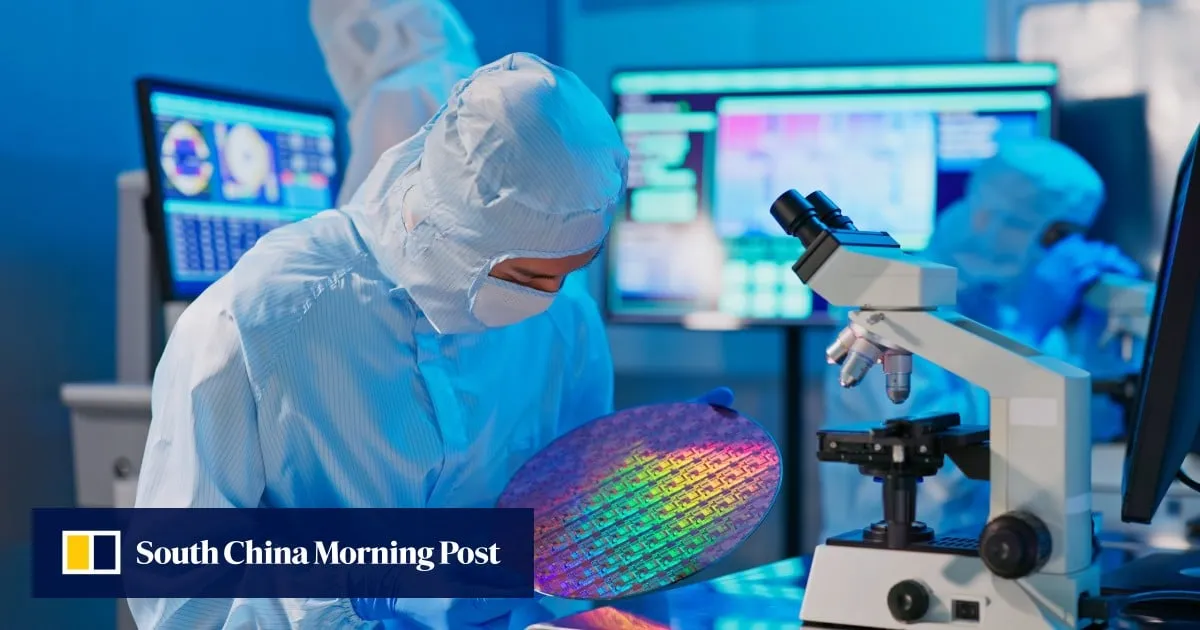
Chinese researchers have announced a new technique to mass produce 2D material wafers, paving the way for high-performance electronics using a successor to silicon.As semiconductor chips continue to evolve, transistor sizes are approaching the physical limits of silicon-based technology. The search for next-generation semiconductor materials that can deliver superior performance has become a global priority.Among the candidates, two-dimensional (2D) materials such as molybdenum disulfide (MoS₂) with their atomically thin structure are regarded as promising successors for the post-Moore’s Law era because of their high carrier mobility and low power consumption.However, one of the core obstacles to commercialisation has been the difficulty of producing them uniformly over large areas and at a high quality.A team led by Wang Jinlan (third left) from Southeast University in Nanjing has announced a breakthrough technique to mass produce 2D material wafers on January 29. Photo: HandoutA team led by Wang Jinlan from Southeast University in Nanjing, working with Wang Xinran and Li Taotao from Nanjing-university" class="entity-link entity-organization" data-entity-id="29903" data-entity-type="organization">Nanjing University, announced a critical breakthrough last month.
SRCSouth China Morning Post
LANGEN
LEANCenter-Right
WORDS167
ENT4
TUE · 2026-02-17 · 12:00 GMTBRIEF NSR-2026-0217-16939
NSR-2026-0217-16939News Report·EN·Technology
Chinese scientists hit breakthrough on 2D semiconductor wafers
Chinese scientists from Southeast University and Nanjing University have developed a new technique for mass-producing 2D material wafers, a potential successor to silicon in high-performance electronics. The breakthrough addresses a major obstacle to commercializing 2D materials like molybdenum disulfide (MoS₂), which offer high carrier mobility and low power consumption.
Zhang TongSouth China Morning PostFiled 2026-02-17 · 12:00 GMTLean · Center-RightRead · 1 min
South China Morning PostFIG 01
Reading time
1min
Word count
167words
Sources cited
4cited
Entities identified
4entities
Quality score
100%
§ 01
Briefing Summary
AI-generatedNEWSAR · AI
Chinese scientists from Southeast University and Nanjing University have developed a new technique for mass-producing 2D material wafers, a potential successor to silicon in high-performance electronics. The breakthrough addresses a major obstacle to commercializing 2D materials like molybdenum disulfide (MoS₂), which offer high carrier mobility and low power consumption. The team, led by Wang Jinlan, announced the development on January 29th. This new method aims to produce these materials uniformly and at high quality over large areas. The research is significant because silicon-based technology is approaching its physical limits, making the search for alternative semiconductor materials a global priority. The advancement could pave the way for next-generation electronics in the post-Moore’s Law era.
Confidence 0.90Sources 4Claims 5Entities 4
§ 02
Article analysis
Model · rule-basedFraming
Technology
Economic Impact
Tone
Measured
AI-assessed
CalmNeutralAlarmist
Factuality
0.80 / 1.00
Factual
LowHigh
Sources cited
4
Well sourced
FewMany
§ 03
Key claims
5 extracted01
A team led by Wang Jinlan from Southeast University in Nanjing announced a critical breakthrough last month.
factualnull
Confidence
1.00
02
Chinese researchers have announced a new technique to mass produce 2D material wafers.
factualnull
Confidence
1.00
03
One of the core obstacles to commercialisation has been the difficulty of producing them uniformly over large areas.
factualnull
Confidence
0.90
04
Transistor sizes are approaching the physical limits of silicon-based technology.
factualnull
Confidence
0.90
05
2D materials are regarded as promising successors for the post-Moore’s Law era.
factualnull
Confidence
0.80
§ 04
Full report
1 min read · 167 words§ 05
Entities
4 identifiedKey playerOppositionContextPositiveNeutralNegative
Organizations2
§ 06
Keywords & salience
9 terms2d materials
1.00
semiconductor wafers
0.90
mass production
0.80
semiconductor chips
0.70
high-performance electronics
0.70
silicon
0.60
molybdenum disulfide
0.60
carrier mobility
0.50
post-moore’s law
0.50
§ 07
Topic connections
Interactive graph No topic relationship data available yet. This graph will appear once topic relationships have been computed.