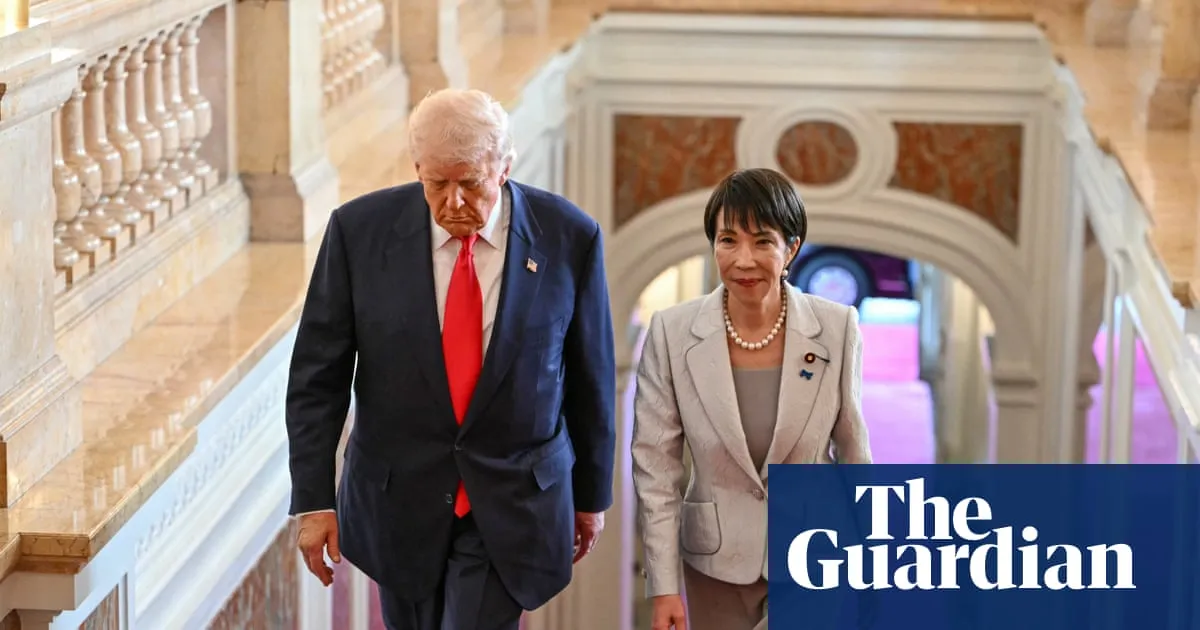
Japan has drawn up plans for investments in US oil, gas and critical mineral projects worth about $36bn under the first wave of a deal with Donald Trump.The US president and Sanae Takaichi, Japan’s prime minister, announced a trio of projects including a power plant in Portsmouth, Ohio, billed by the Trump administration as the largest natural gas-fired generating facility in US history.As a diplomatic row between Japan and China over the security of Taiwan continues, testing the Japanese economy, Takaichi said the projects would strengthen her country’s ties with the US.While Takaichi did not directly mention China, she expressed hope in a statement that the investments would enhance Japanese and US economic security.“Our massive trade deal with Japan has just launched,” Trump declared in a social media post. The White House said Japan would also invest in a deepwater crude oil export facility off the coast of Texas, and a synthetic industrial diamond manufacturing site.The projects are the first batch of the $550bn Japan committed to invest under a trade deal with the US last year. In return, Trump agreed to reduce US tariffs on Japanese exports including cars.“The scale of these projects are so large, and could not be done without one very special word, tariffs,” Trump claimed on Tuesday. His controversial trade strategy alarmed economists in the US, who warned it risked exacerbating inflation.Most of the first wave of investment will go towards the plant in Portsmouth, Ohio, which will generate 9.2 gigawatts of electricity each year, according to the administration. It will be operated by SB Energy, which is a subsidiary of Japanese conglomerate SoftBank Group.The industrial diamond manufacturing site in Georgia, valued at about $600m, is designed to ensure the US can fully produce all the synthetic diamond grit – a critical material for advanced manufacturing and semiconductors – it requires domestically. The project “will end our foolish dependence on foreign sources”, said Trump.China controls much of the critical minerals market, dominating the world’s mining and processing of rare earths that are essential across a wide array of industries, from oil refining to car manufacturing.Beijing has not hesitated to wield this dominance, imposing restrictions on global imports of its rare earths. Such curbs were at the heart of an economic spat with Washington last year. While Trump and the Chinese leader, Xi Jinping, reached a deal last October which reduced tensions in the short term, US officials have repeatedly spoken of the need to reduce reliance on China for critical minerals.Beijing has started in recent months to restrict some exports of rare earths to Japan, amid a row with Tokyo over Taiwan. Takaichi angered Chinese officials in November 2025 by suggesting Japan could become militarily involved in the event of an attempted Chinese invasion of the self-governing island.“We will no longer rely on foreign supply for this essential material,” Howard Lutnick, Trump’s commerce secretary, said of the planned industrial diamond project.“Japan is providing the capital,” added Lutnick. “The infrastructure is being built in the United States. The proceeds are structured so Japan earns its return, and America gains strategic assets, expanded industrial capacity, and strengthened energy dominance.”Japan reported on Wednesday that its exports rose almost 17% in January, driven in part by a sharp rise in exports to China despite the current tensions.
SRCThe Guardian - World News
LANGEN
LEANCenter-Left
WORDS548
ENT11
WED · 2026-02-18 · 06:02 GMTBRIEF NSR-2026-0218-17127
NSR-2026-0218-17127News Report·EN·Economic Impact
US and Japan unveil $36bn of oil, gas and critical minerals projects in challenge to China
The US and Japan have unveiled $36 billion in joint oil, gas, and critical mineral projects, the first phase of a larger $550 billion trade deal. Announced by former President Trump and Japanese Prime Minister Takaichi, the investments aim to strengthen ties and enhance economic security amid ongoing tensions between Japan and China.
Callum JonesThe Guardian - World NewsFiled 2026-02-18 · 06:02 GMTLean · Center-LeftRead · 3 min
The Guardian - World NewsFIG 01
Reading time
3min
Word count
548words
Sources cited
3cited
Entities identified
11entities
Quality score
100%
§ 01
Briefing Summary
AI-generatedNEWSAR · AI
The US and Japan have unveiled $36 billion in joint oil, gas, and critical mineral projects, the first phase of a larger $550 billion trade deal. Announced by former President Trump and Japanese Prime Minister Takaichi, the investments aim to strengthen ties and enhance economic security amid ongoing tensions between Japan and China. Key projects include a natural gas-fired power plant in Ohio, a deepwater crude oil export facility in Texas, and a synthetic industrial diamond manufacturing site in Georgia. The diamond facility seeks to reduce US reliance on foreign sources, particularly China, which dominates the critical minerals market. The deal follows a previous agreement where Trump reduced tariffs on Japanese exports in exchange for Japan's investment commitment.
Confidence 0.90Sources 3Claims 5Entities 11
§ 02
Article analysis
Model · rule-basedFraming
Economic Impact
National Security
Tone
Measured
AI-assessed
CalmNeutralAlarmist
Factuality
0.70 / 1.00
Factual
LowHigh
Sources cited
3
Well sourced
FewMany
§ 03
Key claims
5 extracted01
The project “will end our foolish dependence on foreign sources”.
quoteTrump
Confidence
1.00
02
The industrial diamond manufacturing site in Georgia is valued at about $600m.
factualArticle
Confidence
1.00
03
Japan committed to invest $550bn under a trade deal with the US last year.
factualArticle
Confidence
1.00
04
Japan plans to invest $36bn in US oil, gas, and critical mineral projects.
factualArticle
Confidence
1.00
05
The Portsmouth, Ohio power plant will be the largest natural gas-fired generating facility in US history.
factualTrump administration
Confidence
0.80
§ 04
Full report
3 min read · 548 words§ 05
Entities
11 identifiedKey playerOppositionContextPositiveNeutralNegative
Organizations1
§ 06
Keywords & salience
9 termsus-japan relations
0.90
critical minerals
0.80
economic security
0.80
trade deal
0.70
china
0.60
tariffs
0.60
industrial diamond
0.50
energy projects
0.50
natural gas
0.50
§ 07
Topic connections
Interactive graph Network visualization showing 51 related topics
View Full Graph Person Organization Location Event|Click node to navigate|Edge numbers = shared articles