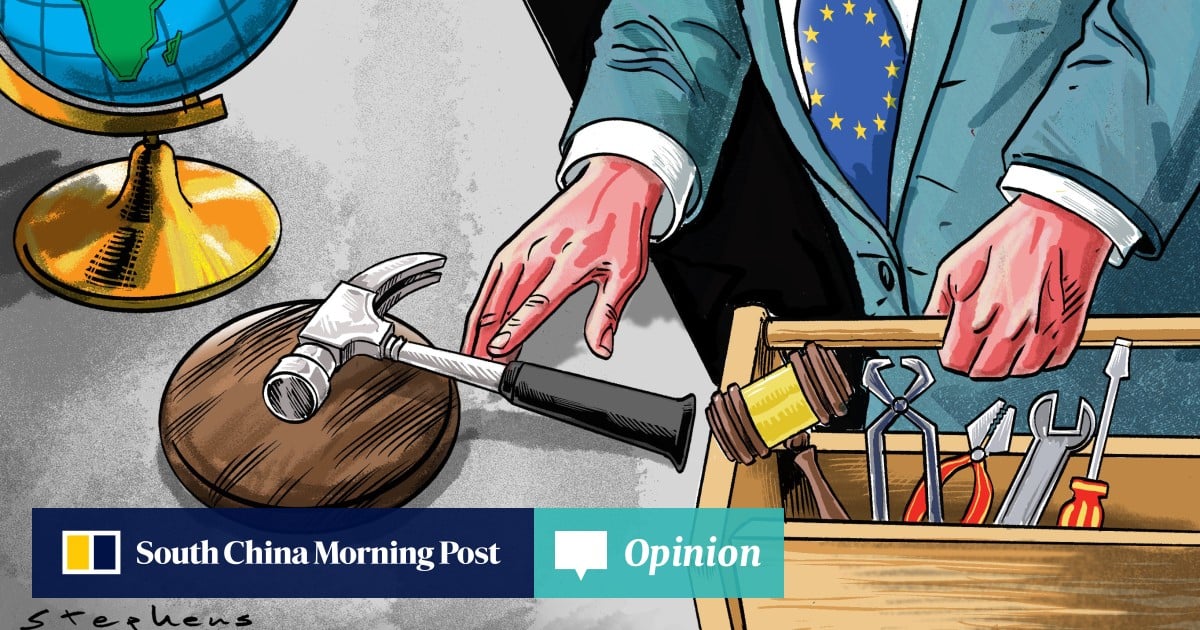
At the opening of the Munich Security Conference this year, German Chancellor Friedrich Merz warned that the rules-based international order is eroding before our eyes. His remarks echoed the conference’s annual report, which painted a picture of fragmentation and disorder.His remarks also echoed a growing anxiety across Europe: that the system built after 1945 is eroding under the weight of geopolitical rivalry, economic coercion and military confrontation. However, to many observers, Europe’s lament rings hollow.If the international order is weakening, it is not simply because of revisionist powers challenging the West. It is also because Western states – Europe included – have treated international rules as flexible instruments rather than binding commitments. If Europe genuinely seeks to restore global credibility to international law, it must first confront its own record of selective adherence.The cornerstone of the post-World War II legal system is the prohibition on the use of force under the UN Charter, except in self-defence or with Security Council authorisation. However, at key moments Europe has supported military interventions that stretched or bypassed this framework.The 1999 Nato intervention in Kosovo proceeded without UN Security Council authorisation, justified instead as a humanitarian necessity. The 2003 invasion of Iraq, while opposed by some European governments, nonetheless saw several European states join a “coalition of the willing” despite contested legal grounds. In 2011, France and the United Kingdom took the lead in Libya, where a civilian protection mandate evolved into de facto regime change.Each case was defended as exceptional. Taken together, however, they contributed to a pattern: rules apply, but not always; sovereignty matters, but not uniformly. To some outside the transatlantic alliance, this signalled that international law could be reinterpreted when strategic imperatives demanded it. Such precedents have weakened the normative force of the very system Europe now seeks to defend.
SRCSouth China Morning Post
LANGEN
LEANCenter-Right
WORDS300
ENT10
WED · 2026-02-18 · 12:30 GMTBRIEF NSR-2026-0218-17280
NSR-2026-0218-17280Analysis·EN·Political Strategy
Why Europe must accept blame for erosion of the global order
The article addresses concerns voiced at the Munich Security Conference regarding the erosion of the rules-based international order. While European leaders attribute this decline to revisionist powers, the article argues that Europe itself bears responsibility.
Tian ShichenSouth China Morning PostFiled 2026-02-18 · 12:30 GMTLean · Center-RightRead · 2 min
South China Morning PostFIG 01
Reading time
2min
Word count
300words
Sources cited
1cited
Entities identified
10entities
Quality score
100%
§ 01
Briefing Summary
AI-generatedNEWSAR · AI
The article addresses concerns voiced at the Munich Security Conference regarding the erosion of the rules-based international order. While European leaders attribute this decline to revisionist powers, the article argues that Europe itself bears responsibility. It claims that Europe has selectively adhered to international rules, undermining the system it now seeks to defend. Specifically, the article cites examples such as the NATO intervention in Kosovo, the Iraq War, and the intervention in Libya, where European involvement stretched or bypassed international law. These instances, presented as exceptions, have created a precedent that weakens the normative force of international law globally. The article suggests that Europe must confront its own record to restore credibility to the international legal system.
Confidence 0.90Sources 1Claims 5Entities 10
§ 02
Article analysis
Model · rule-basedFraming
Political Strategy
Legal & Judicial
Tone
Measured
AI-assessed
CalmNeutralAlarmist
Factuality
0.60 / 1.00
Mixed
LowHigh
Sources cited
1
Limited
FewMany
§ 03
Key claims
5 extracted01
France and the United Kingdom took the lead in Libya in 2011.
factual
Confidence
1.00
02
The 1999 Nato intervention in Kosovo proceeded without UN Security Council authorisation.
factual
Confidence
1.00
03
The rules-based international order is eroding.
quoteFriedrich Merz
Confidence
0.90
04
Europe has treated international rules as flexible instruments rather than binding commitments.
factual
Confidence
0.70
05
Western states have weakened the normative force of the international system.
factual
Confidence
0.60
§ 04
Full report
2 min read · 300 words§ 05
Entities
10 identifiedKey playerOppositionContext
E
Europe location · Key Player
90
FM
Friedrich Merz person · Key Player
70
U
UN organization
70
NA
North Atlantic Treaty Organization organization
60
MS
Munich Security Conference event · Context
60
I
Iraq location · Context
50
K
Kosovo location · Context
50
UK
United Kingdom location
40
F
France location
40
L
Libya location · Context
40
§ 06
Keywords & salience
8 termsinternational order
1.00
europe
0.90
international law
0.80
rules-based order
0.70
military intervention
0.60
un security council
0.50
sovereignty
0.40
geopolitical rivalry
0.40
§ 07
Topic connections
Interactive graph Network visualization showing 51 related topics
View Full Graph Person Organization Location Event|Click node to navigate|Edge numbers = shared articles