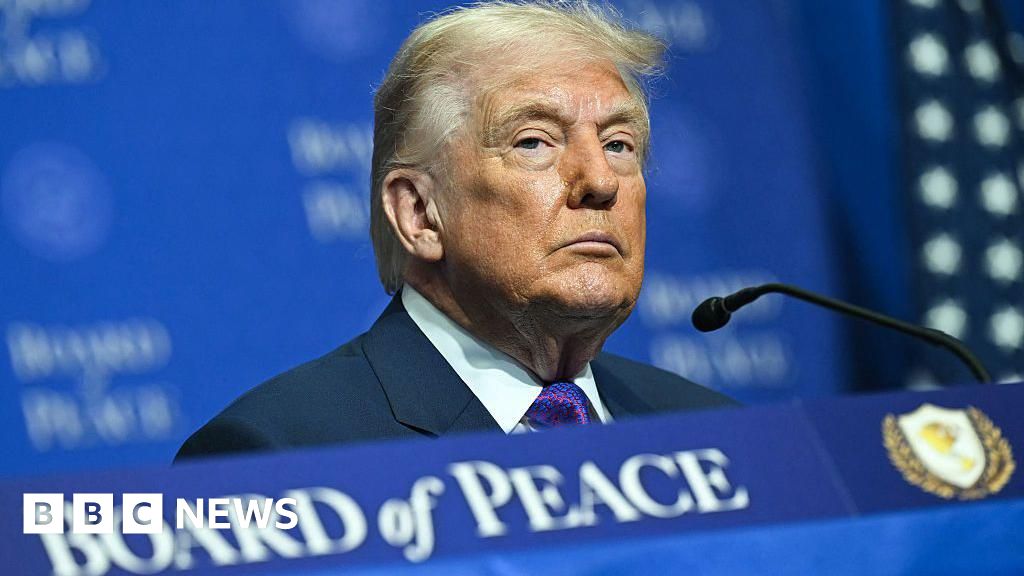
5 hours agoDaniel BushWashington correspondent Getty ImagesUS President Donald Trump delivered his latest ultimatum to Iran on Thursday during a meeting of the Board of Peace, the Middle East coalition Trump formed to stabilise a region he could soon plunge into a new war.The irony of simultaneously calling for peace and threatening military action underscored the competing impulses at the heart of Trump's foreign policy in his second term. Perhaps nowhere is that contradiction clearer than the impasse between Washington and Tehran - a standoff that has quickly escalated and could now lead to the largest US air campaign in years.Trump has said he prefers a diplomatic solution in the form of a deal that ends Iran's nuclear weapons programme. A White House official said on Wednesday that Iran would be "very wise" to strike an agreement.Yet for all the talk of diplomacy, Trump has ramped up his rhetoric against the Islamic Republic in recent weeks, and ordered what analysts say is the biggest US military buildup in the Middle East since the Iraq War in 2003. It is another striking example of Trump's willingness to use military force more often than supporters had expected in his second term, and without prior approval from Congress.Trump's threat to strike Iran cannot simply be dismissed as a negotiating tactic, since the last time he threatened an adversary with military action the US followed through with its attack on Venezuela in January. EPAThat operation had a narrow military objective, at least as defined by the administration, and ended with the successful capture of former President Nicolás Maduro.With Iran, the rationale for another military campaign is far less clear.Trump does not want Tehran to develop nuclear weapons, a priority shared by US allies. The Islamic Republic, which has been weakened by economic sanctions and mass protests against the regime led by the country's Supreme Leader, Ayatollah Ali Khamanei, has signalled it's open to negotiate on the issue of uranium enrichment.The indirect talks between the US and Iran have stalled over the administration's insistence that Tehran also curb its ballistic missile programme and support for proxy groups in the region.But while the negotiations may have deadlocked, Trump hasn't spelled out why attacking Iran again now - less than one year after a US strike last June - will yield the outcome he's after.Trump has insisted the US strike on Iran last year "obliterated" the regime's nuclear facilities. The president hasn't offered an explanation of why another strike is needed, if that is the case, or what, exactly, the new targets might be. And unlike in Venezuela, Trump's broader objectives in Iran remain something of a mystery.Does the administration want to usher in regime change in Iran? Is the US prepared for an Iranian military response that would target American military bases in the region? How might a prolonged conflict affect America's other strategic goals in the Middle East, including the Board of Peace-led process to rebuild Gaza?Trump has offered few details on his thinking about potential day-after scenarios.Israel's role in a potential attack also remains unclear. Israel joined the US in striking Iran last year, and is widely expected to participate again if Trump launches a new military campaign. Israel's Prime Minister Benjamin Netanyahu met Trump at the White House last week to discuss the situation.With his first official State of the Union address of his second term looming next week, Trump also faces additional pressure to make the case for how a potential attack on Iran fits into his domestic political agenda. Trump ran for the presidency in 2024 with a promise to disentangle the US from foreign conflicts - a stance that's popular with his Maga base and many Republicans in Congress who oppose US intervention in places like Ukraine.Since taking office, however, Trump has launched numerous military attacks, including in Syria, Venezuela, Iran and on alleged drug boats in the Caribbean. An extended air campaign in Iran would risk alienating some supporters ahead of the US midterm elections, in a moment when opinion polls suggest voters are increasingly frustrated with Trump's handling of issues like immigration and the economy and when the president has drawn criticism for his focus on foreign affairs.A major attack on Iran would also conflict with Trump's push for the Nobel Peace Prize. Trump has said he deserves it for ending eight wars since the start of his second term, a claim that is widely disputed. There is no precedent for a US president actively campaigning for the world's most prestigious peace prize while wielding American military force abroad.All the uncertainty has left the rest of the world guessing about Trump's motivations in edging the US closer to war with Iran. Still, that may be exactly how the president likes it.Since returning to the White House last year, the president has seemingly relished playing the role of the world's dealmaker-in-chief. Trump has presided over numerous signing ceremonies and international summits like the Board of Peace event on Thursday in Washington. His tariffs regime forced other countries to seek more favourable trade deals with the US, placing Trump at the centre of high-stakes negotiations over the global economy.Trump commanded worldwide attention last month with the strike on Venezuela and his call for the US to seize control of Greenland. The dispute over Greenland was another instance where other nations struggled to interpret Trump's true intentions.When it comes to Iran, Trump said on Thursday that the world would have to wait and see what he might do."We have to make a meaningful deal otherwise bad things happen," he said.
SRCBBC News - World
LANGEN
LEANCenter
WORDS929
ENT12
FRI · 2026-02-20 · 01:45 GMTBRIEF NSR-2026-0220-17771
NSR-2026-0220-17771Analysis·EN·Political Strategy
Trump's foreign policy dilemma laid bare by Iran tensions
Donald Trump's foreign policy faces a dilemma regarding Iran, highlighted by his simultaneous calls for peace and threats of military action. While Trump prefers a diplomatic solution to end Iran's nuclear weapons program, he has increased rhetoric and ordered a significant military buildup in the Middle East.
BBC News - WorldFiled 2026-02-20 · 01:45 GMTLean · CenterRead · 4 min
BBC News - WorldFIG 01
Reading time
4min
Word count
929words
Sources cited
2cited
Entities identified
12entities
Quality score
100%
§ 01
Briefing Summary
AI-generatedNEWSAR · AI
Donald Trump's foreign policy faces a dilemma regarding Iran, highlighted by his simultaneous calls for peace and threats of military action. While Trump prefers a diplomatic solution to end Iran's nuclear weapons program, he has increased rhetoric and ordered a significant military buildup in the Middle East. Indirect talks between the US and Iran have stalled over demands that Tehran curb its ballistic missile program and support for regional proxy groups. Despite Iran signaling openness to negotiate on uranium enrichment, Trump hasn't clarified why military action would achieve his desired outcome, especially after a previous US strike last year. The situation raises questions about the rationale and potential consequences of a large-scale US air campaign against Iran.
Confidence 0.90Sources 2Claims 5Entities 12
§ 02
Article analysis
Model · rule-basedFraming
Political Strategy
National Security
Tone
Measured
AI-assessed
CalmNeutralAlarmist
Factuality
0.60 / 1.00
Mixed
LowHigh
Sources cited
2
Limited
FewMany
§ 03
Key claims
5 extracted01
Trump has insisted the US strike on Iran last year "obliterated" the regime's nuclear facilities.
quoteTrump
Confidence
1.00
02
Trump delivered an ultimatum to Iran during a meeting of the Board of Peace.
factualDaniel Bush (Washington correspondent)
Confidence
1.00
03
The indirect talks between the US and Iran have stalled.
factualnull
Confidence
0.90
04
Trump has ordered what analysts say is the biggest US military buildup in the Middle East since the Iraq War in 2003.
factualanalysts
Confidence
0.90
05
The Islamic Republic has signalled it's open to negotiate on the issue of uranium enrichment.
factualnull
Confidence
0.80
§ 04
Full report
4 min read · 929 words§ 05
Entities
12 identifiedKey playerOppositionContext
DT
Donald Trump person · Key Player
90
I
Iran location · Opposition
85
US
United States location · Key Player
80
T
Tehran location · Opposition
60
ME
Middle East location · Context
60
IR
Islamic Republic organization · Opposition
50
W
Washington location · Context
50
NM
Nicolás Maduro (Maduro) person · Context
40
IW
Iraq War event · Context
40
AA
Ayatollah Ali Khamenei person · Opposition
40
V
Venezuela location · Context
35
BO
Board of Peace organization
35
§ 06
Keywords & salience
8 termsiran tensions
0.90
foreign policy
0.80
military action
0.70
diplomatic solution
0.60
nuclear weapons programme
0.60
middle east
0.50
economic sanctions
0.40
negotiating tactic
0.40
§ 07
Topic connections
Interactive graph Network visualization showing 51 related topics
View Full Graph Person Organization Location Event|Click node to navigate|Edge numbers = shared articles