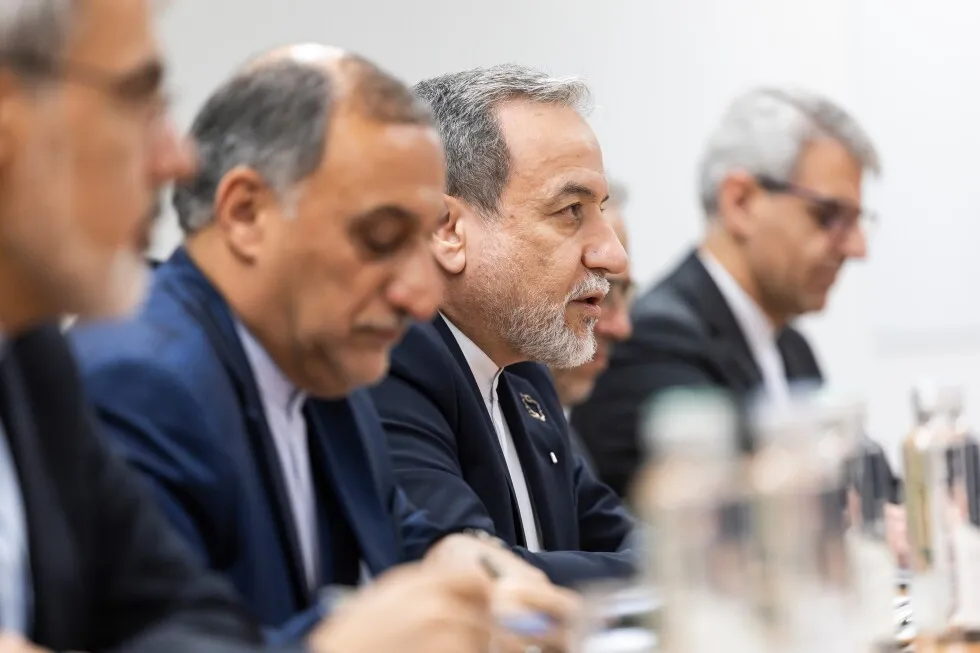
Trump warns he’s considering limited strikes as Iranian diplomat says proposed deal is imminent 1 of 2 | Iranian Foreign Minister Abbas Araghchi, speaks during a bilateral meeting between Switzerland and Iran, in Geneva, Switzerland, Tuesday, Feb. 17, 2026 (Cyril Zingaro/Keystone via AP) 2 of 2 | President Donald Trump speaks during a breakfast with the National Governors Association in the State Dining Room of the White House, Friday, Feb. 20, 2026, in Washington. (AP Photo/Evan Vucci) 1 of 2 Iranian Foreign Minister Abbas Araghchi, speaks during a bilateral meeting between Switzerland and Iran, in Geneva, Switzerland, Tuesday, Feb. 17, 2026 (Cyril Zingaro/Keystone via AP) Add AP News on Google Add AP News as your preferred source to see more of our stories on Google. 2 of 2 President Donald Trump speaks during a breakfast with the National Governors Association in the State Dining Room of the White House, Friday, Feb. 20, 2026, in Washington. (AP Photo/Evan Vucci) Add AP News on Google Add AP News as your preferred source to see more of our stories on Google. Updated [hour]:[minute] [AMPM] [timezone], [monthFull] [day], [year] Washington (AP) — President Donald Trump warned on Friday that limited strikes against Iran are possible even as the country’s top diplomat said Tehran expects to have a proposed deal ready in the next few days following nuclear talks with the United States.In response to a reporter’s question on whether the U.S. could take limited military action as the countries negotiate, Trump said, “I guess I can say I am considering that.” A few hours later, he told reporters that Iran “better negotiate a fair deal.”Iranian Foreign Minister Abbas Araghchi said in a TV interview earlier that his country was planning to finalize a draft deal in “the next two to three days” to send it to Washington.“I don’t think it takes long, perhaps, in a matter of a week or so, we can start real, serious negotiations on the text and come to a conclusion,” Araghchi said on MSNOW’s “Morning Joe” show. The tensions between the longtime adversaries have ramped up as the Trump administration pushes for concessions from Iran and has built up the largest U.S. military presence in the Middle East in decades, with more warships and aircraft on the way. Both countries have signaled that they are prepared for war if talks on Tehran’s nuclear program fizzle out. “We are prepared for diplomacy, and we are prepared for negotiation as much as we are prepared for war,” Araghchi said Friday. Ali Vaez, an Iran expert at the International Crisis Group, said Iran “would treat any kinetic action as an existential threat.” Vaez said he doesn’t think Iran’s leaders are bluffing when they say they would retaliate, while they likely believe they could maintain their hold on power despite any U.S. airstrikes.Trump said a day earlier that he believes 10 to 15 days is “enough time” for Iran to reach a deal following recent rounds of indirect negotiations, including this week in Geneva, that made little visible progress. But the talks have been deadlocked for years after Trump’s decision in 2018 to unilaterally withdraw the U.S. from Iran’s 2015 nuclear deal with world powers. Since then, Iran has refused to discuss wider U.S. and Israeli demands that it scale back its missile program and sever ties to armed groups. Araghchi also said Friday that his American counterparts have not asked for zero enrichment of uranium as part of the latest round of talks, which is not what U.S. officials have said publicly.“What we are now talking about is how to make sure that Iran’s nuclear program, including enrichment, is peaceful and will remain peaceful forever,” he said. He added that in return, Iran will implement some confidence-building measures in exchange for relief on economic sanctions. In response to Araghchi’s claim, a White House official said Trump has been clear that Iran cannot have nuclear weapons or the capacity to build them and that it cannot enrich uranium. The official wasn’t authorized to comment publicly and spoke on condition of anonymity. Tehran has long insisted that any negotiations should only focus on its nuclear program and that it hasn’t been enriching uranium since U.S. and Israeli strikes last June on Iranian nuclear sites. Trump said at the time that the strikes had “obliterated” Iran’s nuclear sites, but the exact damage is unknown as Tehran has barred international inspectors. Iran has also insisted that its nuclear program is peaceful. The U.S. and others suspect it is aimed at eventually developing weapons. Trump’s comments have faced pushback from some lawmakers who say the president should get Congress’ approval before any strike.Democratic Sen. Tim Kaine of Virginia said Friday that he has filed a war powers resolution that would require that step. Though it has no chance of becoming law — in part because Trump himself would have to sign it — some bipartisan consensus has arisen recently among senators who forced votes on previous resolutions on military action in Venezuela.None of those resolutions passed, but they were successful in showing how lawmakers are troubled by some of Trump’s aggressive foreign policy maneuvers. “If some of my colleagues support war, then they should have the guts to vote for the war, and to be held accountable by their constituents, rather than hiding under their desks,” Kaine said in a statement.___Amiri reported from New York. Associated Press writers Michelle L. Price, Ben Finley and Stephen Groves in Washington and Jon Gambrell in Dubai, United Arab Emirates, contributed to this report. Amiri covers foreign policy and the United Nations as a correspondent for The Associated Press, based in New York. Kim covers the White House for The Associated Press. She joined the AP in 2022 and is based in Washington. Kim is also a political analyst for CNN.
SRCAssociated Press (AP)
LANGEN
LEANCenter
WORDS970
ENT7
FRI · 2026-02-20 · 17:53 GMTBRIEF NSR-2026-0220-17920
NSR-2026-0220-17920News Report·EN·National Security
Trump warns he’s considering limited strikes as Iranian diplomat says proposed deal is imminent
Amidst ongoing nuclear talks between the United States and Iran, President Trump stated on Friday that he is considering limited military strikes against Iran. This comes as Iranian Foreign Minister Abbas Araghchi indicated that a proposed deal could be ready within days.
By
FARNOUSH AMIRI and SEUNG MIN KIMAssociated Press (AP)Filed 2026-02-20 · 17:53 GMTLean · CenterRead · 4 min
Associated Press (AP)FIG 01
Reading time
4min
Word count
970words
Sources cited
3cited
Entities identified
7entities
Quality score
100%
§ 01
Briefing Summary
AI-generatedNEWSAR · AI
Amidst ongoing nuclear talks between the United States and Iran, President Trump stated on Friday that he is considering limited military strikes against Iran. This comes as Iranian Foreign Minister Abbas Araghchi indicated that a proposed deal could be ready within days. Araghchi stated that serious negotiations on the text could begin within a week, potentially leading to a conclusion. Tensions between the two countries have increased as the Trump administration seeks concessions from Iran and has expanded its military presence in the Middle East. Both countries have expressed readiness for war if diplomatic efforts regarding Iran's nuclear program fail.
Confidence 0.90Sources 3Claims 5Entities 7
§ 02
Article analysis
Model · rule-basedFraming
National Security
Diplomatic
Tone
Measured
AI-assessed
CalmNeutralAlarmist
Factuality
0.80 / 1.00
Factual
LowHigh
Sources cited
3
Well sourced
FewMany
§ 03
Key claims
5 extracted01
Iran expects to have a proposed deal ready in the next few days following nuclear talks with the United States.
factualAP
Confidence
1.00
02
President Donald Trump warned that limited strikes against Iran are possible.
factualAP
Confidence
1.00
03
Both countries have signaled that they are prepared for war if talks on Tehran’s nuclear program fizzle out.
factualAP
Confidence
0.90
04
Iran was planning to finalize a draft deal in “the next two to three days” to send it to Washington.
quoteIranian Foreign Minister Abbas Araghchi
Confidence
0.90
05
I guess I can say I am considering that.
quoteDonald Trump
Confidence
0.90
§ 04
Full report
4 min read · 970 words§ 05
Entities
7 identifiedKey playerOppositionContextPositiveNeutralNegative
§ 06
Keywords & salience
10 termsiran
1.00
trump
0.90
limited strikes
0.80
proposed deal
0.80
nuclear talks
0.70
negotiations
0.70
military action
0.60
diplomacy
0.50
war
0.50
abbas araghchi
0.40
§ 07
Topic connections
Interactive graph Network visualization showing 51 related topics
View Full Graph Person Organization Location Event|Click node to navigate|Edge numbers = shared articles