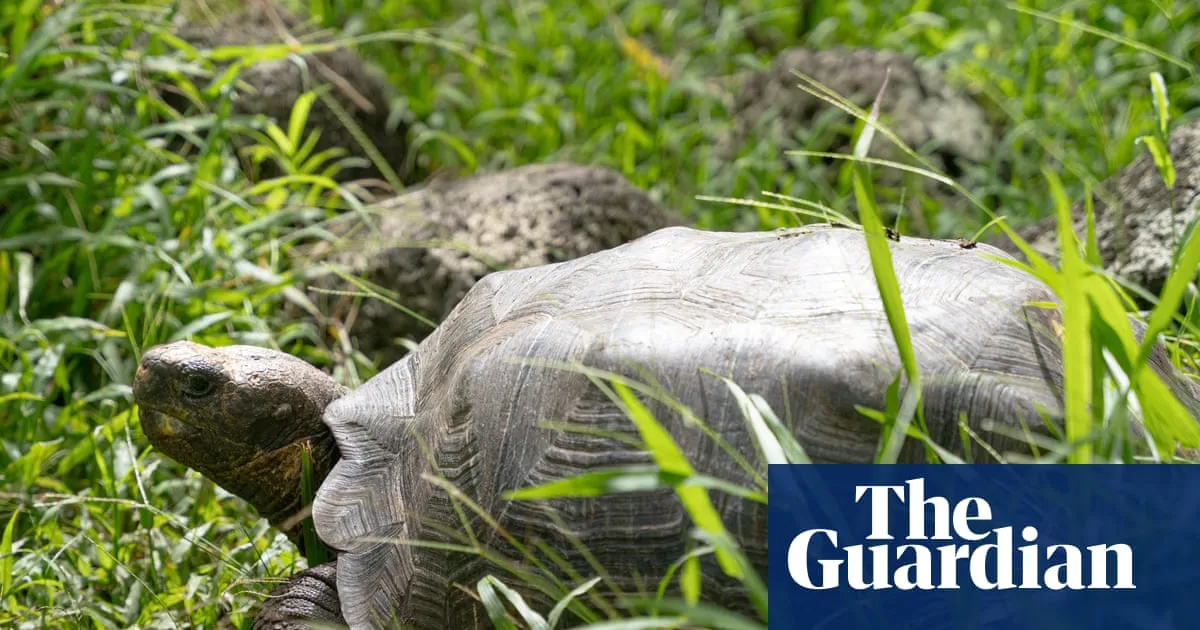
Giant tortoises, the life-giving engineers of remote small island ecosystems, are plodding over the Galápagos island of Floreana for the first time in more than 180 years.The Floreana giant tortoise (Chelonoidis niger niger), a subspecies of the giant tortoise once found across the Galápagos, was driven to extinction in the 1840s by whalers who removed thousands from the volcanic island to provide a living larder during their hunting voyages.Remarkably, 158 juvenile giant tortoises descended from the Floreana subspecies have been returned to the island in a vital step for the largest ecological restoration project undertaken on the Pacific Ocean archipelago.A relic population of giant tortoises discovered on Wolf Volcano in the north of Isabela Island in 2008 were found to be descended in part from the Floreana population. Most of the Wolf Volcano tortoises had domed shells like those living on Isabela’s other volcanoes to the south, but some had a saddleback-shaped carapace more typical of the tortoises that evolved on Floreana.A captive “back breeding” programme began in 2017, for which 23 hybrid tortoises most closely related to the Floreana subspecies were chosen to recreate it as genetically close to the original as possible.More than 600 hatchlings had been born by 2025, and several hundred grew large enough to be returned to their ancestral island. Males can reach nearly 1.5 metres (5ft) in length.mapAlthough whalers wiped out the Floreana tortoise, it ironically endured on Wolf Volcano because they also deposited live tortoises on other islands for safekeeping and sometimes tossed tortoise cargo overboard if they needed to lighten their load during their whaling missions.Floreana, the sixth largest island in the archipelago, was once home to a wealth of endemic wildlife, including spectacular species such as the Floreana mockingbird, the Floreana racer snake. But the arrival of sailors, whalers and then settlers brought invasive mammals including rats and feral cats that wiped out native fauna and flora, a pattern repeated on small islands across the world. When Charles Darwin reached Floreana in 1835, its giant tortoise population was in its death throes.Its reintroduction has been brought about by the Floreana Ecological Restoration Project, a partnership between the Galápagos National Park Directorate and a number of charities working closely with the island’s 160 residents.An invasive species eradication programme, which began in 2023 and has removed most of the rats and feral cats on the island, paved the way for the tortoises’ return.The Galapagos rail has since been rediscovered on Floreana after not being recorded since Darwin’s first visit, and there has been a resurgence in populations of ground finches and native geckos, lizards and snails.Verónica Mora, a Floreana community representative, said of the tortoises’ return: “This moment marks an important step toward a future where conservation and community wellbeing go hand in hand, because our livelihoods, from tourism to agriculture and fishing, depend on the health of this island.”The Floreana giant tortoise. Photograph: PRThe island’s farmers have also reported much-improved harvests since rat numbers were drastically reduced.Giant tortoises are “keystone species”. Their grazing maintains open habitats, promoting the growth of native plants and creating conditions that benefit reptiles, invertebrates and birds. They also distribute native seeds across the island as they roam.“Habitats are the foundation for biodiversity, the home that allows species to move, live and evolve naturally over time,” said Rakan Zahawi, the executive director of the Charles Darwin Foundation. “Giant tortoises are a critical part of this system. By dispersing seeds, shaping vegetation, creating micro-habitats such as their well known wallows, and influencing how landscapes regenerate, they help rebuild ecological processes that many other species depend on.”Hugo Mogollón, the chief executive of Galápagos Conservancy, said: “By identifying tortoises on Wolf Volcano with Floreana ancestry and breeding their descendants, we are returning this species to its island in a form that closely reflects the original lineage – laying a critical scientific foundation for the restoration of Floreana’s ecosystems and the future reintroduction of additional native species.”The next phase of restoration will seek to return species including the Floreana mockingbird, the Floreana racer snake, the vegetarian finch and the little vermilion flycatcher.Dr Jen Jones, the chief executive of the Galapagos Conservation Trust, said: “It’s a validation of the incredible efforts we’ve seen over the last 20 years from a whole ecosystem of conservation NGOs, local authorities, determined individual researchers and community champions.”
SRCThe Guardian - World News
LANGEN
LEANCenter-Left
WORDS720
ENT7
FRI · 2026-02-20 · 21:00 GMTBRIEF NSR-2026-0220-17995
NSR-2026-0220-17995News Report·EN·Environmental
Floreana giant tortoise reintroduced to Galápagos island after almost 200 years
After nearly 200 years, the Floreana giant tortoise, driven to extinction in the 1840s, has been reintroduced to Floreana Island in the Galápagos. In 2008, a relic population with Floreana ancestry was discovered on Isabela Island's Wolf volcano, leading to a captive breeding program in 2017.
Patrick BarkhamThe Guardian - World NewsFiled 2026-02-20 · 21:00 GMTLean · Center-LeftRead · 3 min
The Guardian - World NewsFIG 01
Reading time
3min
Word count
720words
Sources cited
1cited
Entities identified
7entities
Quality score
100%
§ 01
Briefing Summary
AI-generatedNEWSAR · AI
After nearly 200 years, the Floreana giant tortoise, driven to extinction in the 1840s, has been reintroduced to Floreana Island in the Galápagos. In 2008, a relic population with Floreana ancestry was discovered on Isabela Island's Wolf volcano, leading to a captive breeding program in 2017. The program selected hybrid tortoises most closely related to the Floreana subspecies to recreate a genetically similar population. As of 2025, over 600 hatchlings were born, and 158 juvenile tortoises have been released on Floreana as part of the Floreana Ecological Restoration Project. This reintroduction aims to restore the island's ecosystem, which was damaged by invasive species following the arrival of sailors and settlers.
Confidence 0.90Sources 1Claims 5Entities 7
§ 02
Article analysis
Model · rule-basedFraming
Environmental
Human Interest
Tone
Measured
AI-assessed
CalmNeutralAlarmist
Factuality
0.90 / 1.00
Factual
LowHigh
Sources cited
1
Limited
FewMany
§ 03
Key claims
5 extracted01
This moment marks an important step toward a future where conservation and community wellbeing go hand in hand
quoteVerónica Mora, a Floreana community representative
Confidence
1.00
02
An invasive species eradication programme began in 2023 and has removed most of the rats and feral cats.
factual
Confidence
1.00
03
158 juvenile giant tortoises descended from the Floreana subspecies have been returned to the island.
factual
Confidence
1.00
04
The Floreana giant tortoise was driven to extinction in the 1840s by whalers.
factual
Confidence
1.00
05
Floreana giant tortoise reintroduced to Galápagos island after almost 200 years.
factual
Confidence
1.00
§ 04
Full report
3 min read · 720 words§ 05
Entities
7 identifiedKey playerOppositionContextPositiveNeutralNegative
§ 06
Keywords & salience
9 termsgiant tortoise
1.00
galápagos islands
0.90
floreana island
0.80
reintroduction
0.70
ecological restoration
0.70
invasive species
0.60
back breeding program
0.50
extinction
0.50
wildlife conservation
0.40
§ 07
Topic connections
Interactive graph No topic relationship data available yet. This graph will appear once topic relationships have been computed.