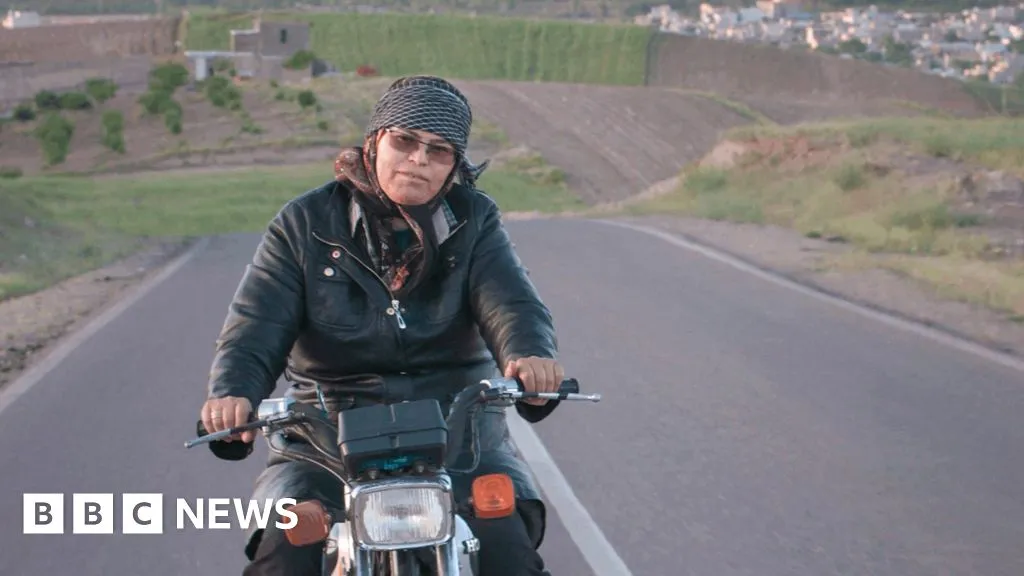
Iran's motorcycling midwife and rights campaigner is star of Oscar-tipped film2 hours agoRosa RahimiGandom FilmsSara Shahverdi is "doing something unusual" in Iran, filmmakers sayGrowing up in the Iranian capital Tehran, filmmaker Sara Khaki recalls seeing many examples of strong women in a male-dominated society.These were women "fighting for their independence and demanding space for their lives", she says.She later decided to research female entrepreneurs and activists in the country, and "came across this really amazing, tenacious individual who lives in the north-west of Iran, who rides a motorcycle, as the only female motorcycle rider in the region, and she's delivered 400 kids as a midwife".That woman is Sara Shahverdi. After months of phone calls to build up a relationship, Khaki and co-director Mohammadreza Eyni learned this woman was also running for a council seat - and decided to make a film about her.Cutting Through Rocks, as it is titled, has now become the first Iranian nominee for Best Documentary at the Oscars next month.The film follows Shahverdi as she runs for office in her village in the region of Zanjan, and deals with various obstacles as a female leader. We see her in a hall filled with 1,500 men representing all 300 local village councils. Among them, she is the only woman.Gandom FilmsFilmmaker Sara Khaki and co-director Mohammadreza Eyni made the documentary over eight yearsShe wins the seat with the most votes - becoming the first woman to do so - and brings long-awaited fuel and electricity to the village. She pushes for land co-ownership between men and women, a rare concept in Iran, and takes up causes like girls' education and child marriage.We see Shahverdi give a speech to a hall of women, lamenting how girls as young as 11 are married and giving birth. On a visit to a girls' school, she speaks with students who promise her they will finish their education, rather than marry young.Khaki says Shahverdi is "doing something unusual" in the film, which began in 2017 and took eight years to make.She worked alongside Eyni, a native speaker of Azeri, the language spoken in the region. Being a male-female duo was important, Khaki says: "I wouldn't be able to enter the worlds that Mohammadreza could easily enter, and vice versa."While stories of women take centre stage in the film, another tale unfolds - Khaki and Eyni got married while making it."It was two stories happening at the same time," says Eyni, "the story of Cutting Through Rocks in front of the camera, and the love story behind the camera."Shahverdi jokingly takes credit for that union. But in the film itself, she also encounters challenging situations.Gandom FilmsEyni and Khaki struck a bond with Shahverdi (centre) while making the filmIn one scene we see Shahverdi take into her home - with parental permission -Fereshteh, a teenager seeking a divorce from her husband whom she married at 12. He is 35, the same age as her father.We see Fereshteh in a court hearing as she explains to the judge her reasons for wanting a divorce. "I wouldn't want my child's future to turn out like mine," she says.She is advised by the judge to make the situation work and later returns to her parents. The filmmakers were granted permission to film 40 minutes of the court hearing, which allowed them to capture the exchange.In a turn of events later on in the film, Shahverdi is summoned to court herself following a complaint about her "operating a dishonourable house". She recalls her interrogator asking: why do women visit your home? Why do you wear men's clothing? Why isn't your voice feminine?She is instructed to see a medical expert witness to determine whether she needs a sex change operation. Shahverdi insists she is comfortable with her gender.We don't see the man conducting the tests, but we hear his advice: "Look, if you are really a woman, you should be considerate of the rules and traditions. In our society, a woman can't just do anything she wants."The judge ultimately decides against surgery and closes Shahverdi's case - but he advises Shahverdi to stop helping women so much and to mind her own business.The filmmakers supported Shahverdi throughout the case.Behind the camera, filming in Iran came with its challenges - Khaki and Eyni say they faced delays obtaining permits from local authorities, interrogations and had their hard drives confiscated.At one point, the duo, who are based between Iran and the United States, were banned from leaving Iran for a year.Gandom FilmsMaking the film in Iran wasn't all plain sailing"There were many, many, many hurdles along our way of storytelling," Khaki says. "And there were many times where we kind of were quite certain that we would never be able to finish this film."But they did - and on 22 January they learned about their Oscar nomination. Khaki describes the timing as "very heavy" and "bittersweet". It also meant the duo couldn't initially share the news with Shahverdi.Eventually they managed to reach her. Shahverdi was silent upon hearing the news, before becoming emotional. "It was not about only the nomination, it was about the whole experience," Eyni explains, "and I think her life, in retrospect".Though they wanted Shahverdi to travel with them to festivals and screenings, the US travel ban on Iranian nationals and visa restrictions elsewhere have hindered things.They did, however, manage to travel to a screening in South Korea in September 2025. "It was very precious… she got to experience the film with teenage Koreans who were truly inspired," says Khaki.Since the film's premiere, Shahverdi's four-year council term has come to an end but the filmmakers say she continues to be a fierce advocate for women and girls. A new school is being built in her village, something she campaigned for."A lot of things have happened in her community… more women having the confidence to take a council seat and make decisions - and so many other teenage girls continuing their education and their parents supporting them," Eyni says.More on this story
SRCBBC News - World
LANGEN
LEANCenter
WORDS1 002
ENT3
SAT · 2026-02-21 · 00:44 GMTBRIEF NSR-2026-0221-18022
NSR-2026-0221-18022News Report·EN·Human Interest
Iran's motorcycling midwife and rights campaigner is star of Oscar-tipped film
"Cutting Through Rocks" is an Oscar-nominated documentary about Sara Shahverdi, an Iranian midwife and rights campaigner. The film, directed by Sara Khaki and Mohammadreza Eyni, follows Shahverdi's journey as she runs for a council seat in her village in the Zanjan region of northwest Iran, beginning in 2017.
BBC News - WorldFiled 2026-02-21 · 00:44 GMTLean · CenterRead · 5 min
BBC News - WorldFIG 01
Reading time
5min
Word count
1 002words
Sources cited
4cited
Entities identified
3entities
Quality score
100%
§ 01
Briefing Summary
AI-generatedNEWSAR · AI
"Cutting Through Rocks" is an Oscar-nominated documentary about Sara Shahverdi, an Iranian midwife and rights campaigner. The film, directed by Sara Khaki and Mohammadreza Eyni, follows Shahverdi's journey as she runs for a council seat in her village in the Zanjan region of northwest Iran, beginning in 2017. As the only female motorcycle rider in the region, she is shown overcoming obstacles as a female leader, ultimately winning the election and advocating for issues like land co-ownership, girls' education, and ending child marriage. The filmmakers, who also married during the eight-year production, highlight Shahverdi's efforts to bring positive change to her community. The film is the first Iranian nominee for Best Documentary at the Oscars.
Confidence 0.90Sources 4Claims 5Entities 3
§ 02
Article analysis
Model · rule-basedFraming
Human Interest
Social Justice
Tone
Measured
AI-assessed
CalmNeutralAlarmist
Factuality
0.80 / 1.00
Factual
LowHigh
Sources cited
4
Well sourced
FewMany
§ 03
Key claims
5 extracted01
The film began in 2017 and took eight years to make.
factual
Confidence
1.00
02
Shahverdi is "doing something unusual" in the film.
quoteSara Khaki
Confidence
1.00
03
Shahverdi won a council seat with the most votes, becoming the first woman to do so, and brought fuel and electricity to the village.
factual
Confidence
1.00
04
Cutting Through Rocks has become the first Iranian nominee for Best Documentary at the Oscars next month.
factual
Confidence
1.00
05
Sara Shahverdi is the only female motorcycle rider in her region of north-west Iran and has delivered 400 kids as a midwife.
factualfilmmakers
Confidence
0.90
§ 04
Full report
5 min read · 1 002 words§ 05
Entities
3 identifiedKey playerOppositionContextPositiveNeutralNegative
§ 06
Keywords & salience
10 termsiranian women
0.90
sara shahverdi
0.90
documentary film
0.80
rights campaigner
0.70
midwife
0.70
female leadership
0.70
child marriage
0.60
girls' education
0.60
oscar nomination
0.60
motorcycle rider
0.50
§ 07
Topic connections
Interactive graph Network visualization showing 51 related topics
View Full Graph Person Organization Location Event|Click node to navigate|Edge numbers = shared articles