EXPLAINERFrom Mahatma Gandhi’s support for Palestine to Modi’s Netanyahu embrace, we trace how India’s ties have evolved over the decades.Prime Minister Benjamin Netanyahu (R) welcomes his Indian counterpart, Narendra Modi, near Tel Aviv in Israel [File: Ammar Awad/Reuters]Published On 22 Feb 2026Indian Prime Minister Narendra Modi is scheduled to begin his two-day visit to Israel on February 25, nine years after his first trip to the country.His 2017 trip was the first ever by an Indian prime minister to Israel.Recommended Stories list of 3 itemslist 1 of 3Trump launches Board of Peace at signing ceremony in Davoslist 2 of 3Strong support in Pakistan for Gaza peacekeeping force but questions lingerlist 3 of 3Epstein’s shadow: Why Bill Gates pulled out of Modi’s AI summitend of listHis upcoming visit also comes just days after India, together with more than 100 other nations, condemned Israel’s de facto expansion in the occupied West Bank after New Delhi initially appeared to hesitate about adding its name to the criticism.From defence and security to trade and technology, India and Israel have forged tight ties in recent years, even as New Delhi has turned cool towards the plight of Palestinians, despite decades of support for their struggle for a sovereign nation.While multiple Western leaders have visited Netanyahu in Israel since the October 7, 2023 attack, very few Global South leaders have, making Modi’s visit more significant, say analysts.Addressing the Conference of Presidents of Major American Jewish Organisations in Jerusalem on February 15, Netanyahu said the two prime ministers were going to discuss “all sorts of cooperation”.“Tremendous alliance between Israel and India, and we are going to discuss all sorts of cooperation. Now, you know, India is not a small country. It has 1.4 billion people. India is enormously powerful, enormously popular,” he said.But India’s ties with Israel were not always this cosy. Here is a timeline of how their relations have evolved — from hostility and suspicion, to secret weapons trade and now open embrace — and what that means for India’s relations with Palestine.1930s and 40s: India opposes the creation of IsraelUnder British colonialism, India strongly identified with the Palestinian struggle for independence.Between 1920 and 1948, Palestine was under British administration, and the United Kingdom, through the Balfour Declaration of 1917, had promised Jews, who had been displaced from Europe due to Adolf Hitler’s oppression, a homeland in the British Mandate in Palestine.This was opposed by many nations, including India, which were also fighting British colonialism at the time.“Palestine belongs to the Arabs in the same sense that England belongs to the English, or France to the French,” Mahatma Gandhi, India’s most prominent freedom fighter, revered as the Father of the Nation, wrote in an article in his weekly newspaper Harijan, on November 26, 1938.While he also sympathised with the Jews in his article and said “the German persecution of the Jews seems to have no parallel in history”, Gandhi stressed that it would be “wrong and inhumane to impose the Jews on the Arabs”.“It would be a crime against humanity to reduce the proud Arabs so that Palestine can be restored to the Jews partly or wholly as their national home,” he wrote.In 1947, India became an independent nation, and that same year, it voted against the United Nations Partition Plan of Palestine into the Jewish state of Israel and the state of Palestine, comprising Palestinian Arabs. According to the book, Selected Works of Jawaharlal Nehru, Volume 5, the first Indian prime minister’s sister, Vijaylaxmi Pandit, who was India’s envoy to the UN, received death threats to pressure New Delhi to vote in favour of the division. But the Nehru government did not buckle.Instead, India, erstwhile Yugoslavia and Iran advocated for a single federated state with — per Nehru — “the largest possible autonomy to respected regions where the Jews and Arabs are in majority”.“We have maintained that Palestine should be independent and free from the control of any single power; that no solution can be lasting unless it is based on the consent of both Arabs and Jews; and no lasting solution is possible which is imposed and maintained by force,” Nehru said in 1948.In 1949, India also voted against Israel’s UN membership.1950s: India recognises Israel, but refuses to set up diplomatic tiesBut Israel was keen for recognition and sent many envoys to meet Indian officials.Renowned scientist Albert Einstein was among those nudged by Israel to help convince India to recognise the Jewish nation.In a letter to Nehru in June 1947, Einstein told him to end “the rivalries of power politics and the egotism of petty nationalist appetites” and support “the glorious renaissance which has begun in Palestine”.At the time, Nehru was not convinced, but eventually, on September 17, 1950, India recognised Israel. “We would have [recognised] long ago, because Israel is a fact. We refrained because of our desire not to offend the sentiments of our friends in the Arab countries,” Nehru said, post recognition.However, India steered clear of establishing diplomatic ties with Israel. For four decades to follow, India even forbade the use of its passport for travel to Israel.1960s: Pro-Palestinian, with an opening for IsraelIndia’s political and diplomatic sympathies continued to lie firmly behind the Palestinian cause. In May 1960, Nehru visited UN troops stationed in Gaza.But when war broke out between India and China in 1962, then Israeli Prime Minister David Ben-Gurion wrote to Nehru, offering his sympathies and weapons.India accepted Israeli weapons and munitions, but requested that the ships supplying them not bear Israeli flags, so as not to antagonise New Delhi’s Arab allies. These details have been revealed in documents held in archives in Jerusalem, and India has not disputed them. This marked the beginning of a decades-long covert relationship between India and Israel.Israel again supplied India with munitions during its 1965 war against Pakistan.1970s: Secret Israeli weapons and a historic Palestinian recognitionAs tensions between India and Pakistan spiked in 1971, DN Chatterjee, India’s ambassador to France, wrote to the Ministry of External Affairs, advocating for New Delhi to seek Israeli assistance.The then prime minister, Indira Gandhi, accepted the proposal, scholar Srinath Raghavan wrote in his book, 1971. Through India’s external intelligence agency, the Research and Analysis Wing (RAW), the country began the process of procuring Israeli arms via Liechtenstein.Israeli Prime Minister Golda Meir wrote to Indira, seeking diplomatic recognition for Israel in return, but India demurred.Instead, despite the military help it had sought and received from Israel, India grew even closer to the Palestinian movement diplomatically through the 1970s. In 1974, it became the first non-Arab country to recognise the Palestinian Liberation Organization (PLO) as the sole representative of the Palestinian people. The following year, the PLO opened an office in India. Thousands of Palestinian students came to India for their higher studies.1980s: ‘My sister’ and a planned attack on a nuclear facilityBy the 1980s, India’s relations with Palestine and Israel had fallen into a familiar pattern. New Delhi overtly, loudly declared its support for the Palestinian cause, and PLO leader Yasser Arafat made frequent visits to the country. But covertly, Israel and India had established security ties.In 1983, when Arafat visited India for a summit of the Non-Aligned Movement, he described Indira, the prime minister, as his “sister”, underscoring the personal and nation-to-nation affinity that existed at the time between India and Palestine.But the early 1980s also saw Israel propose to India a joint operation to attack a Pakistani nuclear facility, which New Delhi turned down.In 1988, India became among the world’s first non-Arab nations to recognise Palestinian statehood.1990s: India and Israel establish diplomatic tiesWith the Cold War over and a unipolar world emerging, India adjusted several of its diplomatic positions. Domestically, India opened up its economy starting in 1991. Externally, it reached out to the United States and, in January 1992, turned its long-hidden relationship with Israel into the establishment of formal diplomatic ties.In a September 2022 report for the Indian think tank Observer Research Foundation, retired Indian diplomat Navdeep Suri wrote that New Delhi took decades to establish diplomatic ties with Israel because of India’s “support for anti-colonial movements and its close ties with Arab countries”.In fact, India’s prime minister in 1992, PV Narasimha Rao, announced the decision to set up diplomatic ties with Israel just weeks after Arafat had visited New Delhi and said he would respect India’s decision on the matter.India and Israel set up their embassies in Tel Aviv and New Delhi, respectively.In 1999, Israel helped India during the Kargil war when its troops were trying to force out Pakistan’s military and Kashmiri rebels who had occupied strategic positions on the Indian side of the de facto border between them, known as the Line of Control or LoC. Israel aided India militarily by supplying laser-guided bomb kits and missiles.2014 onwards: An open embraceIn the early 2000s, India became one of Israel’s largest buyers of defence equipment.But in 2014, when Modi came to power, India’s ties with Israel witnessed a sharp upturn; the hesitancy of the past was shed once and for all.Under the Modi government in 2015, India’s president at the time, Pranab Mukherjee, became the first Indian president to visit Israel, seeking to strengthen bilateral economic and defence ties.In July 2017, Modi visited Israel, becoming the first Indian prime minister to visit the country. During that visit, according to Indian media reports, Modi and Netanyahu said they “visualised that the two countries will become close partners in development, technology, innovation, entrepreneurship, defence and security”. A year later, in January 2018, Netanyahu also visited New Delhi.In 2021, under Modi, the Indian Air Force participated in a multilateral air force exercise called Blue Flag-2021 in Israel. Israeli defence companies like Elbit Systems and Rafael Advanced Defense Systems have also established partnerships with Indian firms, such as Adani Group and Tata Advanced Systems.Trade relations between the two nations have also strengthened under the Modi government. India is currently Israel’s second-largest trading partner in Asia, after China. According to India’s Ministry of External Affairs, trade jumped from $200m in 1992 to $6.5bn in 2024.India’s main exports to Israel include pearls, precious stones, automotive diesel, chemicals, machinery, and electrical equipment, among others, while imports include petroleum, chemical machinery and transport equipment, etc. The two countries also signed a Bilateral Investment Treaty (BIT) last September.At a time when many Western countries, including allies of Israel, have sanctioned far-right members of Netanyahu’s cabinet, including Finance Minister Bezalel Smotrich, these ministers have been welcomed in India.Israeli companies have also sought to hire more employees from India in recent years. After Israel suspended work permits for thousands of Palestinians following the October 2023 attack by Hamas and other Palestinian groups, Israel hired thousands of Indians to work in their place.Meanwhile, India has been a tourist destination for Israelis, with many of them holidaying in the country after serving their mandatory time in the Israeli army.Kfir Tshuva, a lecturer in economics at the Ramat Gan Academic College in Israel, said, under Modi, India and Israel’s relationship has become more visible and politically open.However, he noted that India’s approach in the Middle East was also one of strategic balancing — in which New Delhi maintains separate and independent relationships with multiple actors that may have conflicting interests, rather than framing its policy as a zero-sum choice.“This allows India to deepen cooperation with Israel in areas such as defence, technology and economic integration, while also sustaining diplomatic engagement with the Palestinian leadership and strong ties with Arab states,” he said.“Modi’s visit to Israel [next week] should therefore be understood within this broader strategic calculus. It reflects New Delhi’s effort to integrate stronger bilateral cooperation with Israel into its wider regional strategy without undermining its commitment to peace, its support for a two-state solution, or its substantive relationships with Arab partners,” he added.Kadira Pethiyagoda, author and geopolitical strategist, told Al Jazeera that there are currently multiple countervailing forces at play.“On one hand, India’s short-term interests are advanced by defence trade and investment, and remittances from Israel; on the other, India’s long-term goal of becoming a ‘great power’ with a strategic footprint in the Middle East, invariably involves reducing US regional hegemony,” he said.“This requires that Israel is balanced by other regional powers, like Iran, which have closer ties to India than the US. India would not want to contribute to Israel achieving complete dominance in the Middle East,” he noted.What does this mean for India’s relations with Palestine?Under Modi, India has officially maintained its support for a sovereign Palestinian state alongside Israel — backing the two-state solution — even as he has embraced more publicly warm ties with Netanyahu.But India has been cautious in criticising Israel’s actions on Gaza, even before the genocidal war that began in 2023.In 2016, India abstained from a UN vote which sought to bring Israel before the International Criminal Court (ICC) for its alleged war crimes during its conflict with Gaza in 2014. When Israel began its genocidal war on Gaza, India condemned the humanitarian crisis in the enclave but repeatedly abstained from UN resolutions which called for a ceasefire. In 2024, India also abstained from a UN Human Rights Council resolution which called for an arms embargo on Israel.India has, however, been critical of Israel’s actions in the occupied West Bank. Last week, India joined more than 100 nations in condemning Israel’s recent plans to occupy more territory in the region.A joint statement issued by the nations rejected “all measures aimed at altering the demographic composition, character and status of the Palestinian Territory occupied since 1967, including East Jerusalem”.“Such measures violate international law, undermine the ongoing efforts for peace and stability in the region, run counter to the Comprehensive Plan, and jeopardize the prospect of reaching a peace agreement ending the conflict,” the statement added.But India joined that statement only a day after the first batch of 80 countries and organisations signed it, drawing criticism from the domestic opposition.Modi’s visit to Israel, too, has drawn condemnation from the opposition Congress party and others, who have accused him of reversing decades of Indian support for the Palestinian cause.In a post on X after India condemned Israel’s actions in the occupied West Bank, Congress party’s general secretary in charge of communication and media, Jairam Ramesh, said: “This is sheer hypocrisy and cynicism since the PM will be going to Israel early next week. If he is really serious – which of course he is not – he should call out his good friend Mr Netanyahu, and publicly express India’s grave concern at what Israel is executing in the occupied West Bank.”Analysts have told Al Jazeera that Modi will likely be “highly diplomatic” with respect to discussing the Palestine issue during his Israel trip.According to Pethiyagoda, India has had a fairly unique position among large powers in maintaining cordial ties with both sides in most of the world’s major conflicts.“But the timing of the [Israel] visit, when the US is likely to strike Iran, is not ideal in terms of maintaining this image,” he said, referring to soaring tensions between Washington and Tehran. The Trump administration has amassed warships and jets close to Iran, in preparation for a potential attack, even as the US and Iran also engage in diplomatic talks.He added that during his visit, Modi will likely make reference to the Gaza conflict but “in a neutral, highly diplomatic way”.Tshuva said beyond India’s engagement with the Palestinian leadership, its ties with Arab states remain strategically significant.“Gulf countries are vital to India’s energy security, trade flows, investment partnerships and the welfare of millions of Indian nationals working in the region,” he said.“These economic and geopolitical considerations form an essential part of New Delhi’s Middle East policy and shape its careful approach to the Israeli-Palestinian issue,” he added.
SRCAl Jazeera
LANGEN
LEANCenter
WORDS2 618
ENT10
SUN · 2026-02-22 · 08:25 GMTBRIEF NSR-2026-0222-18255
NSR-2026-0222-18255News Report·EN·Diplomatic
Modi’s Israel visit: Timeline of India’s relations with Israel, Palestine
Indian Prime Minister Narendra Modi is scheduled to visit Israel on February 25, 2026, nine years after his historic first trip in 2017. This visit occurs shortly after India joined over 100 nations in criticizing Israel's West Bank expansion.
Priyanka ShankarAl JazeeraFiled 2026-02-22 · 08:25 GMTLean · CenterRead · 11 min
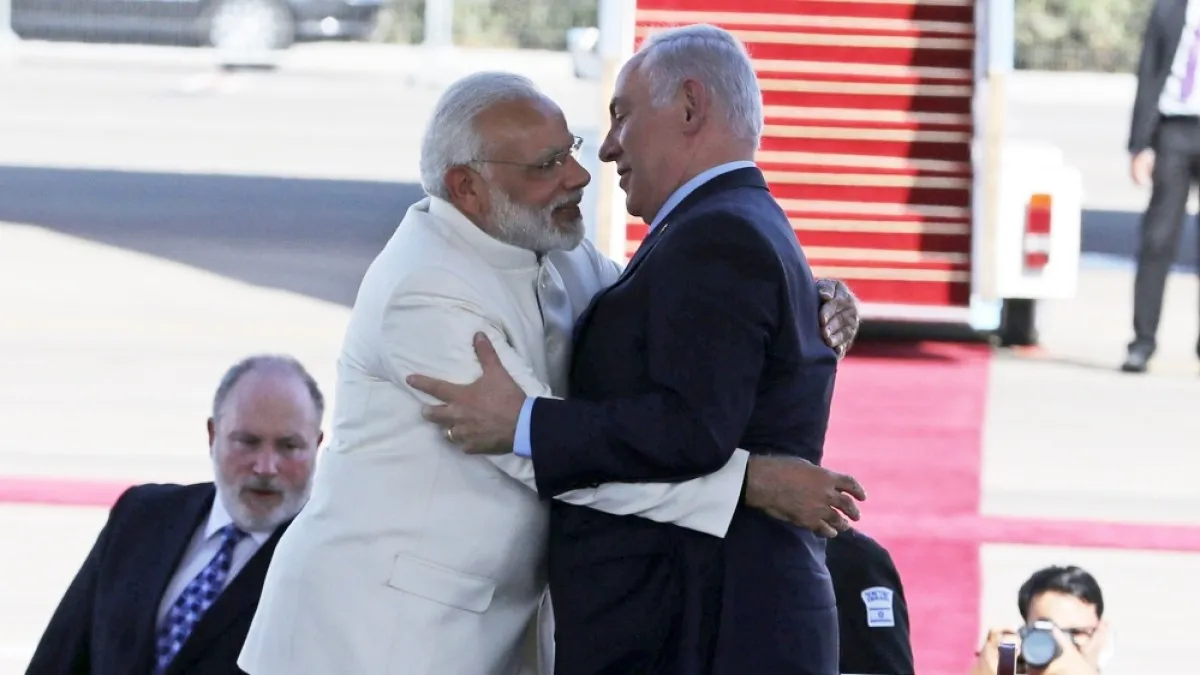
Al JazeeraFIG 01
Reading time
11min
Word count
2 618words
Sources cited
2cited
Entities identified
10entities
Quality score
100%
§ 01
Briefing Summary
AI-generatedNEWSAR · AI
Indian Prime Minister Narendra Modi is scheduled to visit Israel on February 25, 2026, nine years after his historic first trip in 2017. This visit occurs shortly after India joined over 100 nations in criticizing Israel's West Bank expansion. Despite India's historical support for Palestine, relations with Israel have strengthened in recent years, encompassing defense, trade, and technology. Benjamin Netanyahu highlighted the "tremendous alliance" and planned discussions on cooperation. The article will explore the evolution of India-Israel relations, from initial opposition to current close ties, and the implications for India's relationship with Palestine. The timeline will begin in the 1930s and 40s when India opposed the creation of Israel.
Confidence 0.90Sources 2Claims 5Entities 10
§ 02
Article analysis
Model · rule-basedFraming
Diplomatic
Political Strategy
Tone
Measured
AI-assessed
CalmNeutralAlarmist
Factuality
0.70 / 1.00
Factual
LowHigh
Sources cited
2
Limited
FewMany
§ 03
Key claims
5 extracted01
Mahatma Gandhi wrote in 1938, “Palestine belongs to the Arabs in the same sense that England belongs to the English”.
quoteMahatma Gandhi
Confidence
1.00
02
Netanyahu said the two prime ministers were going to discuss “all sorts of cooperation”.
quoteBenjamin Netanyahu
Confidence
1.00
03
India, together with more than 100 other nations, condemned Israel’s de facto expansion in the occupied West Bank.
factual
Confidence
1.00
04
Modi's 2017 trip was the first ever by an Indian prime minister to Israel.
factual
Confidence
1.00
05
Narendra Modi is scheduled to begin his two-day visit to Israel on February 25, nine years after his first trip.
factual
Confidence
1.00
§ 04
Full report
11 min read · 2 618 words§ 05
Entities
10 identifiedKey playerOppositionContextPositiveNeutralNegative
People3
§ 06
Keywords & salience
8 termsindia-israel relations
1.00
palestine
0.80
narendra modi
0.70
benjamin netanyahu
0.60
india's foreign policy
0.60
geopolitics
0.50
sovereign nation
0.40
british colonialism
0.40
§ 07
Topic connections
Interactive graph Network visualization showing 51 related topics
View Full Graph Person Organization Location Event|Click node to navigate|Edge numbers = shared articles