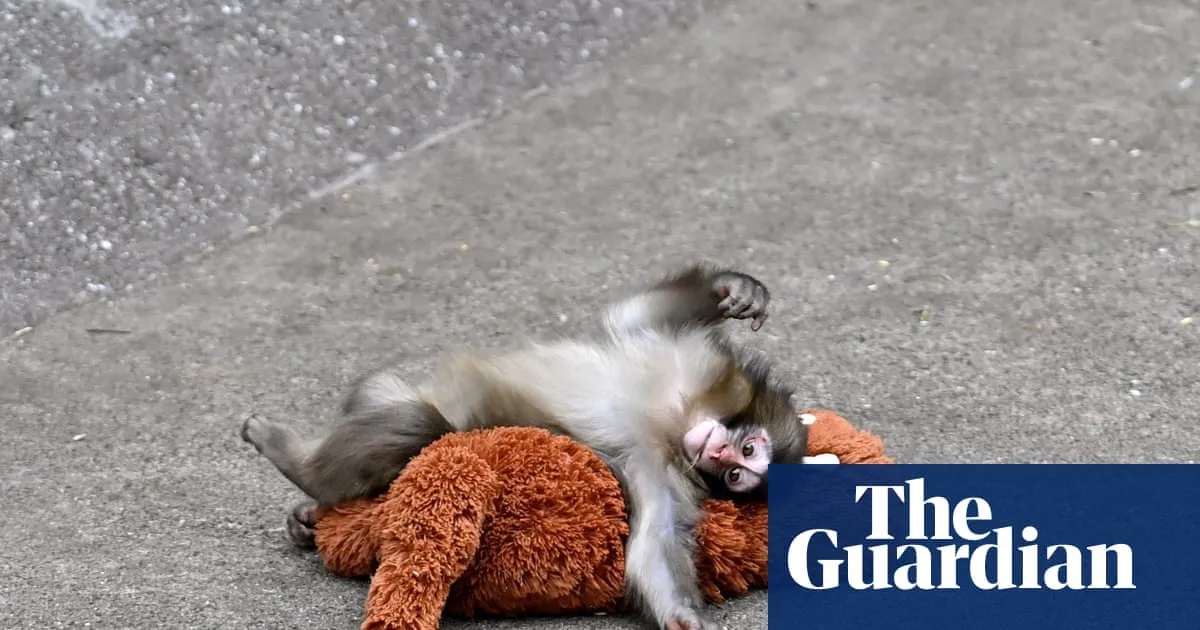
A baby monkey in Japan has captured hearts around the world after videos of him being bullied by other monkeys and rejected by his mother went viral last week.Punch, a Japanese macaque, was born last July at Ichikawa zoo. He has drawninternational attention after zookeepers gave him a stuffed orangutan toy after he was abandoned by his mother.Without maternal guidance to help him integrate, Punch has turned to the toy for comfort. He has been filmed multiple times being dragged and chased by older Japanese macaques inside the enclosure. Early clips showed him wandering alone with the toy after being pushed away by other monkeys, and clutching it tightly while being harassed. Viewers were briefly relieved when later videos emerged of another monkey grooming and comforting him.However, just days later, new footage showed Punch once again being targeted – this time dragged aggressively in a circle by a much larger monkey before running to hide behind a rock, hugging his toy.Punch, who was abandoned by his mother shortly after birth, sitting with a stuffed orangutan toy at Ichikawa city zoo and botanical gardens in Chiba prefecture. Photograph: JIJI PRESS/AFP/Getty ImagesThe videos have prompted questions about why monkeys abandon their babies. Alison Behie, a primatology expert at Australian National University, said such abandonment is unusual but can occur under certain conditions, citing “age, health and inexperience” as possible factors.Behie said: “In Punch’s case, their mother was a first-time mother, indicating inexperience.“Zookeepers also suggest Punch was born during a heatwave, which would be a high stress environment. In environments where survival is threatened from outside stress, mothers may prioritise their own health and future reproduction rather than continue to care for an infant whose health may be compromised by those environmental conditions.”Following Punch’s abandonment, zookeepers introduced the stuffed orangutan after trying alternatives, including rolling towels to different thicknesses for him to cling to.“Baby Japanese macaques immediately cling on to their mother’s body after birth to build muscle strength. They also get a sense of security through holding on to something. However, because he had been abandoned, Punch had nothing to grip on to,” the zookeeper Kosuke Shikano said.“We thought that [the toy] looking like a monkey might help Punch integrate back into the troop later on,” he added.Referring to the stuffed orangutan, Behie said: “The toy Punch has may be serving as an attachment figure, especially given they are six months old so likely still need to be nursed.”Punch sits alone in a fake tree. Photograph: Anadolu/Getty ImagesBehie added that the behaviours of other monkeys towards Punch “isn’t bullying or any abnormal behaviour, but regular social interaction”.According to Behie, Japanese macaques have strict matrilineal hierarchies, where higher-ranking families assert dominance over lower-ranking ones. Even with his mother, Punch would probably still face this aggression, she said.However, Behie said that without his mother “Punch may not develop the appropriate subordinate responses to show they submit to the dominance, which could have ongoing implications for the way they integrate into the group as an adult”.In recent days, the zoo has experienced a surge of visitors hoping to catch a glimpse of Punch. In response, officials have enforced stricter barriers around the enclosure and urged visitors to remain quiet, avoid using stepladders or tripods for photography and limit prolonged viewing.Carla Litchfield, a conservation psychologist at Adelaide University, pointed to the intelligence of Japanese macaques and as a result, their popularity for biomedical and neuroscience experiments in Japan. She also said that macaques were culled in Japan because of their habit of raiding crops.“This story about Punch highlights the impacts of habitat loss, climate change, zoo animal welfare, and the power of social media to connect people to animals,” Litchfield said. “However, hopefully the millions of social media likes, and attention won’t exacerbate the problem of illegal trade in infant monkeys for the exotic pet trade because everyone thinks baby monkeys are cute and would make a great pet.”“Monkeys grow up quickly – Punch will be an adult in four years – and people no longer find them cute and manageable. Monkeys belong with other monkeys. They are social beings and need to be with their own species to thrive mentally and physically.”Punch isn’t the first zoo animal to garner global fascination – Moo Deng, the young pygmy hippo in Thailand captured hearts in 2024 with her stubborn attitude and star quality.
SRCThe Guardian - World News
LANGEN
LEANCenter-Left
WORDS726
ENT3
MON · 2026-02-23 · 06:13 GMTBRIEF NSR-2026-0223-18435
NSR-2026-0223-18435News Report·EN·Human Interest
The tragedy of Punch the monkey: why do mother animals abandon their offspring?
Punch, a baby Japanese macaque at Ichikawa Zoo in Japan, has gained international attention after being abandoned by his first-time mother shortly after his birth in July. Videos show Punch being bullied by other monkeys and seeking comfort in a stuffed orangutan toy provided by zookeepers.
Maya YangThe Guardian - World NewsFiled 2026-02-23 · 06:13 GMTLean · Center-LeftRead · 3 min
The Guardian - World NewsFIG 01
Reading time
3min
Word count
726words
Sources cited
2cited
Entities identified
3entities
Quality score
100%
§ 01
Briefing Summary
AI-generatedNEWSAR · AI
Punch, a baby Japanese macaque at Ichikawa Zoo in Japan, has gained international attention after being abandoned by his first-time mother shortly after his birth in July. Videos show Punch being bullied by other monkeys and seeking comfort in a stuffed orangutan toy provided by zookeepers. Primatology expert Alison Behie suggests the abandonment could be due to the mother's inexperience and a stressful heatwave environment that may have led her to prioritize her own survival. Zookeepers introduced the toy to provide Punch with something to cling to, mimicking the natural behavior of baby macaques clinging to their mothers. The hope is that the toy will eventually aid Punch in integrating back into the troop.
Confidence 0.90Sources 2Claims 5Entities 3
§ 02
Article analysis
Model · rule-basedFraming
Human Interest
Environmental
Tone
Mixed Tone
AI-assessed
CalmNeutralAlarmist
Factuality
0.80 / 1.00
Factual
LowHigh
Sources cited
2
Limited
FewMany
§ 03
Key claims
5 extracted01
The behaviours of other monkeys towards Punch “isn’t bullying or any abnormal behaviour, but regular social interaction”.
quoteAlison Behie
Confidence
1.00
02
Baby Japanese macaques immediately cling on to their mother’s body after birth to build muscle strength.
quotethe zookeeper Kosuke Shikano
Confidence
1.00
03
Alison Behie said such abandonment is unusual but can occur under certain conditions, citing “age, health and inexperience” as possible factors.
quoteAlison Behie
Confidence
1.00
04
Punch, a Japanese macaque, was born last July at Ichikawa zoo.
factualnull
Confidence
1.00
05
Zookeepers suggest Punch was born during a heatwave, which would be a high stress environment.
factualZookeepers
Confidence
0.90
§ 04
Full report
3 min read · 726 words§ 05
Entities
3 identifiedKey playerOppositionContextPositiveNeutralNegative
Organizations1
Locations1
§ 06
Keywords & salience
8 termsmonkey abandonment
0.90
japanese macaque
0.70
infant care
0.60
maternal behavior
0.60
zoo
0.50
stuffed animal
0.50
first-time mother
0.40
primate behavior
0.40
§ 07
Topic connections
Interactive graph No topic relationship data available yet. This graph will appear once topic relationships have been computed.