From 2h agoMorning opening: New Russia sanctions on holdJakub KrupaThe European Union is increasingly unlikely to reach an agreement on the new, 20th package of sanctions against Russia ahead of tomorrow’s fourth anniversary of the full-scale invasion of Ukraine, as Hungary continues to block the package.EU foreign policy chief Kaja Kallas arrives at the start of a Foreign Affairs Council in Brussels, Belgium. Photograph: Olivier Matthys/EPAEU foreign policy chief Kaja Kallas admitted this morning that "there is not going to be progress” on this issue today, as Budapest continues to block the adoption of the sanctions.“We are doing our utmost to have the sanctions package … through … and we are looking for ways how we can do it. But as we have heard some very strong statements from Hungary, … I don’t really … see they are going to change this unfortunately today,” she said.Hungary opposes the proposed measures – as well as the payment of the €90bn loan for Ukraine – as part of its escalating dispute with Ukraine about oil transit using the Druzhba pipeline.Hungarian foreign minister Péter Szijjártó said on Sunday that “until Ukraine resumes oil transit to Hungary and Slovakia via the Druzhba pipeline, we will not allow decisions important to Kyiv to move forward.”It also comes just six weeks before the key parliamentary election in the country, which could see its pro-Russian prime minister Viktor Orbán ousted after 16 years in power.The embattled leader – currently trailing 10 points behind the opposition leader, Tisza’s Péter Magyar – increasingly turns to anti-Ukrainian rhetoric to falsely allege a conspiracy between Kyiv and Brussels to remove him from office and talk about the risk of war expanding to Hungary.The failure to agree on the new package of sanctions would be politically embarrasing for the bloc as its leaders, including the commission president Ursula von der Leyen, plan to travel to Kyiv on Tuesday to mark the anniversary.I will bring you all the key lines from Brussels here, as well as other stories from across Europe, as we expect Rob Jetten to be sworn in as the new Dutch prime minister, Finland’s Alexander Stubb to meet France’s Emmanuel Macron in Paris, and hear from the European Parliament on the future of the EU-US trade deal.It’s Monday, 23 February 2026, it’s Jakub Krupa here, and this is Europe Live.Good morning.Key events4m agoMerz says he expects Trump to respect EU-US deal struck last year6m agoEuropean parliament set to pause implementation of EU-US trade deal amid uncertainties over tariffs8m agoRussia's Putin 'not winning war' in Ukraine, Finland's Stubb says15m ago'Cannot be otherwise,' Macron says as he hopes to see EU loan for Ukraine, Russian sanctions agreed31m agoFinland's Stubb expected at Élysée for talks with Macron soon52m agoConfusion reigns on US tariffs after last week's supreme court ruling1h agoUkraine 'hates Hungary' and pursues 'very hostile' policies, Hungarian foreign minister says as he lashes against Kyiv, Brussels1h agoRob Jetten becomes youngest-ever Dutch prime minister at helm of minority government2h ago20th package of sanctions only matter of time, French minister insists2h ago'We cannot proceed like this,' Lithuania's Budrys expresses frustration with Hungary2h agoFailure to adopt sanctions would make Russia 'happy,' Estonian foreign minister says2h agoHungarian government seeks to create, exploit anti-Ukrainian hostility in election campaign, Poland's Sikorski says2h agoMorning opening: New Russia sanctions on holdShow key events onlyPlease turn on JavaScript to use this featureMerz says he expects Trump to respect EU-US deal struck last yearLisa O’Carrollin LondonThe German chancellor, Friedrich Merz, has said he expects Donald Trump to respect the tariff deal struck last July at his Scottish golf course.As confusion reigns across the globe as to whether the new 15% tariff rate, announced by the US on Saturday, would be implemented for the UK, the EU and others, Merz spokes person said:“We expect the US to follow the Supreme Court of the US decision with clear policies,” he said.The EU on Sunday called on the US to honour the July agreement. “A deal is a deal,” it said.The new 15% tariff rate Trump says he will impose from tomorrow flows from powers in the 1974 Trade Act, a different legal framework to the reciprocal tariffs Trump imposed unilaterally last year on dozens of countries.They can only hold for 150 days and must then get congressional approval.Jakub KrupaThe European Commission’s press briefing is about to start, and they will no doubt address this point.Let’s listen in. I will bring you the key lines here.European parliament set to pause implementation of EU-US trade deal amid uncertainties over tariffsLisa O’Carrollin LondonThe European Parliament is set to pause the process of ratification of the trade deal withe Donald Trump later this afternoon, the lead negotiator of the conservative group of MEPs has said.The parliament has already paused the deal once, over Trump’s threat to Greenland, but unpaused earlier this month with a vote of all MEPs expected in March to formally ratify the agreement.Bernd Lange, chair of the International Trade Committee of the European Parliament, has convened an extraordinary meeting on Monday following the supreme court ruling in the US striking down the tariffs as illegal.Željana Zovko, the lead trade negotiator in the European People’s Party group on the US deal told Bloomberg (£) that “we have no other option” but to delay the approval process to seek to clarity on the situation.Russia's Putin 'not winning war' in Ukraine, Finland's Stubb saysStubb is responding – and impressively, in French (beginning with a funny, and possibly impossible to translate in any sensible way, idiom describing his fluency).He picks up some of the same themes, including on Arctic security – “not just in Greenland, but also in Norway, Sweden, and of course Finland”.On Ukraine, he says that Putin “is not winning the war, but he is not [ready to] make peace” either.He says the war has been an unmitigated disaster for Russia, which is “losing a lot of soldiers” and facing “an economic failure,” and so Europe should continue to support Ukraine.He also highlights the bilateral ties between Finland and France, before apologising for his French, which was pretty spot on, if you ask me.Macron seems to agree as he enthusiastically applauds his guest and gives him a big hug, before they disappear for further talks.'Cannot be otherwise,' Macron says as he hopes to see EU loan for Ukraine, Russian sanctions agreedMacron is speaking now.He says that their talks will focus on the question of supporting Ukraine as the country enters the fifth year of full-scale war defending itself from the Russian aggression.He says he is determined to see the EU make progress on the €90bn loan for Ukraine and the 20th package of sanctions against Russia and see the political decisions made at the last European Council meeting implemented.“It cannot be otherwise,” he says.He also touches upon the issue of Arctic security, including a call for the EU to do more in this area, and the broader push to invest more in Europe’s defence and to reform the EU’s competitiveness.France's president Emmanuel Macron welcomes Finland's president Alexander Stubb before a meeting at the Élysée Palace in Paris. Photograph: Ludovic Marin/AFP/Getty ImagesFinland's Stubb expected at Élysée for talks with Macron soonFinland’s president Alexander Stubb is expected at the Élysée Palace any moment now for his talks with France’s Emmanuel Macron.The pair – prominently involved in helping Ukraine navigate a tricky relationship with the new US administration under Donald Trump – meets just a day before the fourth anniversary of the full-scale Russian invasion on the country.I will bring you their press statements before the talks here.Confusion reigns on US tariffs after last week's supreme court rulingLisa O’Carrollin LondonConfusion continues as to whether Donald Trump’s new 15% tariffs kick in tomorrow in the UK or the EU, despite the US trade representative Jamieson Greer assurances that nothing changes for the 20 odd countries the US has already agree tariff deals.Shipping containers stacked at the Rhine-Neckar commercial port in Mannheim, Germany. Photograph: Ronald Wittek/EPAThe new president of the British Chambers of Commerce, Andy Haldane, told the BBC he believed that the 15% tariffs did apply from tomorrow unless the government hears otherwise.“We are 10% [tariff rate with the US]. If he [Trump] follows through tomorrow, that will be 15% and that will mean UK sits towards the bottom the league table in terms of who’s been made worst off by the measures of the weekend,” he told the BBC Today programme.And the German confederation of businesses, BDI, called on the EU to “quickly approach the US and provide clarity on tariffs and trade rules”.BDI president Peter Leibinger said: “These decisions create significant new uncertainty for transatlantic trade. Businesses on both sides of the Atlantic urgently need planning certainty and reliable trading conditions. The EU, with the support of the German government, should quickly approach the United States and provide clarity on tariffs and trade rules. Only through dialogue can transparency be established and trust in transatlantic economic relations be secured.” On Sunday Greer told CBS that the US will not back out of tariff deals it has already sealed with countries around the world, including the UK, the EU, Japan, Switzerland and others.“We want them to understand these deals are going to be good deals,” Greer said. “We’re going to stand by them. We expect our partners to stand by them.”In a strongly worded statement, the EU called on the US not to walk back the July deal.“A deal is a deal,” it said. “As the United States’ largest trading partner, the EU expects the US to honour its commitments.” Jakub KrupaOne other thing we will be keeping an eye on today is the latest on the EU-US trade relationship after last Friday’s US supreme court ruling on Trump’s tariffs.The European Parliament is expected to discuss what to do with the EU-US trade deal later today.In the meantime, let’s cross to our international trade expert Lisa O’Carroll for an update.Meanwhile, with all formalities wrapped up over in the Netherlands (10:48), here is the first formal photo of the Dutch government lineup, led by prime minister Jetten.King Willem-Alexander and prime minister Rob Jetten with the new cabinet on the steps of Huis ten Bosch Palace in The Hague, the Netherlands. Photograph: ANP/ShutterstockUkraine 'hates Hungary' and pursues 'very hostile' policies, Hungarian foreign minister says as he lashes against Kyiv, BrusselsHungary’s foreign minister Péter Szijjártó is now speaking to reporters, offering the Budapest view on the entire situation.Hungary’s foreign minister Péter Szijjártó speaks to the press as he arrives for the EU Foreign Affairs Council in Brussels, Belgium. Photograph: John Thys/AFP/Getty ImagesHe insists Hungary “doesn’t hate Ukraine,” but “the problem is that the Ukrainian state hates Hungary, and the Ukrainian state carries out an anti-Hungarian political approach for the last ten years.” “Ukraine behaves in a very hostile manner towards Hungary. Please ask Ukrainians why they have stopped the oil deliveries to Hungary, why they put the security of energy supply of Hungary [at] risk, why they do not give back the rights to the Hungarian national community? … And, I’m very curious what their answer will be.” He says “the Ukrainian state behaves in a very hostile way to Hungary in the recent period.”He says “the European Commission behaves like the Ukrainian commission,” putting Ukraine’s interests ahead of Hungary’s.He says Hungary’s decision to halt the sanctions and the loan is because “Ukraine has decided not to restart the oil deliveries to Hungary,” which “endangers our energy security,” which he calls at attempt to blackmail Budapest. “This is it. And no one has the right to put our energy security at risk, because it’s a issue of it’s an issue of national sovereignty.” He adds: “So, the ball is in the court of Ukraine as the Ukrainians, when they’re going to restart the oil deliveries of Hungary. As long as it doesn’t happen, there will be no change in the Hungarian position.” Reminder: many of these comments are intended for domestic consumption as the country enters final weeks of its already tense political campaign ahead of the key election on 12 April (9:52).Rob Jetten becomes youngest-ever Dutch prime minister at helm of minority government38-year-old Rob Jetten has been sworn in as the Netherland’s new prime minister, the youngest premier in history, leading a three-party minority administration.Prime minister-designate Rob Jetten during the swearing-in ceremony of the new ministers of the Jetten cabinet in the Orange Hall of Huis ten Bosch Palace in The Hague, the Netherlands. Photograph: ANP/ShutterstockThe Royal Decrees signed by King Willem-Alexander and prime minister Rob Jetten in the Meeting Room at Huis ten Bosch Palace, The Hague, the Netherlands. Photograph: ANP/ShutterstockThe three coalition parties have only 66 seats in the 150-seat house, and will have to rely on opposition lawmakers to get enough support to pass virtually any legislation.The new government will meet for the first time this afternoon.Luxembourg’s foreign minister Xavier Bettel said that Hungarians were transactional in their way of working at the EU level, saying “we usually have to find the chequebook or … [some other] agreement with them.”“It’s a bit like [being on] a market with them: they block, and if they get what they want, they agree.”But he says it’s been problematic for years and is “not fair” for other member states, and hopes that a resolution could be found soon.20th package of sanctions only matter of time, French minister insistsIn turn, France’s Jean-Noël Barrot insisted it was a matter of when, not if, the 20th package of sanctions against Russia will be adopted, which he said would further deprive Russia’s Putin of capacity to pursue his “colonial fantasies” in Ukraine.'We cannot proceed like this,' Lithuania's Budrys expresses frustration with HungaryLithuania’s foreign minister Kęstutis Budrys said he was “very frustrated” with the Hungarian block.“We have to move forward, and I’m really upset and frustrated that one of the countries is blocking it for the reasons that are internal or external, I don’t know, but they are not based in European needs,” he told reporters. “I really expect that we can have the open and honest discussion, looking each other to the eyes and answering these questions: what we are doing here, what we are disrupting; is it only about Ukraine, or is it about us remaining 27 in the European Union?” He added: “We cannot proceed like this. We cannot give away those carrots each time and expect that, oh, there will be one country that will block so what we will [give] to them. It cannot work like this. European Union was designed in different way. … We have one constant [source of] disruption, [and] I have the question whether we should review the decision making process. That’s one option. The other option is to also to invoke the article seven and just stop this exploitation of the principle of unanimity. It is really damaging and dangerous.” Failure to adopt sanctions would make Russia 'happy,' Estonian foreign minister saysGermany’s foreign minister Johann Wadephul also said he was “astonished” by the Hungarian position on sanctions, and hoped to discuss this during today’s meeting of EU foreign ministers.But Estonia’s foreign minister Margus Tsahkna was more blunt saying that the failure to adopt the new sanctions would only benefit Russia.“If we are not able to put the sanctions on Russia, then Russia will be happy,” he said.Hungarian government seeks to create, exploit anti-Ukrainian hostility in election campaign, Poland's Sikorski saysPoland’s foreign minister Radosław Sikorski has sharply criticised Hungary for blocking the 20th package of sanctions, saying it was “shocking” that with their history of fighting against Soviet aggression in the 20th century, the leaders in Budapest choose to attack Ukraine for domestic gains.Poland's foreign minister Radoslaw Sikorski speaks to the press as he arrives for the EU Foreign Affairs Council in Brussels. Photograph: John Thys/AFP/Getty Images“I would have expected a much greater feeling of solidarity from Hungary for Ukraine. Instead, with the help of state propaganda and private but controlled by the government media, the ruling party managed to create a climate of hostility towards the victim of aggression, and … now is trying to exploit that in the general election,” he said.Morning opening: New Russia sanctions on holdJakub KrupaThe European Union is increasingly unlikely to reach an agreement on the new, 20th package of sanctions against Russia ahead of tomorrow’s fourth anniversary of the full-scale invasion of Ukraine, as Hungary continues to block the package.EU foreign policy chief Kaja Kallas arrives at the start of a Foreign Affairs Council in Brussels, Belgium. Photograph: Olivier Matthys/EPAEU foreign policy chief Kaja Kallas admitted this morning that "there is not going to be progress” on this issue today, as Budapest continues to block the adoption of the sanctions.“We are doing our utmost to have the sanctions package … through … and we are looking for ways how we can do it. But as we have heard some very strong statements from Hungary, … I don’t really … see they are going to change this unfortunately today,” she said.Hungary opposes the proposed measures – as well as the payment of the €90bn loan for Ukraine – as part of its escalating dispute with Ukraine about oil transit using the Druzhba pipeline.Hungarian foreign minister Péter Szijjártó said on Sunday that “until Ukraine resumes oil transit to Hungary and Slovakia via the Druzhba pipeline, we will not allow decisions important to Kyiv to move forward.”It also comes just six weeks before the key parliamentary election in the country, which could see its pro-Russian prime minister Viktor Orbán ousted after 16 years in power.The embattled leader – currently trailing 10 points behind the opposition leader, Tisza’s Péter Magyar – increasingly turns to anti-Ukrainian rhetoric to falsely allege a conspiracy between Kyiv and Brussels to remove him from office and talk about the risk of war expanding to Hungary.The failure to agree on the new package of sanctions would be politically embarrasing for the bloc as its leaders, including the commission president Ursula von der Leyen, plan to travel to Kyiv on Tuesday to mark the anniversary.I will bring you all the key lines from Brussels here, as well as other stories from across Europe, as we expect Rob Jetten to be sworn in as the new Dutch prime minister, Finland’s Alexander Stubb to meet France’s Emmanuel Macron in Paris, and hear from the European Parliament on the future of the EU-US trade deal.It’s Monday, 23 February 2026, it’s Jakub Krupa here, and this is Europe Live.Good morning.
SRCThe Guardian - World News
LANGEN
LEANCenter-Left
WORDS3 073
ENT12
MON · 2026-02-23 · 10:43 GMTBRIEF NSR-2026-0223-18489
NSR-2026-0223-18489News Report·EN·Political Strategy
New Russia sanctions on hold as Hungary blocks EU package ahead of fourth anniversary of Ukraine war – Europe live
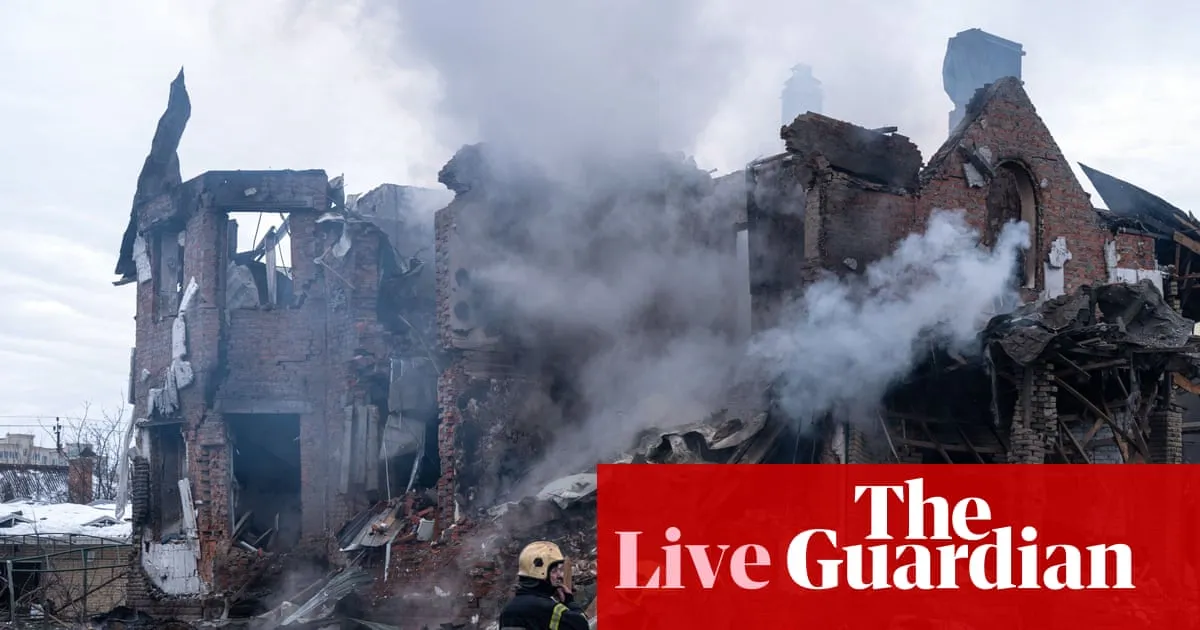
The European Union is unlikely to agree on a 20th package of sanctions against Russia before the fourth anniversary of the Ukraine war due to Hungary's continued opposition. Hungary is blocking the sanctions, as well as a €90 billion loan for Ukraine, due to a dispute over oil transit via the Druzhba pipeline.
Jakub KrupaThe Guardian - World NewsFiled 2026-02-23 · 10:43 GMTLean · Center-LeftRead · 13 min
The Guardian - World NewsFIG 01
Reading time
13min
Word count
3 073words
Sources cited
4cited
Entities identified
12entities
Quality score
100%
§ 01
Briefing Summary
AI-generatedNEWSAR · AI
The European Union is unlikely to agree on a 20th package of sanctions against Russia before the fourth anniversary of the Ukraine war due to Hungary's continued opposition. Hungary is blocking the sanctions, as well as a €90 billion loan for Ukraine, due to a dispute over oil transit via the Druzhba pipeline. Hungarian Foreign Minister Péter Szijjártó stated that oil transit must resume before Hungary allows decisions important to Kyiv to move forward. The failure to agree on the sanctions package is politically embarrassing for the EU, especially as leaders plan to visit Kyiv to mark the anniversary. The situation also comes ahead of Hungary's parliamentary election, where the current prime minister is trailing in the polls and using anti-Ukrainian rhetoric.
Confidence 0.90Sources 4Claims 5Entities 12
§ 02
Article analysis
Model · rule-basedFraming
Political Strategy
Diplomatic
Tone
Measured
AI-assessed
CalmNeutralAlarmist
Factuality
0.70 / 1.00
Factual
LowHigh
Sources cited
4
Well sourced
FewMany
§ 03
Key claims
5 extracted01
Hungarian foreign minister said they won't allow decisions important to Kyiv to move forward until oil transit resumes.
quotePéter Szijjártó
Confidence
1.00
02
Hungary opposes the sanctions and the €90bn loan for Ukraine due to a dispute about oil transit.
factualJakub Krupa
Confidence
1.00
03
EU foreign policy chief Kaja Kallas admitted there will be no progress on the sanctions issue today.
quoteKaja Kallas
Confidence
1.00
04
Hungary is blocking the EU's 20th package of sanctions against Russia.
factualJakub Krupa
Confidence
1.00
05
Viktor Orbán is allegedly using anti-Ukrainian rhetoric to falsely allege a conspiracy to remove him from office.
factualJakub Krupa
Confidence
0.80
§ 04
Full report
13 min read · 3 073 words§ 05
Entities
12 identifiedKey playerOppositionContextPositiveNeutralNegative
People7
Organizations1
§ 06
Keywords & salience
10 termsrussia sanctions
0.90
ukraine war
0.80
hungary
0.80
ukraine
0.70
eu
0.70
oil transit
0.60
druzhba pipeline
0.60
viktor orbán
0.50
european parliament
0.50
eu-us trade deal
0.40
§ 07
Topic connections
Interactive graph Network visualization showing 51 related topics
View Full Graph Person Organization Location Event|Click node to navigate|Edge numbers = shared articles