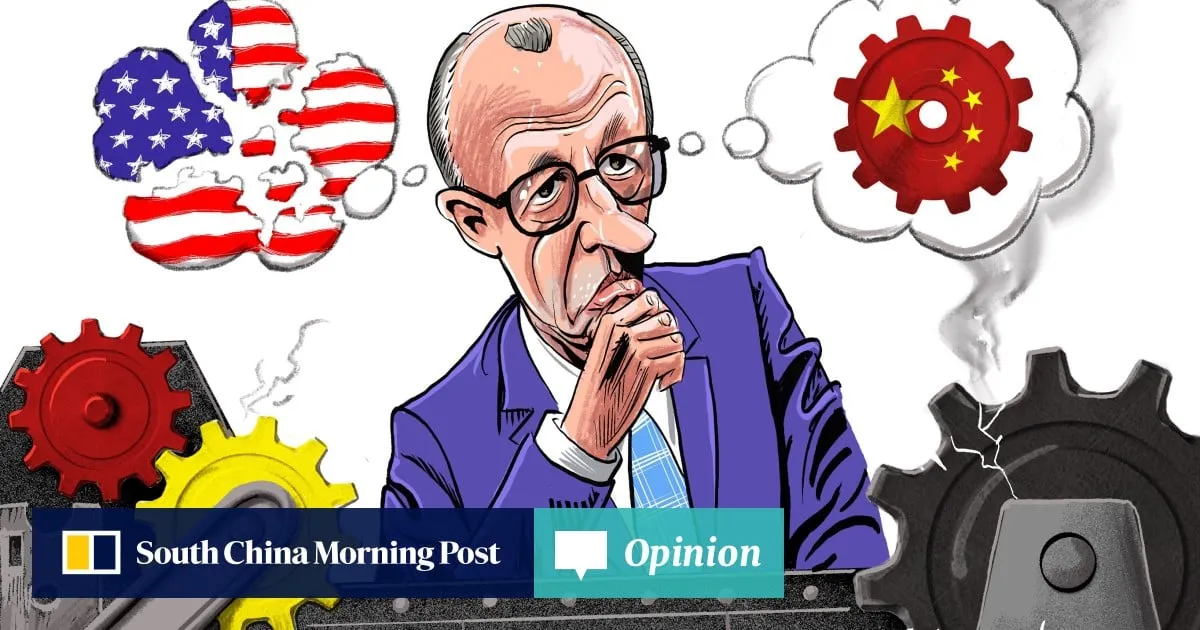
German Chancellor Friedrich Merz, who heads to Beijing this week, had warned last year in relation to China that economic dependencies make Germany “susceptible to blackmail”. As chancellor, he confronts an export model under strain, a deteriorating transatlantic environment and the fiscal reality that moral posturing does not sustain an industrial economy.Merz has never been shy about stating where he stands. As chairman of the non-profit Atlantik-Brucke from 2009 to 2019, he boosted the view that Berlin’s prosperity rests on Washington. His party was outraged in 2022 when then German chancellor Olaf Scholz approved Chinese shipping giant Cosco’s purchase of a 24.9 per cent stake in a terminal at the Hamburg port, branding it a “fatal mistake”. In the opposition, his party framed exposure to China as a strategic error; in government, Merz confronts its scale.In 2025, China displaced the United States to regain its position as Germany’s largest trading partner, with around €252 billion (US$296.9 billion) in trade: €171 billion in imports from and €82 billion in exports to China.An economy anchored in employment, public budgets and a technological edge built on exporting machinery, chemicals and cars might hesitate before recasting relations with its largest trading partner as a question of moral superiority. When prosperity rests on external markets, foreign policy becomes an extension of industrial policy.The sharpest external pressure on Germany has not come from Beijing but from the country Merz most admires. Tariffs on European goods, enforced higher Nato spending, the capitulation that was the US-EU “Agreement on Reciprocal, Fair, and Balanced Trade”, and territorial pressure on Denmark over Greenland have illustrated the costs of asymmetric dependence within an alliance.These measures have not displaced Chinese competition as the central economic test. They have, however, reordered the hierarchy of immediate constraints; Berlin is squeezed from two directions, but the nature of the pressure differs. From Washington comes alliance-based extraction and coercion. From Beijing comes competitive displacement within global value chains.
SRCSouth China Morning Post
LANGEN
OutletPrivately owned · Hong Kong
WORDS322
ENT11
MON · 2026-02-23 · 13:07 GMTBRIEF NSR-2026-0223-18539
NSR-2026-0223-18539Analysis·EN·Political Strategy
Germany’s outreach to China signals a reckoning, rather than a shift
German Chancellor Friedrich Merz is visiting Beijing amid growing concerns about Germany's economic dependence on China. Despite previously warning about China's potential for blackmail and advocating for stronger ties with the U.S., Merz now faces the reality of China being Germany's largest trading partner, with trade totaling around €252 billion in 2023.
Sebastian Contin Trillo-FigueroaSouth China Morning PostFiled 2026-02-23 · 13:07 GMTOutlet · Privately owned · Hong KongRead · 2 min
South China Morning PostFIG 01
Reading time
2min
Word count
322words
Sources cited
1cited
Entities identified
11entities
NEWSAR · AI
German Chancellor Friedrich Merz is visiting Beijing amid growing concerns about Germany's economic dependence on China. Despite previously warning about China's potential for blackmail and advocating for stronger ties with the U.S., Merz now faces the reality of China being Germany's largest trading partner, with trade totaling around €252 billion in 2023. Germany's export-driven economy, reliant on machinery, chemicals, and cars, is hesitant to jeopardize this relationship. Furthermore, pressure from the U.S., including tariffs and demands for higher NATO spending, adds to Germany's economic challenges. While the U.S. exerts pressure through alliance-based coercion, China presents a challenge through competitive displacement within global value chains.
Confidence 0.90Sources 1Claims 5Entities 11
Framing
Political Strategy
Economic Impact
Tone
Measured
AI-assessed
CalmNeutralAlarmist
Factuality
0.60 / 1.00
Mixed
LowHigh
Sources cited
1
Limited
FewMany
01
Germany imported €171 billion from China and exported €82 billion to China.
statistic
Confidence
1.00
02
Trade between Germany and China was around €252 billion (US$296.9 billion).
statistic
Confidence
1.00
03
In 2025, China displaced the United States to regain its position as Germany’s largest trading partner.
factual
Confidence
1.00
04
Economic dependencies make Germany “susceptible to blackmail”.
quoteFriedrich Merz
Confidence
1.00
05
Merz boosted the view that Berlin’s prosperity rests on Washington.
factual
Confidence
0.90
§ 04
Full report
2 min read · 322 wordsKey playerOppositionContextPositiveNeutralNegative
Organizations2
germany-china relations
1.00
economic dependency
0.80
trade relations
0.70
industrial policy
0.60
transatlantic relations
0.60
us-eu trade
0.50
global value chains
0.50
imports
0.40
exports
0.40
§ 07
Connections
Who appears together in the newsIn this articleWider coverageLine weight = articles in common
Laying out network…
Strongest ties articles in common
- 4,854
- 1,809
- 1,738
- 1,175
- 960
- 844