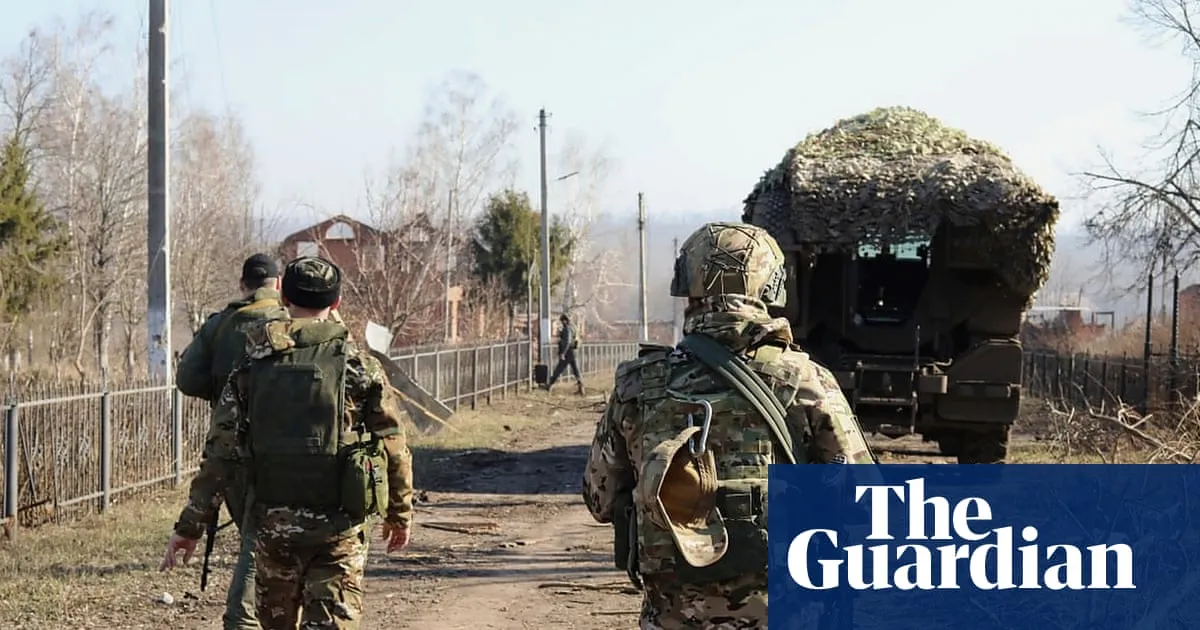
Russia will be able to sustain its invasion of Ukraine throughout 2026 even allowing for emerging economic and manpower pressures, while its missile and drone threat to Europe is growing, according to a leading military thinktank.Bastian Giegerich, the director general of the International Institute for Strategic Studies, said there was “little indication” that “Russia’s ability to continue its war against Ukraine for a fifth year is diminished”.The thinktank reported that the Kremlin spent at least $186bn (£138bn) on defence in 2025, an increase of 3% in real terms, amounting to 7.3% of the country’s GDP – more than double the proportion spent by the US and about three times the level of the UK.Fenella McGerty, a defence finance expert with the thinktank, said that while Russia’s economy was slowing, which could lead to “a potential decline” in real-terms military spending in 2026, it had to be set against several years of sharp growth.Military spending “had doubled in real terms since 2021”, she emphasised, allowing Russia to spend more heavily on military equipment and recruitment to sustain relentless ground and air attacks against Ukraine in the immediate future.Four years ago, Vladimir Putin launched the full-scale invasion of Ukraine. Though Russia’s smaller neighbour did not collapse, the Kremlin reoriented to a war economy, and continued to fight with high intensity despite sustaining more than 1.2 millions casualties killed and wounded.Vladimir Putin during a ceremony at the Kremlin earlier this week. Photograph: Russian Foreign Ministry’s official/APAImages/Shutterstock“Despite western conversations about a sustainable ceasefire agreement, Russia intensifies its attacks on Ukraine’s critical infrastructure and population centres with a mix of cruise and ballistic missiles and one-way attack UAVs [drones],” Giegerich added.Nigel Gould Davies, a Russia expert at the thinktank, said there were “growing signs that Russia’s rate of recruitment has begun to fall short of its monthly losses” on the battlefield, though Moscow has the ability to cut its casualty rate by reducing the tempo of its offensives across the Ukrainian frontline.Gould Davies, a former UK ambassador to Belarus, said if that trend were to be continued it could eventually force the Kremlin to “a moment of truth” where it would have to risk a second enforced mobilisation and risk the scale of social unrest seen during the enlistment of September 2022.Russia recruits an estimated 30,000 to 35,000 people a month, though Gould Davies said he believed its forces’ quality was dropping because recruiters were having to turn to “the alcoholics and the drug addicted, and the frankly sick”.Estimates of Russian casualties are variable. Figures released by the UK MoD earlier this month suggested Russia incurred 35,030 casualties in December and 31,713 in January, somewhat lower than the “nearly 40,000 a month” cited by western officials in a briefing on Monday.Moscow is also using the war to develop new battle tactics, missiles and attack drones, the thinktank said, including a modernised Shahed-136 that could strike targets across Europe to a range of 2,000km, as part an overall military modernisation.Giegerich said that underscored the need for Nato “to increase investments in missile defence and anti-drone systems”, the need for which was demonstrated when 21 Russian drones crossed into Poland last September, closing several airports and forcing people in three regions to be told to shelter indoors.European Nato allies and Canada promised to increased defence budgets to 3.5% by 2035 last summer in response to the growing Russian threat, and demands from the Trump administration that the continent takes primary responsibility for its own security.But the IISS, in its annual review, The Military Balance, cautioned that this would require “sustained and significant investments” that many Nato allies would find hard to reach, given it could require spending cuts and trade off elsewhere.Europe would also take “well into the 2030s” to reduce its military dependance on the US, Giegerich said, because it remained dependent on an unpredictable White House for military intelligence, cloud computing and space assets. Improving air defence was also a priority, he added.
SRCThe Guardian - World News
LANGEN
LEANCenter-Left
WORDS658
ENT7
TUE · 2026-02-24 · 15:09 GMTBRIEF NSR-2026-0224-18914
NSR-2026-0224-18914News Report·EN·National Security
Russia can keep fighting Ukraine war throughout 2026, says military thinktank
A report by the International Institute for Strategic Studies indicates that Russia can sustain its war in Ukraine through 2026, despite emerging economic and manpower pressures. Russia's military spending has doubled since 2021, reaching 7.3% of its GDP in 2025, enabling continued high-intensity attacks.
Dan Sabbagh Defence and security editorThe Guardian - World NewsFiled 2026-02-24 · 15:09 GMTLean · Center-LeftRead · 3 min
The Guardian - World NewsFIG 01
Reading time
3min
Word count
658words
Sources cited
4cited
Entities identified
7entities
Quality score
100%
§ 01
Briefing Summary
AI-generatedNEWSAR · AI
A report by the International Institute for Strategic Studies indicates that Russia can sustain its war in Ukraine through 2026, despite emerging economic and manpower pressures. Russia's military spending has doubled since 2021, reaching 7.3% of its GDP in 2025, enabling continued high-intensity attacks. While Russia's economy is slowing, its substantial prior military spending allows for continued equipment and recruitment. Despite potential recruitment shortfalls, Russia could reduce casualties by slowing offensives. The report also highlights Russia's intensified attacks on Ukrainian infrastructure using missiles and drones, posing a growing threat to Europe.
Confidence 0.90Sources 4Claims 5Entities 7
§ 02
Article analysis
Model · rule-basedFraming
National Security
Economic Impact
Tone
Measured
AI-assessed
CalmNeutralAlarmist
Factuality
0.70 / 1.00
Factual
LowHigh
Sources cited
4
Well sourced
FewMany
§ 03
Key claims
5 extracted01
Military spending had doubled in real terms since 2021.
factualFenella McGerty, defence finance expert
Confidence
1.00
02
The Kremlin spent at least $186bn on defence in 2025, an increase of 3% in real terms.
statisticInternational Institute for Strategic Studies
Confidence
1.00
03
Russia intensifies its attacks on Ukraine’s critical infrastructure and population centres.
factualBastian Giegerich, director general of IISS
Confidence
0.90
04
Russia will be able to sustain its invasion of Ukraine throughout 2026.
predictionInternational Institute for Strategic Studies
Confidence
0.80
05
Russia recruits an estimated 30,000 to 35,000 people a month.
statisticNigel Gould Davies, Russia expert
Confidence
0.70
§ 04
Full report
3 min read · 658 words§ 05
Entities
7 identifiedKey playerOppositionContextPositiveNeutralNegative
Organizations2
§ 06
Keywords & salience
10 termsukraine war
1.00
russia
0.90
military spending
0.80
economic impact
0.70
drone threat
0.60
manpower
0.60
missile threat
0.60
military equipment
0.50
casualty rate
0.50
war economy
0.40
§ 07
Topic connections
Interactive graph Network visualization showing 51 related topics
View Full Graph Person Organization Location Event|Click node to navigate|Edge numbers = shared articles