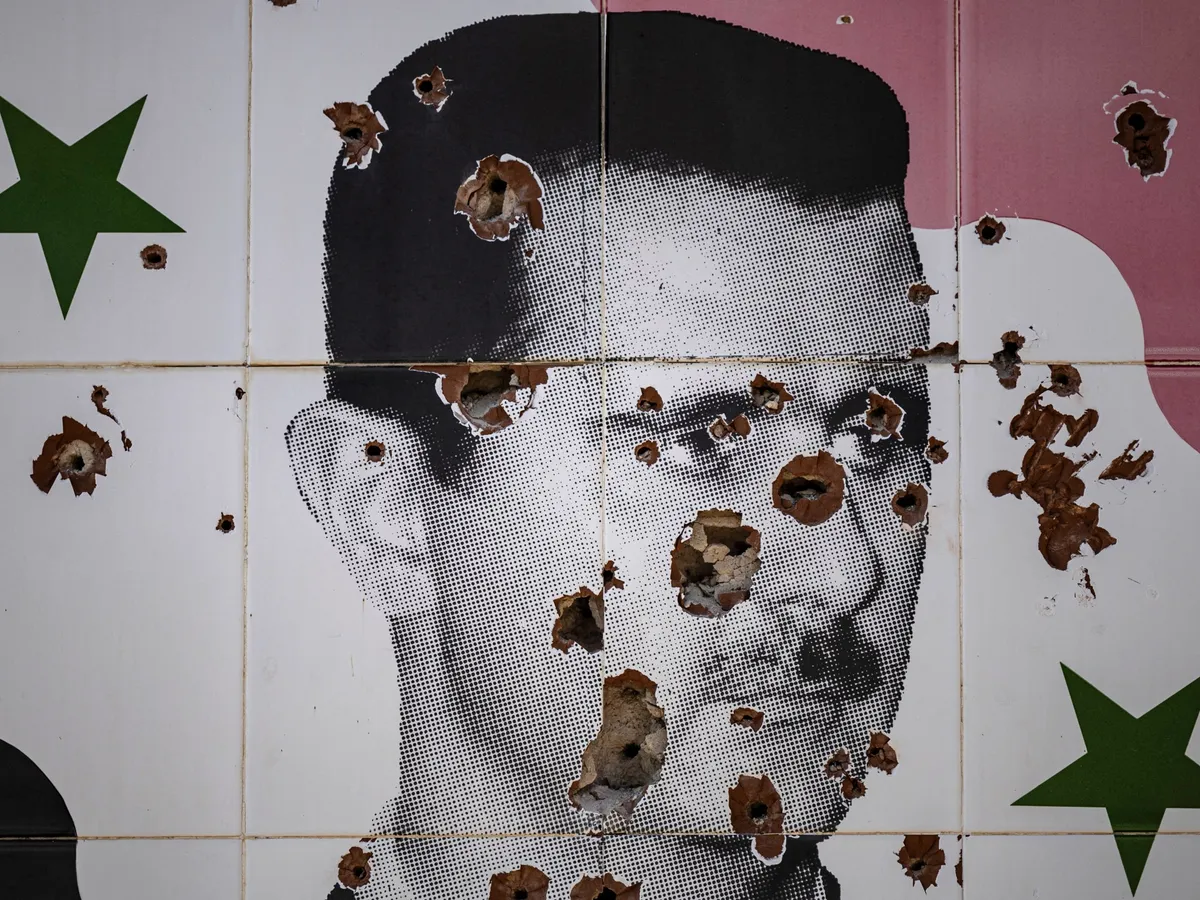
REPORTER'S NOTEBOOKAl Jazeera’s Justin Salhani compares Damascus on the day after al-Assad’s fall with one year later.Nobody our reporter spoke to in Damascus wants Bashar al-Assad back [AFP]Published On 10 Dec 2025Damascus, Syria – On the morning of December 5, 2025, a taxi drove me across the Lebanon-Syria border. This time was different from my first trip across, in the early hours of December 9, 2024, just a day after Bashar al-Assad fled Syria for Moscow.On that day, Syrian Army military vehicles were abandoned on the side of the highway to Damascus. Also abandoned, scattered along the highway’s shoulders, were the uniforms of the men who had once driven them.Recommended Stories list of 3 itemslist 1 of 3Climate change will make the world “much nastier place”list 2 of 3Israeli troops used this Palestinian woman as a human shieldlist 3 of 3Head of Hamas Abroad says Palestinians in Gaza must be given chance to healend of listA year later, they’re all gone. So, too, are the defaced portraits of Bashar and his father Hafez, who ruled the country from 1971 until last year. And gone is a sign I’d photographed a year earlier that read “Assad’s Syria welcomes you”.A photograph of a sign reading ‘Assad’s Syria welcomes you’, taken on December 9, 2024, the day after Bashar al-Assad fled Syria for Moscow [Justin Salhani/Al Jazeera]I was back in Damascus to cover the first anniversary of the fall of the regime. A year later, people return to Umayyad Square to celebrate.This time, armed men are organising the crowds instead of firing their rifles into the air. The muddied SUVs that transported anti-Assad forces into Damascus have been replaced by new security forces vehicles, emblazoned with the new national emblem adopted by Ahmed al-Sharaa’s government.A lot can change in a year. Immediately after the fall, Syrians had a five-decade weight removed from their chests. It had pressed down on their ribs and organs and robbed them of feelings of agency.‘May God protect the government’For years, many Syrians – even in the diaspora – avoided giving their real names or having their photos taken out of fear of repercussions for themselves or loved ones back in Syria.After al-Assad’s fall, many Syrians were eager to express the suppressed thoughts they’d long burrowed away.In Umayyad Square, even though the anniversary was still three days away, people gathered and waved flags and lit fireworks. Many spoke of their joy at the upcoming celebration.“The situation is good, may God protect the government,” said Moataz, a 19-year-old student. “The situation in the last year changed … in every way.”We finished speaking, and I began talking to another student. Then, Moataz approached me and asked me to please not include his family name in the report.Another of his friends refused to be interviewed. Nothing was wrong, they said, they just felt more comfortable that way.Standing next to me was a Canadian colleague. When Moataz’s friend heard he was from Canada, he told him that Syria was good to visit for a week or two, but that it’s better to live in Canada.Most in the square had only ever known one family’s rule. Many, under the age of 25, had only known one man’s rule. Exorcising the trauma and demons, especially those of the years of the uprising and violent suppression, will understandably take time. So will improving the country and its infrastructure.Syrian shop owners I spoke to in the al-Salhiye and al-Hamadiyeh souqs told me that they no longer feared security forces would raid their shops, but that business had largely still not improved. Hopes are high that the lifting of United States sanctions, including the recent repeal of the Caesar Act, might kick-start the economy. But for now, many are living day-to-day or off remittances.A street artist in the al-Salhiye souk in Damascus [Justin Salhani/Al Jazeera]The disappearedOne criticism from activists is that little progress has been made on the issue of the tens of thousands of disappeared Syrians. Portraits of missing persons posted in Damascus’s Marjeh Square were torn down.A year earlier, my colleagues and I had driven towards Sednaya prison north of the city. We parked a couple of kilometres away, as Israeli air strikes exploded in the distance, and carried on by foot towards the prison.There, we found tens of thousands of people looking for any sign, whisper or remnant of their loved ones who had been disappeared in the nefarious Syrian prison network built by the Assad regime over decades. On our way down from the prison, people arriving asked us if there were any prisoners left inside. They did not yet know that all the remaining prisoners had been liberated and that rumours of an underground holding cell were proof of the depths of creative depravity the regime was capable of.That regime is gone. And nobody I spoke to in Damascus wants al-Assad back. That fact alone has made a world of difference to millions of Syrians. However, discussions with shop owners, servers at cafes, a former hotel employee, former prisoners, researchers, students, engineers, taxi drivers and members of the diaspora considering returning home, also highlighted that it will not be enough to rebuild the country.The World Bank estimates reconstruction in Syria needs $216bn. Dozens of areas still lie in ashes and rubble. The economy has yet to take off, and the pledges of financial and political support from international and regional allies have not fully materialised yet.A year on from al-Assad’s fall, some streets are being repaved, gunmen in mismatched fatigues who once roamed the city streets have been replaced by men in matching black uniforms with state insignia. An official sheen has been laid over Damascus. Many locals may match that sheen with their own expressions of joy, but underneath, many are still struggling.To come home or not to come home?Syria is still in a post-war phase.While locals said electricity and infrastructure are improving, walking through unlit streets or alleys is still not uncommon. While visiting a friend in the Muhajreen neighbourhood, he looked at the clock. “The electricity hasn’t come yet today,” he said. “We’ve been getting two hours on and four hours off.”Of course, few people in Damascus miss the days of al-Assad. His mere absence has opened up the possibility of return for thousands of Syrians.Many feel there is an opportunity to help rebuild and reshape the country.About three million Syrians have reportedly returned to the country in the last year. I met a handful during my short trip.Omran, 22, moved back a week ago from Lebanon, where he worked installing solar panels after not seeing his mother or little brother for close to a decade.Abu Taj, 24, came back after 10 years in Saudi Arabia and hopes his family will soon follow. At a dinner near Bab Sharqi, a group energetically discussed the last year, the changes they wanted to see and how they might be part of shaping it.A Syrian-Palestinian researcher who had moved back from Lebanon a few months earlier had her criticisms but felt contagiously optimistic about the direction the country was going in.Others, Syrians living abroad in London, Amman or Istanbul, said they were considering moving back as well. For them, there is finally hope.End the culture of impunityOn December 9, 2024, I visited a villa used by the al-Assads to host guests. In front of the villa was a neatly curated row of fruit trees, bearing kumquats.As locals filtered in and out of the ransacked villa, visiting a location that had previously been off-limits to the public, a man wearing a leather jacket picked kumquats off the trees and sucked the juice from them. He projected his voice for all around to hear, “How sweet this is!”He could have been talking about the fruit or the moment in history.On that day, and for months afterwards, it was common to see men in a variety of colours and patterns of fatigues, patrolling the city or manning checkpoints.Today, they’ve been replaced by men in standardised black uniforms. People are no longer jumping up and down, hugging them and celebrating with them. But in Damascus at least, people didn’t visibly fear them in public.Of course, the past year has also included a variety of lived experiences, including some that are dark.
SRCAl Jazeera
LANGEN
LEANCenter
WORDS1 374
ENT5
WED · 2025-12-10 · 15:00 GMTBRIEF NSR-2025-1210-1917
NSR-2025-1210-1917News Report·EN·Political Strategy
One year after the fall of al-Assad, a reporter returns to Damascus
In December 2025, an Al Jazeera reporter returned to Damascus, Syria, one year after Bashar al-Assad fled to Moscow. The reporter observed significant changes since his previous visit immediately following Assad's departure.
Justin SalhaniAl JazeeraFiled 2025-12-10 · 15:00 GMTLean · CenterRead · 6 min
Al JazeeraFIG 01
Reading time
6min
Word count
1 374words
Sources cited
1cited
Entities identified
5entities
Quality score
100%
§ 01
Briefing Summary
AI-generatedNEWSAR · AI
In December 2025, an Al Jazeera reporter returned to Damascus, Syria, one year after Bashar al-Assad fled to Moscow. The reporter observed significant changes since his previous visit immediately following Assad's departure. Abandoned military vehicles and defaced portraits of the Assad regime were gone. In their place, new security forces vehicles and the new national emblem were visible. People gathered in Umayyad Square to celebrate the upcoming anniversary of the regime's fall. The atmosphere was markedly different, with Syrians expressing relief and a newfound sense of freedom after decades of oppression. The reporter noted that people were eager to express their suppressed thoughts and celebrate without fear.
Confidence 0.90Sources 1Claims 5Entities 5
§ 02
Article analysis
Model · rule-basedFraming
Political Strategy
Human Interest
Tone
Measured
AI-assessed
CalmNeutralAlarmist
Factuality
0.70 / 1.00
Factual
LowHigh
Sources cited
1
Limited
FewMany
§ 03
Key claims
5 extracted01
"The situation is good, may God protect the government," said Moataz, a 19-year-old student.
quoteMoataz
Confidence
1.00
02
Ahmed al-Sharaa's government adopted a new national emblem.
factualAl Jazeera
Confidence
1.00
03
Syrian Army military vehicles were abandoned on the side of the highway to Damascus.
factualAl Jazeera
Confidence
1.00
04
Bashar al-Assad fled Syria for Moscow on December 8, 2024.
factualAl Jazeera
Confidence
1.00
05
Nobody our reporter spoke to in Damascus wants Bashar al-Assad back
quoteAl Jazeera
Confidence
0.80
§ 04
Full report
6 min read · 1 374 words§ 05
Entities
5 identifiedKey playerOppositionContextPositiveNeutralNegative
People3
§ 06
Keywords & salience
8 termsfall of al-assad
1.00
damascus
0.90
syria
0.80
bashar al-assad
0.70
regime change
0.60
political transition
0.50
anniversary
0.50
security forces
0.40
§ 07
Topic connections
Interactive graph Network visualization showing 47 related topics
View Full Graph Person Organization Location Event|Click node to navigate|Edge numbers = shared articles