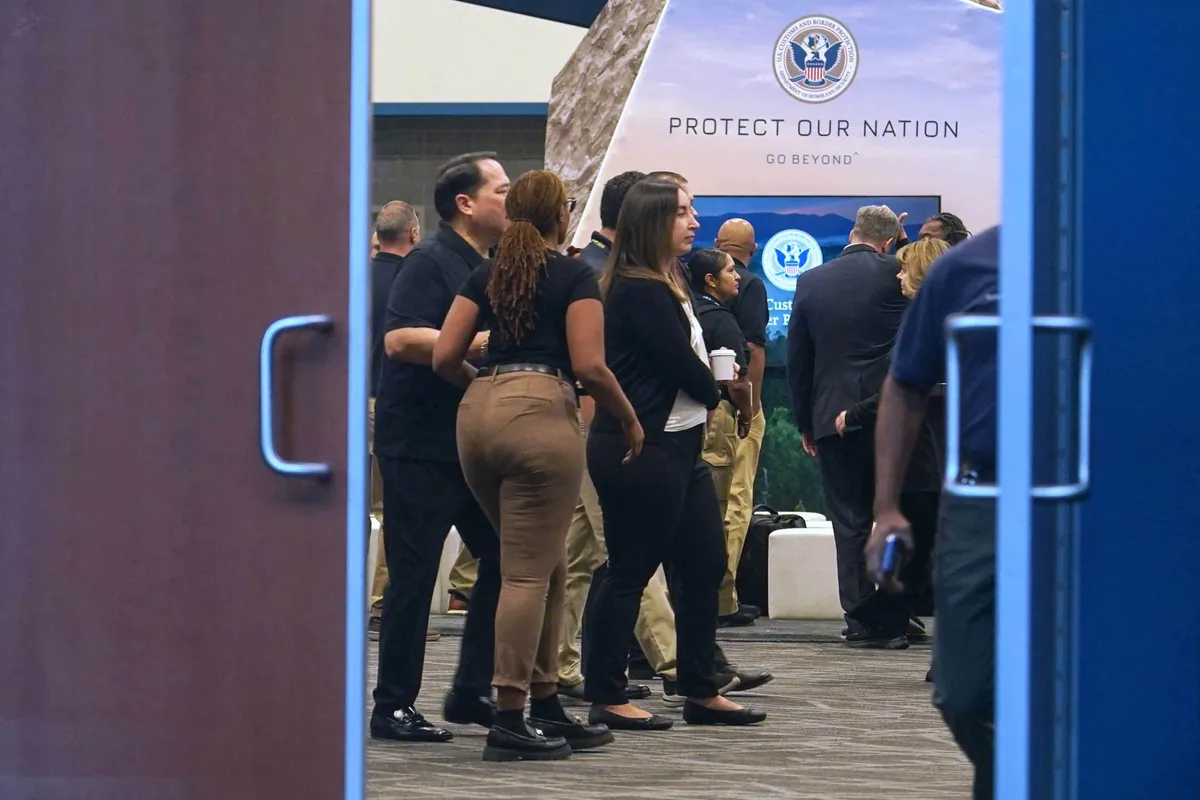
Four House Democrats demanded the top Federal Bureau of Prisons official explain how he plans to address the agency’s “persistent, unsafe conditions” and “pervasive shortage of critical staff,” driven in part by corrections officers fleeing the bureau for more lucrative jobs at Immigration and Customs Enforcement. Outlined in a six-page letter sent Friday to BOP Director William Marshall III, the lawmakers’ questions come after a ProPublica investigation found that workers at federal lockups from Florida to California had been lured away by the $50,000 starting bonus and higher pay at ICE, which more than doubled its number of officers and agents last year during the Trump administration’s monthslong recruiting blitz. The prisons bureau, meanwhile, lost a net of more than 1,800 workers last year. “We are deeply concerned that these developments compromise the safety and security of both inmates and staff,” Reps. Jamie Raskin of Maryland, Lucy McBath of Georgia, Jasmine Crockett of Texas and Joe Neguse of Colorado wrote in their letter. “The shrinking existing workforce has been left to contend with an ever-growing use of overtime, which leads to fatigue, burnout, and increased attrition.” The representatives said that short staffing, in turn, has led to more lockdowns, more violence and less access to recidivism-reducing programs for prisoners. Their letter also raised questions about the cancellation of the union contract, which they noted critics have said “appears retaliatory,” and the ongoing reliance on “augmentation” — the practice of forcing nurses, teachers and plumbers who work in the prisons to fill in as corrections officers — to plug staffing gaps. “We believe these deeply troubling issues require concrete answers,” the lawmakers wrote. They set a 30-day deadline for the bureau to respond in writing. Prison union officials have also pressed the case, urging lawmakers to insist that Marshall and his deputy, Josh Smith, testify before Congress on the issue. The prison agency declined to answer questions from ProPublica about the lawmakers’ letter, saying it would respond directly to Congress. In a statement, a spokesperson said that the BOP “continues to prioritize efforts” to increase staffing, adding that some staff will always have to step in as corrections officers “for the safety and security of staff, inmates and the public.” The BOP has long struggled to hire and retain enough workers to staff its facilities, where roughly 34,700 employees are responsible for more than 138,000 prisoners. As of 2023, union officials said some 40% of corrections officer jobs remained vacant. That same year, the lack of staff helped land the prison system on a government list of high-risk agencies with serious vulnerabilities. As part of a long-term hiring push, the bureau turned to signing bonuses, retention pay and a fast-tracked hiring process. Although those efforts drew in a net of more than 1,200 people in 2024 — the bureau’s largest workforce increase in a decade — the cost of hiring incentives, along with raises, overtime and inflation, strained an already-stagnant budget. Early last year, the agency paused hiring and retention incentives to save money, a move that threatened to undermine the prior year’s staffing gains. Still, the financial strain continued and, by the fall, dozens of staff and prisoners were telling ProPublica about unusual scarcities in facilities across the country. Some prisons fell behind on utility and trash bills, while others ran out of staple foods including eggs and beef. At one point, a prison in Louisiana came within days of running out of food for inmates before union officials intervened and urged agency leaders to fix the problem. In their letter last week, the representatives said they were “alarmed” by the financial shortfalls ProPublica reported, as well as by the worsening staffing figures. Last year, the bureau’s net loss of employees was larger than in any other year since 2017, according to data ProPublica obtained through an open records request. With a dwindling workforce, the bureau’s overtime costs have soared. According to a recent Congressional Research Service report, in 2025 the federal prison system spent more than $387 million on overtime, a number surpassed only once in the past decade. Several prison officials who asked to remain anonymous told ProPublica this month that officers at some facilities are often forced to work two to four double shifts per week, sometimes putting in so many overtime hours that prisoners have expressed concern. “The only ones who like it are the predatory inmates,” one corrections officer told ProPublica. “Inmates don’t like super cops, but they at least want to feel like if they are attacked, someone will see it and stop it as quickly as they can. You ain’t getting that with a CO on a double who can barely keep his eyes open.”Meanwhile, the lawmakers said they were “gravely concerned” about some of the ways BOP leaders have tried to save money and minimize the use of overtime, including by locking down facilities and skimping on staff, which, lawmakers said, the bureau then attempted to cover up.When the Office of Inspector General visited one facility last year, the housing units were all well staffed, “a trick” the lawmakers said was accomplished only by extreme use of augmentation. “Reportedly, after the visit, the facility immediately resumed short-staffing units,” the lawmakers wrote. “Committee staff have reviewed housing unit staffing and augmentation rosters documenting this apparent effort to mislead the OIG.”
SRCProPublica
LANGEN
LEANCenter-Left
WORDS887
ENT10
WED · 2026-02-25 · 17:35 GMTBRIEF NSR-2026-0225-19245
NSR-2026-0225-19245News Report·EN·Political Strategy
Democrats Demand Answers for Federal Prison Staffing Shortage After Corrections Officers Flee for ICE Jobs
Four House Democrats are demanding answers from the Federal Bureau of Prisons (BOP) regarding critical staffing shortages within federal prisons. The lawmakers' letter to BOP Director William Marshall III follows reports of corrections officers leaving for higher-paying jobs at Immigration and Customs Enforcement (ICE), exacerbated by a $50,000 signing bonus.
Keri BlakingerProPublicaFiled 2026-02-25 · 17:35 GMTLean · Center-LeftRead · 4 min
ProPublicaFIG 01
Reading time
4min
Word count
887words
Sources cited
6cited
Entities identified
10entities
Quality score
100%
§ 01
Briefing Summary
AI-generatedNEWSAR · AI
Four House Democrats are demanding answers from the Federal Bureau of Prisons (BOP) regarding critical staffing shortages within federal prisons. The lawmakers' letter to BOP Director William Marshall III follows reports of corrections officers leaving for higher-paying jobs at Immigration and Customs Enforcement (ICE), exacerbated by a $50,000 signing bonus. This exodus, coupled with the loss of over 1,800 BOP workers last year, has led to unsafe conditions, increased overtime, and reduced access to recidivism-reducing programs. The representatives also raised concerns about the cancellation of the union contract and the reliance on "augmentation," where non-corrections staff fill in as officers. The lawmakers have given the BOP 30 days to respond in writing, while the BOP states it is prioritizing efforts to increase staffing.
Confidence 0.90Sources 6Claims 5Entities 10
§ 02
Article analysis
Model · rule-basedFraming
Political Strategy
Human Rights
Tone
Measured
AI-assessed
CalmNeutralAlarmist
Factuality
0.80 / 1.00
Factual
LowHigh
Sources cited
6
Well sourced
FewMany
§ 03
Key claims
5 extracted01
The prisons bureau lost a net of more than 1,800 workers last year.
statistic
Confidence
1.00
02
ICE more than doubled its number of officers and agents last year.
factualProPublica investigation
Confidence
1.00
03
Corrections officers are fleeing the Bureau of Prisons for more lucrative jobs at ICE.
factual
Confidence
1.00
04
Four House Democrats demanded answers for federal prison staffing shortages.
factual
Confidence
1.00
05
Short staffing has led to more lockdowns, more violence and less access to recidivism-reducing programs.
quoteReps. Jamie Raskin, Lucy McBath, Jasmine Crockett and Joe Neguse
Confidence
0.90
§ 04
Full report
4 min read · 887 words§ 05
Entities
10 identifiedKey playerOppositionContextPositiveNeutralNegative
People4
Organizations3
Events1
§ 06
Keywords & salience
10 termsfederal prison staffing shortage
1.00
corrections officers
0.90
immigration and customs enforcement
0.80
bureau of prisons
0.80
staff attrition
0.70
unsafe conditions
0.70
overtime
0.60
prison violence
0.50
recidivism
0.40
augmentation
0.40
§ 07
Topic connections
Interactive graph Network visualization showing 2 related topics
View Full Graph Person Organization Location Event|Click node to navigate|Edge numbers = shared articles