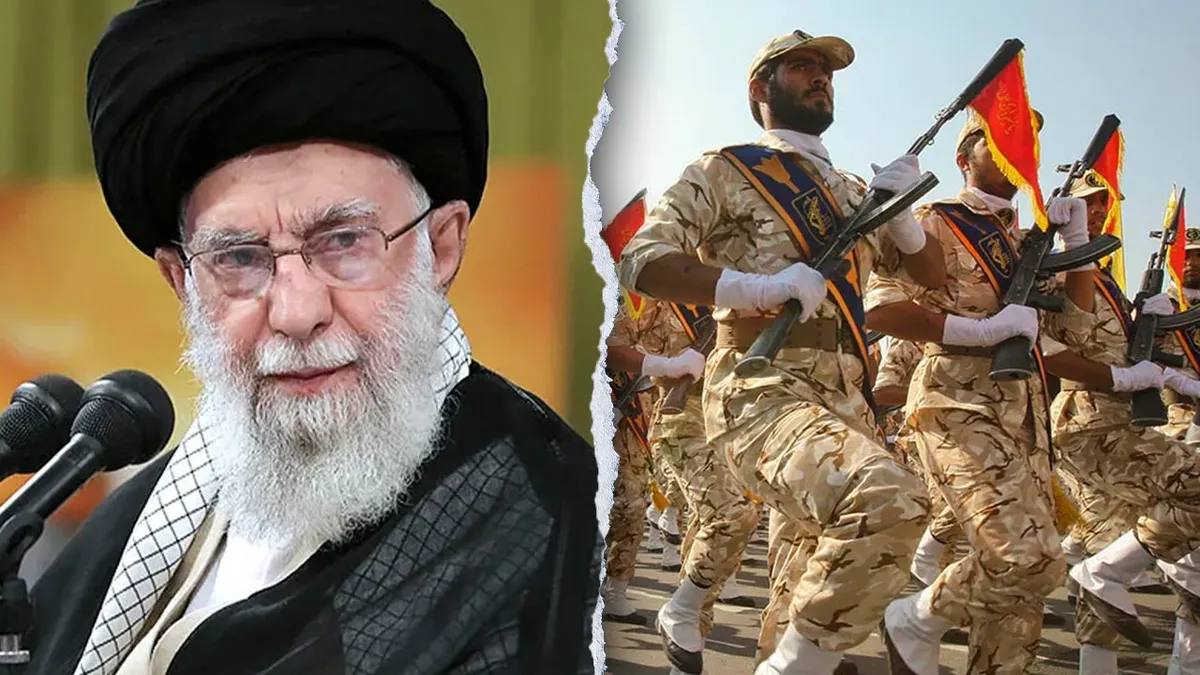
FIRST ON FOX: A new report detailing the inner workings of Ayatollah Ali Khamenei ’s office says the Islamic Republic’s real command structure lies not in Iran’s visible government, but in a shadow apparatus designed to preserve regime control even if the supreme leader himself disappears from public view. The report , Unmasking the Bayt: Inside the Supreme Leader’s Office, published by United Against Nuclear Iran (UANI) and authored by Saeid Golkar and Kasra Aarabi, describes the Bayt, the Office of the Supreme Leader, as a vast institutional network embedded across Iran’s military, economy, religious institutions and state bureaucracy. "It is the hidden nerve center of the regime in Iran … it operates as a state within a state," Aarabi said in an interview with Fox News Digital. WITKOFF WARNS Iran IS ‘A WEEK AWAY’ FROM 'BOMB-MAKING MATERIAL' AS TRUMP WEIGHS ACTION According to Aarabi, the system allows Khamenei to oversee and influence decision-making at every level of the Islamic Republic, including nuclear policy, war planning and internal security. "This is what gives Khamenei absolute control. It’s not the visible state, this is the invisible state," he said. The report estimates roughly 4,000 people operate inside the Bayt’s core structure, with tens of thousands more working through affiliated institutions across the country. "There’s around 4,000 close employees… think of them as commissars… the real policymakers," Aarabi said. "Beyond that, the Bayt’s umbrella has 40,000 individuals working for it… entrenched at every single layer of policy, every single state entity." The report maps a tightly controlled inner circle at the top of the Bayt, including Khamenei’s sons, particularly Mojtaba Khamenei, who is described as operating like a "mini-supreme leader" within his father’s office. It details how the structure reaches directly into Iran’s military chain of command, with senior promotions requiring approval from the Supreme Leader’s office and parallel counterintelligence bodies monitoring loyalty across the armed forces. The Bayt, the report says, also plays a decisive role in nuclear negotiations and wartime decision-making, ensuring ultimate authority remains concentrated around the supreme leader. The network, Aarabi said, effectively duplicates state ministries inside Khamenei’s office, allowing direct oversight and ideological enforcement across government agencies, universities and cultural institutions. TRUMP ISSUES STERN Iran WARNING AS TEHRAN ANGRILY REACTS TO SPEECH AMID MUTED WORLD REACTION The report also outlines how the Bayt sustains regime durability through control of the economy, religious institutions and the education system. Networks of foundations and conglomerates tied to the supreme leader oversee major sectors of Iran’s economy, while clerical institutions, universities and cultural bodies are monitored by embedded representatives tasked with enforcing ideological compliance and suppressing dissent. "Think of the Bayt as the nucleus of the core power of the regime," Aarabi said. The findings come amid renewed speculation about Khamenei’s health and reduced public visibility, as well as growing regional tensions and the possibility of military confrontation involving Iran. Aarabi pushed back on suggestions that Khamenei’s absence from public appearances signals weakening authority or internal fragmentation. "We saw this during the 12-day war … even if he is hiding in a bunker, he is in full control. The Bayt has been tightening Khamenei’s grip on power," he said. The structure, he argued, was deliberately built to function even without the supreme leader physically present. "Even if he is eliminated, the Bayt as an institution enables the supreme leader to function," Aarabi said. "Think of the supreme leader as an institution rather than just a single individual." The report places the Bayt at the top of Iran’s power hierarchy, above the Islamic Revolutionary Guard Corps and the formal government. PRESIDENT TRUMP’S Iran WARNING IS SERIOUS — BUT AMERICANS NEED THE FULL FACTS "The Bayt is the core apparatus… the strategic policymaking body that is driving the ballistic missile program, the nuclear program , [and] regional destabilization," Aarabi said. The implications, he added, are significant for policymakers in Washington and across the region, particularly as the U.S. weighs options for confronting Iran’s nuclear program and regional activities. "Eliminating Khamenei in isolation on its own is not enough… you have to dismantle this extensive apparatus that he has created," Aarabi said. Instead, any effort to weaken the regime would require targeting the broader institutional structure surrounding the supreme leader, not just the individual at its center. "It involves a comprehensive strategy… cyber operations, sanctions, [and] a military component," he said. "For any meaningful change in Iran… you have to go after the core nucleus of power within the Islamic regime, and that is the Bayt." He said on reports of Khamenei being a target that, "the elimination of Khamenei alone is not enough… dismantling the extensive apparatus of the Bayt is essential," he added.
SRCFox News - World
LANGEN
LEANCenter-Right
WORDS781
ENT9
WED · 2026-02-25 · 23:04 GMTBRIEF NSR-2026-0226-19320
NSR-2026-0226-19320News Report·EN·National Security
Iran's supreme leader runs 'state within a state' through secret 4,000-person network, report says
A new report by United Against Nuclear Iran (UANI) reveals that Iran's Supreme Leader, Ayatollah Ali Khamenei, controls a vast, clandestine network known as the Bayt, or Office of the Supreme Leader. This 4,000-person organization, with tens of thousands more affiliated, operates as a "state within a state," exerting influence across Iran's military, economy, religious institutions, and state bureaucracy.
Efrat LachterFox News - WorldFiled 2026-02-25 · 23:04 GMTLean · Center-RightRead · 4 min
Fox News - WorldFIG 01
Reading time
4min
Word count
781words
Sources cited
2cited
Entities identified
9entities
Quality score
100%
§ 01
Briefing Summary
AI-generatedNEWSAR · AI
A new report by United Against Nuclear Iran (UANI) reveals that Iran's Supreme Leader, Ayatollah Ali Khamenei, controls a vast, clandestine network known as the Bayt, or Office of the Supreme Leader. This 4,000-person organization, with tens of thousands more affiliated, operates as a "state within a state," exerting influence across Iran's military, economy, religious institutions, and state bureaucracy. The Bayt allows Khamenei to maintain absolute control over decision-making, including nuclear policy, war planning, and internal security. Senior military promotions require the Supreme Leader's approval, and parallel counterintelligence bodies monitor loyalty. The Bayt also duplicates state ministries, enabling direct oversight of government agencies, universities, and cultural institutions.
Confidence 0.90Sources 2Claims 5Entities 9
§ 02
Article analysis
Model · rule-basedFraming
National Security
Political Strategy
Tone
Mixed Tone
AI-assessed
CalmNeutralAlarmist
Factuality
0.60 / 1.00
Mixed
LowHigh
Sources cited
2
Limited
FewMany
§ 03
Key claims
5 extracted01
Senior military promotions require approval from the Supreme Leader’s office.
factualUANI Report
Confidence
0.90
02
Ayatollah Ali Khamenei’s office operates as a 'state within a state'.
quoteKasra Aarabi
Confidence
0.90
03
The Bayt's umbrella has 40,000 individuals working for it.
statisticKasra Aarabi
Confidence
0.80
04
The Bayt has around 4,000 close employees.
statisticKasra Aarabi
Confidence
0.80
05
Mojtaba Khamenei is described as operating like a 'mini-supreme leader'.
quoteUANI Report
Confidence
0.70
§ 04
Full report
4 min read · 781 words§ 05
Entities
9 identifiedKey playerOppositionContextPositiveNeutralNegative
People5
Organizations3
Locations1
§ 06
Keywords & salience
10 termssupreme leader
1.00
iran
0.90
state within a state
0.90
khamenei
0.80
bayt
0.80
regime control
0.70
nuclear policy
0.60
internal security
0.50
military
0.50
islamic republic
0.40
§ 07
Topic connections
Interactive graph Network visualization showing 51 related topics
View Full Graph Person Organization Location Event|Click node to navigate|Edge numbers = shared articles