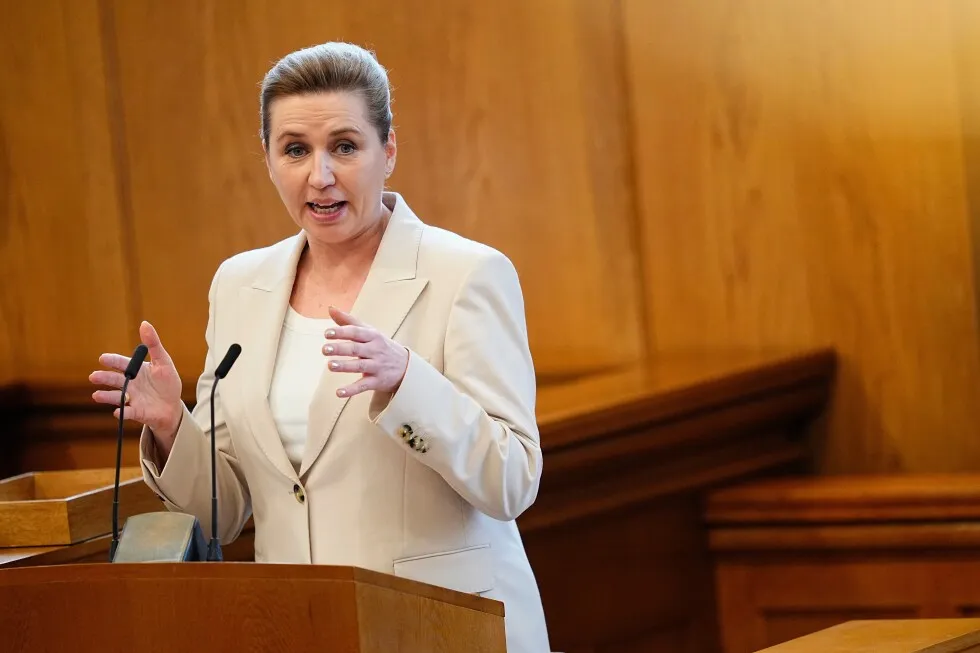
Denmark calls an early election following tense US-Greenland standoff 1 of 2 | Danish Prime Minister Mette Frederiksen announces an upcoming parliamentary election, in the Parliament Hall at Christiansborg, in Copenhagen, Thursday, Feb. 26, 2026. (Thomas Traasdahl/Ritzau Scanpix via AP) 2 of 2 | Danish Prime Minister Mette Frederiksen announces an upcoming parliamentary election, in the Parliament Hall at Christiansborg, in Copenhagen, Thursday, Feb. 26, 2026. (Thomas Traasdahl/Ritzau Scanpix via AP) 1 of 2 Danish Prime Minister Mette Frederiksen announces an upcoming parliamentary election, in the Parliament Hall at Christiansborg, in Copenhagen, Thursday, Feb. 26, 2026. (Thomas Traasdahl/Ritzau Scanpix via AP) Add AP News on Google Add AP News as your preferred source to see more of our stories on Google. 2 of 2 Danish Prime Minister Mette Frederiksen announces an upcoming parliamentary election, in the Parliament Hall at Christiansborg, in Copenhagen, Thursday, Feb. 26, 2026. (Thomas Traasdahl/Ritzau Scanpix via AP) Add AP News on Google Add AP News as your preferred source to see more of our stories on Google. Updated [hour]:[minute] [AMPM] [timezone], [monthFull] [day], [year] Copenhagen, Denmark (AP) — Danish Prime Minister Mette Frederiksen on Thursday called an early general election for March 24, as the country digests a standoff with U.S. President Donald Trump, who has designs on Greenland, a semiautonomous territory of Denmark. Voters in the Scandinavian country, a NATO and European Union member, will determine who sits in the Folketing, or parliament. It has 179 seats — 175 of which go to lawmakers representing Denmark and two apiece to lawmakers from Greenland and the kingdom’s other semiautonomous territory, the Faroe Islands.“It is now up to you, the voters, to decide what direction Denmark will take over the next four years. And I am looking forward to it,” Frederiksen, 48, said as she made her announcement in parliament. The US-Greenland crisis has dominated Danish politics for monthsTrump’s push for U.S. control of Greenland, which culminated in his short-lived threat last month to impose new tariffs on Denmark and several other European countries, was a major challenge for the Danish government over the past year.Frederiksen likely hopes that her handling of the Greenland crisis, in which she appeared straight-talking and tough, will give her a boost with Danish voters. Last month, she warned that an American takeover of Greenland would amount to the end of the NATO military alliance.Polls also show a bump in the popularity of the prime minister’s Social Democrats during recent weeks which were dominated by the looming Greenland crisis. Some Danish citizens have been so upset with the U.S. president’s frequent talks about seizing Greenland that they participated in protests and even boycotted American goods in supermarkets. After Trump backed down on his Greenland threats last month, the U.S., Denmark and Greenland started technical talks on an Arctic security deal. Still, the prime minister made clear earlier this month that she remains wary about the Greenland issue. Asked at the Munich Security Conference whether the crisis had passed, she replied: “No, unfortunately not. I think the desire from the U.S. president is exactly the same. He is very serious about this theme.” Frederiksen, a center-left Social Democrat, has become known for her strict immigration policies, which are among the toughest in Europe.Last month, her government unveiled a legal reform allowing the deportation of foreigners who have been sentenced to at least one year of unconditional imprisonment for serious crimes Years before other countries on the continent tried to outsource asylum request procedures to third countries or set up so-called “return hubs” for rejected asylum seekers outside the European Union, Fredriksen pitched such ideas.A general election must be held at least every four years but the prime minister can call one at any time. The last election was held on Nov. 1, 2022, and resulted in a three-party coalition that crosses the left-right divide.
SRCAssociated Press (AP)
LANGEN
LEANCenter
WORDS641
ENT9
THU · 2026-02-26 · 12:23 GMTBRIEF NSR-2026-0226-19531
NSR-2026-0226-19531News Report·EN·Political Strategy
Danish prime minister calls a parliamentary election on March 24
Danish Prime Minister Mette Frederiksen announced a parliamentary election to be held on March 24, 2026. The election will determine the composition of the 179-seat Folketing, Denmark's parliament.
By
JAMES BROOKS and KIRSTEN GRIESHABERAssociated Press (AP)Filed 2026-02-26 · 12:23 GMTLean · CenterRead · 3 min
Associated Press (AP)FIG 01
Reading time
3min
Word count
641words
Sources cited
1cited
Entities identified
9entities
Quality score
100%
§ 01
Briefing Summary
AI-generatedNEWSAR · AI
Danish Prime Minister Mette Frederiksen announced a parliamentary election to be held on March 24, 2026. The election will determine the composition of the 179-seat Folketing, Denmark's parliament. Frederiksen cited the need for voters to decide the country's direction for the next four years. The early election comes after a period of political tension stemming from a standoff with the U.S. over Greenland, a semiautonomous Danish territory. Frederiksen's handling of the Greenland situation is expected to be a key factor influencing voters.
Confidence 0.90Sources 1Claims 5Entities 9
§ 02
Article analysis
Model · rule-basedFraming
Political Strategy
Diplomatic
Tone
Measured
AI-assessed
CalmNeutralAlarmist
Factuality
0.80 / 1.00
Factual
LowHigh
Sources cited
1
Limited
FewMany
§ 03
Key claims
5 extracted01
Trump's push for U.S. control of Greenland culminated in a threat to impose tariffs on Denmark.
factualAP
Confidence
1.00
02
Frederiksen said voters will decide the direction Denmark will take over the next four years.
quoteMette Frederiksen
Confidence
1.00
03
The Folketing has 179 seats, with 175 for Denmark and 2 each for Greenland and the Faroe Islands.
factualAP
Confidence
1.00
04
The election follows a standoff with U.S. President Donald Trump over Greenland.
factualAP
Confidence
1.00
05
Danish Prime Minister Mette Frederiksen called an early general election for March 24.
factualAP
Confidence
1.00
§ 04
Full report
3 min read · 641 words§ 05
Entities
9 identifiedKey playerOppositionContextPositiveNeutralNegative
§ 06
Keywords & salience
9 termsparliamentary election
1.00
danish prime minister
0.80
denmark
0.80
greenland
0.70
us-greenland standoff
0.70
mette frederiksen
0.60
politics
0.50
donald trump
0.50
parliament
0.40
§ 07
Topic connections
Interactive graph Network visualization showing 51 related topics
View Full Graph Person Organization Location Event|Click node to navigate|Edge numbers = shared articles