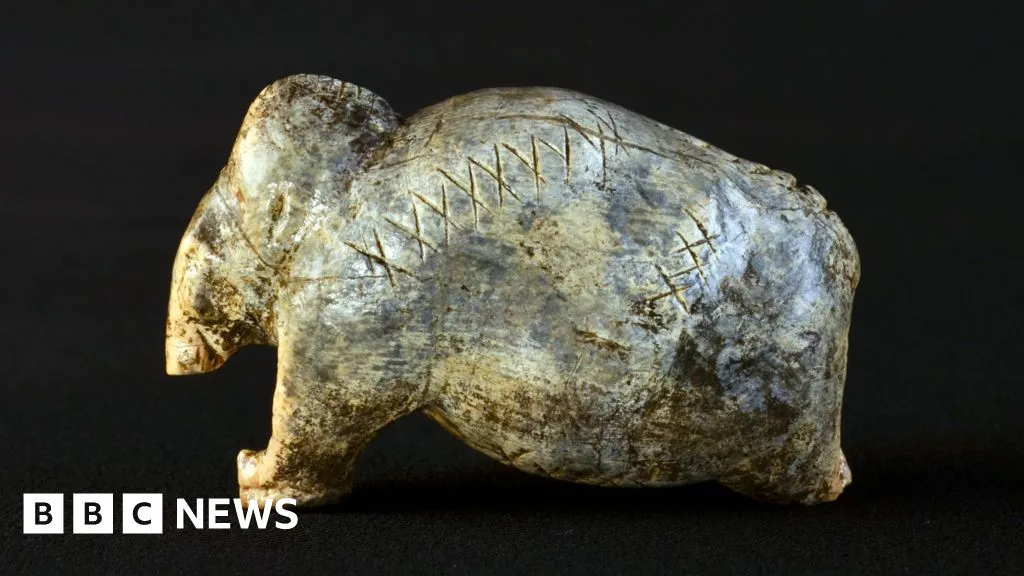
First writing may be 40,000 years earlier than thought3 hours agoGeorgina RannardScience reporterUniversity of Tübingen / Hildegard JensenA 40,000-year-old mammoth figurine with engraved rows of crosses and dotsThe history of writing down thoughts and feelings could be tens of thousands of years older than previously believed, surprising archaeologists who made the discovery.The researchers discerned patterns of meaning in lines, notches, dots, and crosses on objects like mammoth tusks as old as 45,000 years in caves in Germany.Traditionally historians date the first written words to proto-cuneiform scripts made around 5,000 years ago in ancient Iraq, or Mesopotamia.The precise meaning of the symbols in Germany remains a mystery.The objects are from just before Homo sapiens moved to Europe from Africa where they interacted with Neanderthals.Until now it was thought that writing developed in Mesopotamia around 3,000 BCE, followed by hieroglyphics in Egypt and later in China and Mesoamerica."The Stone Age sign sequences are an early alternative to writing," says Prof Christian Bentz from Saarland University, an author of the new research.The work suggests that Stone Age people were as clever as modern-day humans, according to researcher Ewa Dutkiewicz from Berlin's Museum of Prehistory and Early History."So far, we've only scratched the surface of what can be found in terms of symbol sequences on a wide variety of artifacts," she says.The team analysed more than 3,000 characters on 260 objects to uncover what they call the DNA of writing.Some of the objects are from a 37-km long cave system called the Lonetal in Baden-Württemberg, southern Germany.Landesmuseum Württemberg / Hendrik ZwietaschThe so-called "adorant" has a human-like figure and several rows of notches and dots. On a small mammoth carved from tusk, the researchers analysed carefully engraved rows of crosses and dots.And on an artefact called "adorant" from the Geißenklösterle cave in the Achtal valley, they identified rows of dots and notches on an ivory plaque showing a lion-human creature.They believe the arrangement of the marks, in particular the dots on the back, show the patterns acted as communication.The researchers believe that Stone Age people deliberately carved these symbols to communicate messages, meaning, and convey thoughts.Staatliche Museen zu Berlin, Vorderasiatisches Museum / Olaf M. TesmerA proto-cuneiform tablet from around 3350 years ago "Our results also show that the hunter-gatherers of the Paleolithic era developed a symbol system with a statistically comparable information density to the earliest proto-cuneiform tablets from ancient Mesopotamia – a full 40,000 years later," says Bentz.The clue to finding meaning is in the density of the symbols. They found high repetition of the signs and predictability in the subsequent symbols that is "comparable to much later proto-cuneiform," according to Bentz.They found denser patterns on figurines than on tools.The team say that it shows that communicating information was very important for Paleolithic people."They were skilled craftspeople. You can tell they carried the objects with them. Many of them fit very well in the hand, just the right size to fit in the palm," says Dutkiewicz.The research is published in the journal PNAS.
SRCBBC News - World
LANGEN
LEANCenter
WORDS499
ENT10
THU · 2026-02-26 · 12:02 GMTBRIEF NSR-2026-0226-19549
NSR-2026-0226-19549News Report·EN·Technology
First writing may be 40,000 years earlier than thought
Researchers at the University of Tübingen have made a significant discovery that challenges traditional views on the origins of writing. The team analyzed over 3,000 characters on 260 objects from Germany's Lonetal cave system and found evidence of patterns of meaning in lines, notches, dots, and crosses dating back around 45,000 years.
BBC News - WorldFiled 2026-02-26 · 12:02 GMTLean · CenterRead · 2 min
BBC News - WorldFIG 01
Reading time
2min
Word count
499words
Sources cited
3cited
Entities identified
10entities
Quality score
100%
§ 01
Briefing Summary
AI-generatedNEWSAR · AI
Researchers at the University of Tübingen have made a significant discovery that challenges traditional views on the origins of writing. The team analyzed over 3,000 characters on 260 objects from Germany's Lonetal cave system and found evidence of patterns of meaning in lines, notches, dots, and crosses dating back around 45,000 years. This is tens of thousands of years earlier than previously believed, with the earliest known written words attributed to proto-cuneiform scripts made around 5,000 years ago in ancient Iraq. The discovery suggests that Stone Age people were capable of complex communication, and the team believes they deliberately carved these symbols to convey messages and thoughts. The precise meaning of the symbols remains a mystery, but the findings provide new insights into the evolution of writing.
Confidence 0.90Sources 3Claims 5Entities 10
§ 02
Article analysis
Model · rule-basedFraming
Technology
Human Interest
Tone
Measured
AI-assessed
CalmNeutralAlarmist
Factuality
0.80 / 1.00
Factual
LowHigh
Sources cited
3
Well sourced
FewMany
§ 03
Key claims
5 extracted01
The team analysed more than 3,000 characters on 260 objects to uncover what they call the DNA of writing.
factualThe team
Confidence
1.00
02
Traditionally historians date the first written words to proto-cuneiform scripts made around 5,000 years ago in ancient Iraq.
factualhistorians
Confidence
1.00
03
Patterns of meaning were discerned in lines, notches, dots, and crosses on objects as old as 45,000 years in caves in Germany.
factualresearchers
Confidence
1.00
04
The hunter-gatherers of the Paleolithic era developed a symbol system with a statistically comparable information density to proto-cuneiform.
quoteBentz
Confidence
0.90
05
The Stone Age sign sequences are an early alternative to writing.
quoteProf Christian Bentz from Saarland University
Confidence
0.90
§ 04
Full report
2 min read · 499 words§ 05
Entities
10 identifiedKey playerOppositionContextPositiveNeutralNegative
Organizations1
§ 06
Keywords & salience
7 termswriting
0.80
stone age
0.70
proto-cuneiform
0.60
neanderthals
0.50
symbol sequences
0.50
cuneiform scripts
0.40
homo sapiens
0.40
§ 07
Topic connections
Interactive graph No topic relationship data available yet. This graph will appear once topic relationships have been computed.