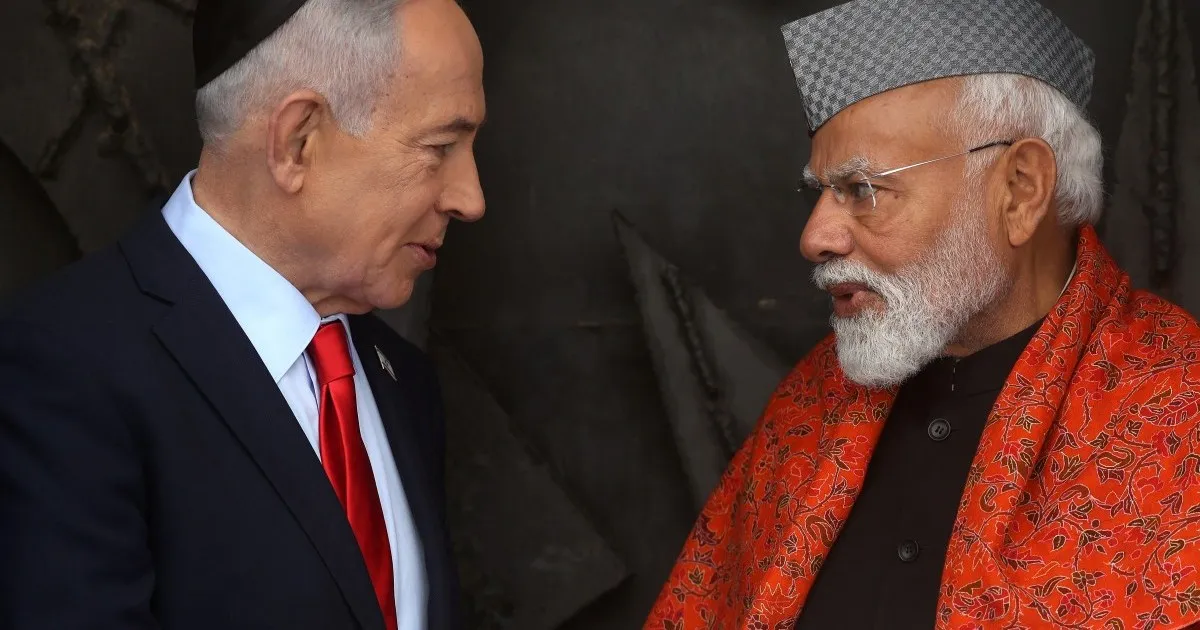
EXPLAINERIndian PM throws his weight behind Israel’s Netanyahu even as genocide continues in occupied Palestinian territory.Indian Prime Minister Narendra Modi, right speaks with his Israeli counterpart, Benjamin Netanyahu, after paying respects before the eternal flame at the Hall of Remembrance during his visit to the Yad Vashem Holocaust Memorial Museum in Jerusalem on February 26, 2026 [Ilia Yefimovich/AFP]Published On 26 Feb 2026Indian Prime Minister Narendra Modi has wrapped up a two-day visit to Israel, which was marked by a welcoming embrace from his counterpart, Benjamin Netanyahu, and a conspicuous silence about Israel’s genocidal war in occupied Palestinian territory.During the visit, which began on Wednesday, the two leaders lauded their strong friendship, which they said has deepened bilateral ties, and signed agreements on a range of issues, including innovation and agriculture.“You are a great friend of Israel, … Narendra. You are more than a friend. You are a brother,” Netanyahu told Modi when both leaders addressed the Israeli parliament in Jerusalem on Wednesday.Netanyahu showed Modi around Yad Vashem, a memorial in Jerusalem to the victims of the Holocaust, and hosted a dinner after they had spoken to the Knesset, where Modi was conferred with the parliament’s highest honour.This was the second ever visit by an Indian prime minister to Israel after Modi’s first visit in 2017. That time, he also did not visit Palestine despite India’s long history of supporting the Palestinian cause.While India opposed the creation of Israel in 1948 and formalised diplomatic relations only in 1992, relations between the two countries have improved since then, flourishing particularly since Modi became India’s prime minister in 2014.Since then, their ties have blossomed, anchored in defence and the shared nationalistic leanings of their leaders.Here are five key takeaways from Modi’s trip to Israel:Netanyahu greets Modi during a special session of the Knesset on February 25, 2026 [Ronen Zvulun/Reuters]Full support for Israel, silence on Gaza genocideWednesday was the first time an Indian leader had addressed the Knesset. Modi received a standing ovation after declaring: “India stands with Israel firmly, with full conviction, in this moment and beyond.”Modi told the Israeli parliament that he carries “the deepest condolences of the people of India for every life lost and for every family whose world was shattered in the barbaric terrorist attack by Hamas on October 7” in 2023.“We feel your pain. We share your grief. India stands with Israel firmly, with full conviction, in this moment and beyond,” he said. “No cause can justify the murder of civilians. Nothing can justify terrorism.”The Indian prime minister referred to the Mumbai attacks in 2008, which New Delhi has blamed on neighbouring Pakistan, saying: “Like you, we have a consistent and uncompromising policy of zero tolerance for terrorism with no double standards.”Modi also threw his weight behind United States President Donald Trump’s 20-point Gaza peace plan, stating that India “supports all efforts that contribute to durable peace and regional stability”.While Modi said he backed “dialogue, peace and stability in the region”, he skipped any mention of the continuing genocide in Gaza, where the Israeli army has killed more than 72,000 Palestinians since October 2023.Anwar Alam, a senior fellow at the Policy Perspective Foundation, a think tank in New Delhi, said the timing of Modi’s visit is “too poor and has grossly compromised India’s historical pro-Palestine stand”.Alam argued that while New Delhi, a leader of the anticolonial nonalignment movement, can continue to maintain ties with Tel Aviv, “India cannot allow itself to display such insensitivity to Palestinian sufferings and stand with the coloniser.”Modi signs the guestbook at Yad Vashem as Netanyahu and Dani Dayan, chairman of the Yad Vashem Holocaust Memorial Museum, watch on February 26, 2026 [Ilia Yefimovich/AFP]Modi emphasises ‘civilisational ties’ with IsraelOne reason Modi, unlike previous Indian leaders, has displayed such warmth towards the Israeli prime minister is the Indian Hindu right’s enthusiasm for the ideology of Zionism, analysts said.Modi’s Bharatiya Janata Party (BJP) has roots in a philosophy, Hindutva, which ultimately seeks to transform India into a Hindu nation and a natural homeland for Hindus anywhere in the world – similar to Israel’s view of itself as a Jewish homeland.During his speech to the Knesset, therefore, Modi doubled down on what he called the “civilisational ties” between the two nations. He started his address to the Knesset by announcing himself as “a representative of one ancient civilisation addressing another”.“We are both ancient civilisations, and it is perhaps no surprise that our civilisational traditions also reveal philosophical parallels,” he said, quoting the Israeli “principle of ‘tikkun olam’ about healing the world”.“In India, there is great admiration for Israel’s resolve, courage and achievements,” Modi said. “Long before we related to each other as modern states, we were linked by ties that go back more than 2,000 years.”Modi mused about “returning to a land to which I have always felt drawn”. “After all, I was born on the same day that India formally recognised Israel – September 17, 1950.”While India formally recognised Israel in 1950, two years after its formation, it only established diplomatic relations with it in 1992.Modi disembarks as he arrives at Ben Gurion International Airport near Tel Aviv, Israel, on February 25, 2026 [Shir Torem/Reuters]Deepening defence tiesThese days, India is Israel’s largest weapons buyer, pumping billions of dollars into Israel’s defence industry each year. In 2024 as Israel waged its war on Gaza, Indian weapons firms sold Israel rockets and explosives, according to an Al Jazeera investigation.On Thursday, Modi held talks with Netanyahu focused on further boosting ties in the areas of defence and security along with trade, technology and agriculture.“We have decided to establish the Critical and Emerging Technologies Partnership. This will give new momentum to cooperation in areas such as AI, quantum, and critical minerals,” Modi said. The two countries are also currently negotiating a free trade agreement.Elevating strategic tiesIndia and Israel are reportedly inching closer to an alliance, along with other global powers, to boost security cooperation.Before Modi’s visit, Netanyahu pitched a “hexagon of alliances” that he said would include India, Greece, Cyprus and other unnamed Arab, African and Asian states to collectively stand against what he called “radical” Shia and Sunni Muslim “axes” of adversaries in the region.Modi has not confirmed this plan but did call for cooperation on multilateral projects, including the India-Middle East-Europe Economic Corridor (IMEC) and the I2U2, consisting of India, Israel, the United Arab Emirates and US.The IMEC envisions connecting India with the Middle East and Europe through an integrated rail and shipping corridor. The economic corridor would pass through India, the UAE, Jordan, Saudi Arabia, Israel and Europe. It was unveiled in September 2023 during a Group of 20 summit in New Delhi.“IMEC is very ambitious in bringing together these countries in ways that at one point would have been incomprehensible,” said Harsh Pant, vice president of the Observer Research Foundation, a New Delhi-based think tank. “Today, it has become possible because India’s footprint has grown in the Middle East and in Europe.”Geopolitical analysts have referred to the I2U2 as “the West Asian Quad” in reference to the Quadrilateral Security Dialogue, a forum of the US, Japan, Australia and India.Modi also referred to the Abraham Accords, brokered by the US since 2020 for Gulf and North African countries to normalise relations with Israel, and “applauded your courage and vision”.“Since then, the situation has changed significantly. The path is even more challenging. Yet it is important to sustain that hope,” Modi said.Netanyahu and Modi greet children in the Knesset during Modi’s two-day visit to Israel, aimed at deepening ties with a key trade and defence partner [Debbie Hill/Pool/AFP]‘Dehyphenating’ India from Israel-PalestinePant said, like some Arab nations, India wants to dehyphenate its relations in the region to suit its own strategic interests better. Dehyphenation is a foreign policy under which a country aims to maintain independent relationships with nations that may be in conflict with each other.
SRCAl Jazeera
LANGEN
LEANCenter
WORDS1 308
ENT5
THU · 2026-02-26 · 15:52 GMTBRIEF NSR-2026-0226-19597
NSR-2026-0226-19597News Report·EN·Diplomatic
From Gaza to defence: Five key takeaways from Indian PM Modi’s Israel visit
In February 2026, Indian Prime Minister Narendra Modi made a two-day visit to Israel, meeting with Prime Minister Benjamin Netanyahu and solidifying the increasingly strong relationship between the two nations. This was the second visit by an Indian Prime Minister to Israel, the first being in 2017.
Yashraj SharmaAl JazeeraFiled 2026-02-26 · 15:52 GMTLean · CenterRead · 6 min
Al JazeeraFIG 01
Reading time
6min
Word count
1 308words
Sources cited
2cited
Entities identified
5entities
Quality score
100%
§ 01
Briefing Summary
AI-generatedNEWSAR · AI
In February 2026, Indian Prime Minister Narendra Modi made a two-day visit to Israel, meeting with Prime Minister Benjamin Netanyahu and solidifying the increasingly strong relationship between the two nations. This was the second visit by an Indian Prime Minister to Israel, the first being in 2017. Modi addressed the Knesset, receiving a standing ovation and affirming India's support for Israel, particularly after the Hamas attacks. Discussions and agreements focused on strengthening bilateral ties in areas like innovation and agriculture. Notably, Modi's visit included no mention of the ongoing conflict in Gaza or the Palestinian territories, despite India's historical support for the Palestinian cause. Relations between India and Israel have grown significantly since Modi became Prime Minister in 2014, particularly in defense.
Confidence 0.90Sources 2Claims 5Entities 5
§ 02
Article analysis
Model · rule-basedFraming
Diplomatic
Political Strategy
Tone
Mixed Tone
AI-assessed
CalmNeutralAlarmist
Factuality
0.70 / 1.00
Factual
LowHigh
Sources cited
2
Limited
FewMany
§ 03
Key claims
5 extracted01
India opposed the creation of Israel in 1948 and formalised diplomatic relations only in 1992.
factual
Confidence
1.00
02
Modi declared: “India stands with Israel firmly, with full conviction, in this moment and beyond.”
quoteNarendra Modi
Confidence
1.00
03
This was the second ever visit by an Indian prime minister to Israel after Modi’s first visit in 2017.
factual
Confidence
1.00
04
Netanyahu told Modi: “You are a great friend of Israel, … Narendra. You are more than a friend. You are a brother.”
quoteBenjamin Netanyahu
Confidence
1.00
05
Indian Prime Minister Narendra Modi concluded a two-day visit to Israel.
factual
Confidence
1.00
§ 04
Full report
6 min read · 1 308 words§ 05
Entities
5 identifiedKey playerOppositionContextPositiveNeutralNegative
Organizations1
§ 06
Keywords & salience
8 termsindia-israel relations
0.90
narendra modi
0.80
benjamin netanyahu
0.70
gaza genocide
0.70
palestinian territory
0.60
knesset
0.50
defence
0.50
diplomatic relations
0.40
§ 07
Topic connections
Interactive graph Network visualization showing 51 related topics
View Full Graph Person Organization Location Event|Click node to navigate|Edge numbers = shared articles