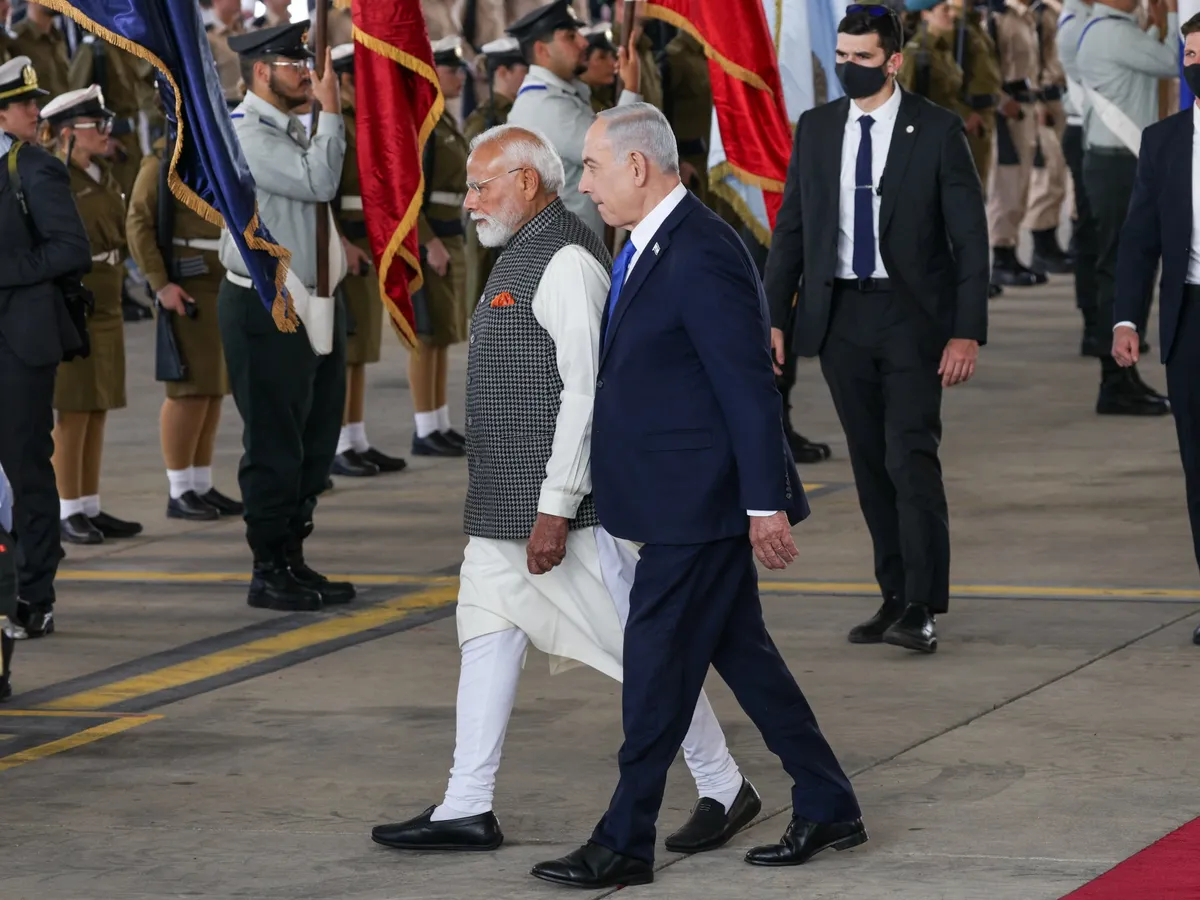
The tightening strategic embrace between New Delhi and Tel Aviv could test Pakistan’s security and diplomacy, say analysts.India's Prime Minister Narendra Modi and Israel's Prime Minister Benjamin Netanyahu attend a welcome ceremony upon Modi's arrival at Ben Gurion International Airport in Lod, near Tel Aviv, Israel, on February 25, 2026 [Shir Torem/Reuters]Published On 25 Feb 2026Islamabad, Pakistan – When Indian Prime Minister Narendra Modi stepped off the plane in Tel Aviv on Wednesday for his second visit to Israel, and the first by any Indian premier since his own landmark trip in 2017, the symbolism was unmistakable.He was given a red-carpet welcome by Israeli Prime Minister Benjamin Netanyahu, a head of government who is facing an International Criminal Court arrest warrant and prosecuting a war in Gaza that much of the world has condemned as genocide.Recommended Stories list of 4 itemslist 1 of 4India’s Modi visits Israel: What’s on the agenda, and why it matterslist 2 of 4Will Ethiopia be part of Israel’s ‘hexagon’ alliance rivalling its enemies?list 3 of 4Netanyahu says Israel will forge regional alliance to rival ‘radical axes’list 4 of 4Turkish ‘threat’ talked up in Israel as Netanyahu focuses on new alliancesend of listYet Modi’s visit signalled not hesitation, but a wholehearted endorsement to expand India’s strategic embrace of Israel.Days before his arrival, Netanyahu announced at a cabinet meeting what he described as a “hexagon of alliances”, a proposed regional framework placing India at its centre alongside Greece, Cyprus and unnamed Arab, African and Asian states.Its declared purpose was to counter what he called “radical axes, both the radical Shia axis, which we have struck very hard, and the emerging radical Sunni axis”.In a region where Turkiye’s President Recep Tayyip Erdogan has been among Israel’s most outspoken critics, and where Saudi Arabia and Pakistan formalised a Strategic Mutual Defence Agreement in September 2025 – all three Sunni-majority nations – the outline of what Tel Aviv may view as this “axis” is not difficult to discern.Against that backdrop, India’s deepening alignment with Israel directly impacts – and could reshape – Islamabad’s strategic calculus in an already volatile region, say analysts.Expanding defence and technology tiesThe India-Israel relationship has accelerated sharply since Modi’s 2017 visit. India is now Israel’s largest arms customer, and the agenda this week spans defence, artificial intelligence, quantum computing and cybersecurity.A new classified framework is expected to open exports from Israel of previously restricted military hardware to India. Among the systems reportedly under discussion is Israel’s Iron Beam, a 100kW-class high-energy laser weapon inducted into the Israeli army in December 2025. Cooperation on Iron Dome missile defence technology transfer for local manufacturing is also under consideration.For Masood Khan, Pakistan’s former ambassador to both the United States and the United Nations, the visit marks a decisive moment.“News coming out suggests they are going to sign a special strategic agreement, one that could be seen as a counterpart to the agreement signed by Pakistan and Saudi Arabia last year,” he said. “Israel already has such special agreements with countries like the US and Germany.”Masood Khalid, a former Pakistani ambassador to China, pointed to this military dimension.“We saw how Israeli drones worked in the India-Pakistan conflict against us last year,” he said, referring to India’s use of Israeli-origin platforms during the May 2025 strikes against Pakistan, when the South Asian neighbours waged an intense four-day aerial war. “Public statements from both sides speak of strengthening strategic cooperation – particularly in defence, counterterrorism, cybersecurity and AI.”India’s defence ties with Israel are no one-way street any more. During Israel’s war on Gaza in 2024, Indian arms firms supplied rockets and explosives to Tel Aviv, an Al Jazeera investigation confirmed.Umer Karim, an associate fellow at the Riyadh-based King Faisal Center for Research and Islamic Studies, sees the partnership as part of a wider recalibration.“It is clear that India has entered into a strategic partnership with Israel, and at a time when both governments have been criticised for their actions, this bilateral relationship has become increasingly important for both,” he told Al Jazeera.Netanyahu’s ‘hexagon’ and PakistanNetanyahu’s hexagon proposal remains undefined. He has promised an “organised presentation” at a later date.While Israel believes it has weakened what the Israeli PM described as the “Shia axis” through its 2024-2025 campaign against Iran-aligned groups such as Hezbollah and Hamas, the “emerging radical Sunni axis” is less clearly articulated.Analysts suggest it could refer to states and movements aligned with strands of political Islam and sharply critical of Israeli policy, including Turkiye and countries that have strengthened security ties with Riyadh and Ankara, as Pakistan has. Pakistan is also the only Muslim nation with nuclear weapons – something that has long worried Israel: In the 1980s, Israel tried to recruit India for a joint military operation against a nuclear facility in Pakistan, but backed off the plan after New Delhi abstained.Karim was convinced about Pakistan’s place in Netanyahu’s crosshairs.“Absolutely, Pakistan is part of this so-called radical Sunni axis,” he said, arguing that Pakistan’s strategic agreement with Riyadh and its close ties with Turkiye directly affect Israel’s calculations. “In order to counter this, Israel will increase its defence cooperation and intel sharing with Delhi.”Khalid pointed to longstanding intelligence links.“Intelligence sharing between Indian RAW and Israeli Mossad dates back to the sixties. So their strengthened interaction in this domain should be of serious concern for us,” he said, referring to the external intelligence agencies of India and Israel.Others urge caution. Gokhan Ereli, an Ankara-based independent Gulf researcher, argued that Pakistan is unlikely to be an explicit target within Israel’s framing.“In this context, Pakistan is more plausibly affected indirectly, through the alignment of Israeli, Indian and Western threat narratives, than being singled out as a destabilising actor in its own right,” he told Al Jazeera.Khan, the former ambassador, agreed.“I don’t perceive a direct threat, but the latent animosity is there. And when Modi is in Tel Aviv, he will try to poison Netanyahu and other leaders there to think about Pakistan in a hostile way,” he said.Muhammad Shoaib, assistant professor of international relations at Quaid-i-Azam University, echoed that assessment.“India’s close relations with Israel are likely to negatively impact Tel Aviv’s perception and statements on Pakistan,” he said.The Gulf balancing actPerhaps the most complex arena for Pakistan is the Gulf. For decades, it has relied on Gulf partners for financial support, including rolled-over loans and remittances that form a crucial pillar of its economy.Pakistan signed a mutual defence agreement with Saudi Arabia in September last year [File: Press Information Department via AP Photo]After signing the Strategic Mutual Defence Agreement with Saudi Arabia last September, discussions have intensified about Turkiye joining a similar framework. Yet the United Arab Emirates, one of Pakistan’s closest Gulf partners, signed a strategic agreement with India in January 2026.Khalid called for deeper economic integration to underpin these ties.“Pakistan is doing well to strengthen its bilateral ties with key Middle East countries, Saudi Arabia, UAE, Qatar and Kuwait,” he said, “but apart from GCC, Pakistan also needs to promote regional cooperation, particularly with countries of Central Asia, Turkiye, Iran and Russia. Geoeconomics through greater trade and connectivity should be the basis of this regional cooperation.” The Gulf Cooperation Council consists of Bahrain, Kuwait, Oman, Qatar, Saudi Arabia and the UAE.
SRCAl Jazeera
LANGEN
LEANCenter
WORDS1 201
ENT12
WED · 2026-02-25 · 13:14 GMTBRIEF NSR-2026-0225-19178
NSR-2026-0225-19178Analysis·EN·National Security
Why Indian PM Modi’s Israel visit matters for Pakistan’s security
Indian Prime Minister Narendra Modi's visit to Israel has significant implications for Pakistan's security and diplomacy. The visit marked a deepening strategic alliance between New Delhi and Tel Aviv, with India becoming Israel's largest arms customer.
Abid HussainAl JazeeraFiled 2026-02-25 · 13:14 GMTLean · CenterRead · 5 min
Al JazeeraFIG 01
Reading time
5min
Word count
1 201words
Sources cited
2cited
Entities identified
12entities
Quality score
100%
§ 01
Briefing Summary
AI-generatedNEWSAR · AI
Indian Prime Minister Narendra Modi's visit to Israel has significant implications for Pakistan's security and diplomacy. The visit marked a deepening strategic alliance between New Delhi and Tel Aviv, with India becoming Israel's largest arms customer. Netanyahu announced a "hexagon of alliances" framework during Modi's visit, placing India at its center alongside Greece, Cyprus, and unnamed Arab, African, and Asian states. This proposed regional framework aims to counter what Netanyahu calls "radical axes." The India-Israel relationship has accelerated since Modi's 2017 visit, with defense and technology ties being a key focus of the current agenda. Pakistan's security calculus may be reshaped by this development, given its formal Strategic Mutual Defence Agreement with Saudi Arabia in September 2025.
Confidence 0.90Sources 2Claims 5Entities 12
§ 02
Article analysis
Model · rule-basedFraming
National Security
Political Strategy
Tone
Mixed Tone
AI-assessed
CalmNeutralAlarmist
Factuality
0.60 / 1.00
Mixed
LowHigh
Sources cited
2
Limited
FewMany
§ 03
Key claims
5 extracted01
Saudi Arabia and Pakistan formalised a Strategic Mutual Defence Agreement in September 2025.
factual
Confidence
1.00
02
Netanyahu announced a “hexagon of alliances”, a proposed regional framework placing India at its centre.
factualNetanyahu
Confidence
1.00
03
India is now Israel’s largest arms customer.
factual
Confidence
0.90
04
Modi's visit signalled a wholehearted endorsement to expand India’s strategic embrace of Israel.
factual
Confidence
0.80
05
The tightening strategic embrace between New Delhi and Tel Aviv could test Pakistan’s security and diplomacy.
predictionanalysts
Confidence
0.70
§ 04
Full report
5 min read · 1 201 words§ 05
Entities
12 identifiedKey playerOppositionContextPositiveNeutralNegative
People3
Organizations1
§ 06
Keywords & salience
10 termsindia-israel relations
1.00
pakistan's security
0.90
strategic embrace
0.80
benjamin netanyahu
0.70
narendra modi
0.70
defence ties
0.60
regional alliance
0.60
strategic calculus
0.50
radical axes
0.50
arms customer
0.40
§ 07
Topic connections
Interactive graph Network visualization showing 51 related topics
View Full Graph Person Organization Location Event|Click node to navigate|Edge numbers = shared articles