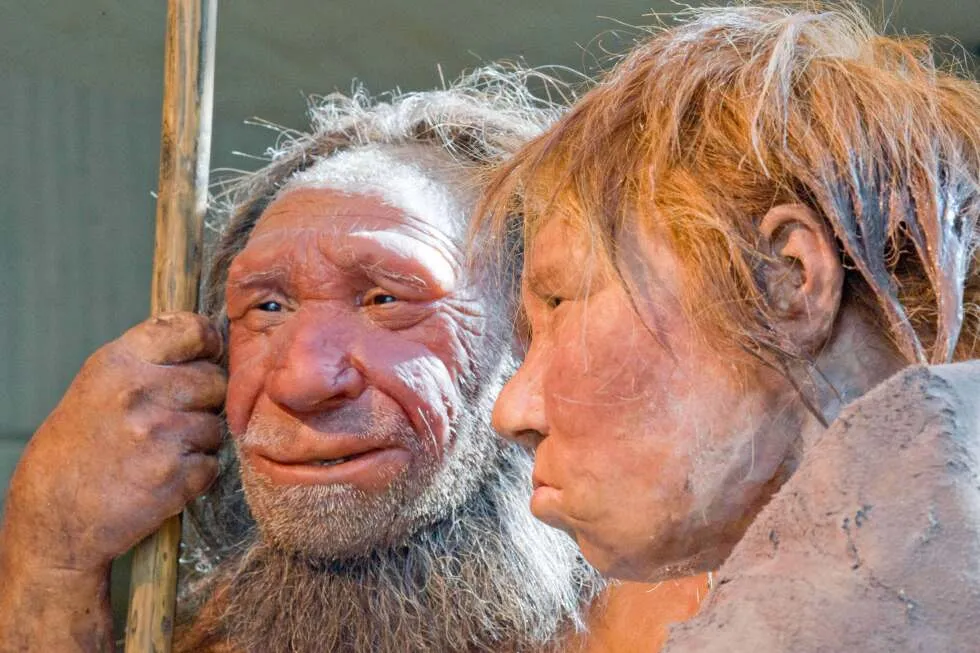
A genetic analysis reveals new details on ancient couplings between humans and Neanderthals 1 of 4 | Most of our Neanderthal ancestors may have been male, according to an new genetic analysis. Scientists looked at the human genes that got interspersed with Neanderthal ones during an ancient mating event. (AP Video/Mary Conlon) 2 of 4 | This Friday, March 20, 2009 file photo shows reconstructions of a Neanderthal man, left, and woman at the Neanderthal museum in Mettmann, Germany. (AP Photo/Martin Meissner, File) 3 of 4 | A reconstructed Neanderthal skeleton, right, and a modern human version of a skelaton, left, are on display at the Museum of Natural History Jan. 8, 2003 in New York. (AP Photo/Frank Franklin II, File) 4 of 4 | People visit the exhibits inside the Smithsonian Hall of Human Origins, including this Neanderthal skeleton display, Thursday, July 20, 2023, at the Smithsonian Museum of Natural History, in Washington. Growing research – including ancient DNA technology – is changing the picture of human evolution and how our ancestors interacted with other human-like creatures. (AP Photo/Jacquelyn Martin) 1 of 4 Most of our Neanderthal ancestors may have been male, according to an new genetic analysis. Scientists looked at the human genes that got interspersed with Neanderthal ones during an ancient mating event. (AP Video/Mary Conlon) Add AP News on Google Add AP News as your preferred source to see more of our stories on Google. 2 of 4 This Friday, March 20, 2009 file photo shows reconstructions of a Neanderthal man, left, and woman at the Neanderthal museum in Mettmann, Germany. (AP Photo/Martin Meissner, File) Add AP News on Google Add AP News as your preferred source to see more of our stories on Google. 3 of 4 A reconstructed Neanderthal skeleton, right, and a modern human version of a skelaton, left, are on display at the Museum of Natural History Jan. 8, 2003 in New York. (AP Photo/Frank Franklin II, File) Add AP News on Google Add AP News as your preferred source to see more of our stories on Google. 4 of 4 People visit the exhibits inside the Smithsonian Hall of Human Origins, including this Neanderthal skeleton display, Thursday, July 20, 2023, at the Smithsonian Museum of Natural History, in Washington. Growing research – including ancient DNA technology – is changing the picture of human evolution and how our ancestors interacted with other human-like creatures. (AP Photo/Jacquelyn Martin) Add AP News on Google Add AP News as your preferred source to see more of our stories on Google. Updated [hour]:[minute] [AMPM] [timezone], [monthFull] [day], [year] New York (AP) — Humans and Neanderthals cozied up from time to time when they lived in the same areas tens of thousands of years ago. But we don’t know much about who got with whom, or why.A new genetic analysis offers some ancient gossip: The pairings were more often female humans with male Neanderthals.How exactly this happened remains a huge question mark. Did human women venture into Neanderthal populations, or were the Neanderthal males drawn to larger human enclaves? Were these interactions peaceful, confusing, secretive or even violent?“I don’t know if we’ll ever get a definitive answer to how this happened, since we can’t travel back in time,” said population genetics expert Xinjun Zhang with the University of Michigan, commenting on the new analysis.But the study, published Thursday in the journal Science, shows “that whenever Neanderthals and modern humans have mated, there has been a preference for male Neanderthals and female modern humans, as opposed to the other way around,” said author Alexander Platt, who studies genetics at the University of Pennsylvania. Scientists know that Neanderthals and humans mated because there is a small but important percentage of Neanderthal DNA in most modern humans outside of sub-Saharan Africa — including genes that can help us fight some diseases and make us more susceptible to others. But they have also known that the Neanderthal DNA is not distributed evenly throughout the human genome. In particular, there is a surprising lack of Neanderthal DNA in the human X chromosome, one of the bundles of genes in each cell known as a sex chromosome, compared with the amount of Neanderthal DNA in the other, non-sex chromosomes in the cell. Scientists thought that maybe the genes in those locations were simply not beneficial – or even harmful. Perhaps people with those gene patterns didn’t survive as well so those genes were filtered out by evolution over time. Or, they thought, maybe the difference could be explained by how the two species intermingled.To try to solve the riddle, Platt and colleagues looked instead at the Neanderthal genome and the human DNA that got interspersed during a “mating event” 250,000 years ago. When comparing these genes, they found more of a human fingerprint on the Neanderthal X chromosome – the same chromosome that, in humans, has less Neanderthal DNA than would be expected.The most likely explanation for this mirror image pattern is mating behavior. That’s because of the way sex chromosomes are passed from parents to children, explained Platt. Because genetic females have two X chromosomes and genetic males have one X and one Y chromosomes, two out of every three X chromosomes in a population, on average, are inherited from people’s mothers. If more human females mated with Neanderthal males than the other way around, over thousands of years you would expect to see just what they found: more human DNA in Neanderthal X chromosomes and less Neanderthal DNA in human X chromosomes. “I think that they’ve taken some really important steps in filling missing pieces to the puzzle,” said Joshua Akey, who studies evolutionary genomics at Princeton University and wasn’t involved with the new study. The study can’t totally rule out other explanations. For example, Zhang said, it’s possible that the offspring of human males and Neanderthal females just didn’t survive as well.But the simplest and most likely, explanation, the study found, is also the most interesting: “It’s not the result of a strictly Darwinian survival of the fittest,” Platt said. “It’s really the result of how we interact with each other, and what our culture and society and behavior is like.”The Associated Press Health and Science Department receives support from the Howard Hughes Medical Institute’s Department of Science Education and the Robert Wood Johnson Foundation. The AP is solely responsible for all content. Ramakrishnan is a science reporter for The Associated Press, based in New York. She covers research and new developments related to space, early human history and more.
SRCAssociated Press (AP)
LANGEN
LEANCenter
WORDS1 090
ENT7
THU · 2026-02-26 · 19:53 GMTBRIEF NSR-2026-0226-19610
NSR-2026-0226-19610News Report·EN·Technology
A genetic analysis reveals new details on ancient couplings between humans and Neanderthals
A recent genetic analysis has shed new light on ancient interactions between humans and Neanderthals. Scientists examined the human genes interspersed with Neanderthal genes from past mating events.
By
ADITHI RAMAKRISHNANAssociated Press (AP)Filed 2026-02-26 · 19:53 GMTLean · CenterRead · 5 min
Associated Press (AP)FIG 01
Reading time
5min
Word count
1 090words
Sources cited
0cited
Entities identified
7entities
Quality score
100%
§ 01
Briefing Summary
AI-generatedNEWSAR · AI
A recent genetic analysis has shed new light on ancient interactions between humans and Neanderthals. Scientists examined the human genes interspersed with Neanderthal genes from past mating events. The analysis suggests that a majority of Neanderthal ancestors to modern humans may have been male. This research contributes to a growing body of knowledge, aided by ancient DNA technology, that is reshaping our understanding of human evolution and the interactions between our ancestors and other human-like species. Exhibits at museums like the Smithsonian Hall of Human Origins showcase Neanderthal skeletons and highlight the ongoing discoveries in this field.
Confidence 0.90Claims 4Entities 7
§ 02
Article analysis
Model · rule-basedFraming
Technology
Human Interest
Tone
Measured
AI-assessed
CalmNeutralAlarmist
Factuality
0.70 / 1.00
Factual
LowHigh
Sources cited
0
No named sources
FewMany
§ 03
Key claims
4 extracted01
Scientists looked at the human genes that got interspersed with Neanderthal ones during an ancient mating event.
factualAP
Confidence
1.00
02
A new genetic analysis reveals new details on ancient couplings between humans and Neanderthals.
factualAP
Confidence
1.00
03
Most of our Neanderthal ancestors may have been male, according to a new genetic analysis.
factualAP
Confidence
0.80
04
The pairings were more often female humans with male Neanderthals.
factualAP
Confidence
0.70
§ 04
Full report
5 min read · 1 090 words§ 05
Entities
7 identifiedKey playerOppositionContextPositiveNeutralNegative
People3
§ 06
Keywords & salience
7 termsneanderthals
1.00
genetic analysis
0.90
human evolution
0.80
ancient couplings
0.70
human genes
0.60
ancient dna
0.50
mating event
0.50
§ 07
Topic connections
Interactive graph Network visualization showing 3 related topics
View Full Graph Person Organization Location Event|Click node to navigate|Edge numbers = shared articles