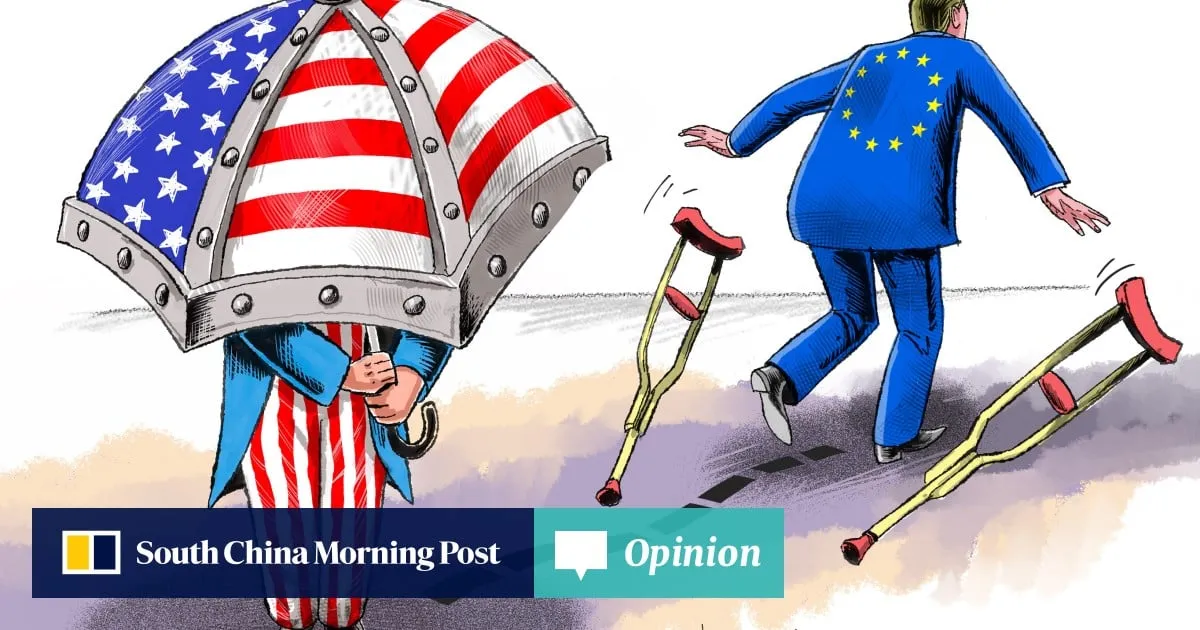
This year’s Munich Security Conference arrived as less of a shock to Europeans, who have largely accepted that the good old days are gone for good. A few might still have got teary-eyed when US Secretary of State Marco Rubio described America as eternally “the child of Europe”, but most in the audience understood the underlying message: “You are on your own now, Granny.”The difference between Rubio’s more measured phrasing and Vice-President J.D. Vance’s blunt remarks last year is largely a matter of syntax. “Nobody doubts the good old days are over and we need to look after ourselves. Rubio and Vance are, in fact, saying the same thing,” one European diplomat observed.Officials, experts and academics I’ve spoken with during my recent visits to Munich, Berlin and Brussels agree on two imperatives: Europe must urgently regain its competitiveness and achieve strategic autonomy. The consensus holds that Europe now lags behind the United States and China, particularly in technology and advanced manufacturing. Without reclaiming its competitive edge, the continent will enter major-power negotiations from a position of weakness.Make no mistake: the EU still excels in basic research and innovation, but it remains painfully slow to translate breakthroughs into market-ready products.Part of the problem stems from well-documented overregulation. For instance, it would cost a small or medium-sized business €200,000 to €500,000 (US$235,000 to US$590,600) just to go through the compliance process required by the EU AI Act to deploy an AI system considered “high risk”.Market fragmentation compounds the challenge: legal frameworks, tax regimes and business practices vary significantly across the 27 member states, hindering European tech firms from scaling as rapidly as their American and Chinese counterparts.
SRCSouth China Morning Post
LANGEN
LEANCenter-Right
WORDS275
ENT9
FRI · 2026-02-27 · 01:00 GMTBRIEF NSR-2026-0227-19695
NSR-2026-0227-19695Analysis·EN·Political Strategy
Europe is ready for strategic autonomy, but at what cost?
The Munich Security Conference highlighted a growing consensus among European officials and experts that Europe must pursue strategic autonomy and regain its competitiveness. This shift comes as the US signals a change in its relationship with Europe, suggesting a need for greater self-reliance.
Chow Chung-yanSouth China Morning PostFiled 2026-02-27 · 01:00 GMTLean · Center-RightRead · 2 min
South China Morning PostFIG 01
Reading time
2min
Word count
275words
Sources cited
2cited
Entities identified
9entities
Quality score
100%
§ 01
Briefing Summary
AI-generatedNEWSAR · AI
The Munich Security Conference highlighted a growing consensus among European officials and experts that Europe must pursue strategic autonomy and regain its competitiveness. This shift comes as the US signals a change in its relationship with Europe, suggesting a need for greater self-reliance. The primary concern is that Europe lags behind the US and China, especially in technology and advanced manufacturing, hindering its ability to negotiate effectively on the global stage. While the EU excels in basic research, it struggles to translate innovations into marketable products due to overregulation, such as the EU AI Act, and market fragmentation across its 27 member states. These factors impede the growth of European tech firms compared to their American and Chinese counterparts.
Confidence 0.90Sources 2Claims 5Entities 9
§ 02
Article analysis
Model · rule-basedFraming
Political Strategy
Economic Impact
Tone
Measured
AI-assessed
CalmNeutralAlarmist
Factuality
0.60 / 1.00
Mixed
LowHigh
Sources cited
2
Limited
FewMany
§ 03
Key claims
5 extracted01
It would cost a small or medium-sized business €200,000 to €500,000 to comply with the EU AI Act for high-risk AI systems.
statistic
Confidence
1.00
02
Legal frameworks, tax regimes and business practices vary significantly across the 27 member states.
factual
Confidence
0.90
03
The EU still excels in basic research and innovation.
factual
Confidence
0.90
04
Europe must urgently regain its competitiveness and achieve strategic autonomy.
quoteOfficials, experts and academics
Confidence
0.90
05
Europe lags behind the United States and China, particularly in technology and advanced manufacturing.
factualOfficials, experts and academics
Confidence
0.80
§ 04
Full report
2 min read · 275 words§ 05
Entities
9 identifiedKey playerOppositionContextPositiveNeutralNegative
Organizations1
Locations5
§ 06
Keywords & salience
10 termsstrategic autonomy
1.00
european union
0.80
competitiveness
0.70
advanced manufacturing
0.60
technology
0.60
market fragmentation
0.50
overregulation
0.50
united states
0.40
china
0.40
eu ai act
0.40
§ 07
Topic connections
Interactive graph Network visualization showing 51 related topics
View Full Graph Person Organization Location Event|Click node to navigate|Edge numbers = shared articles