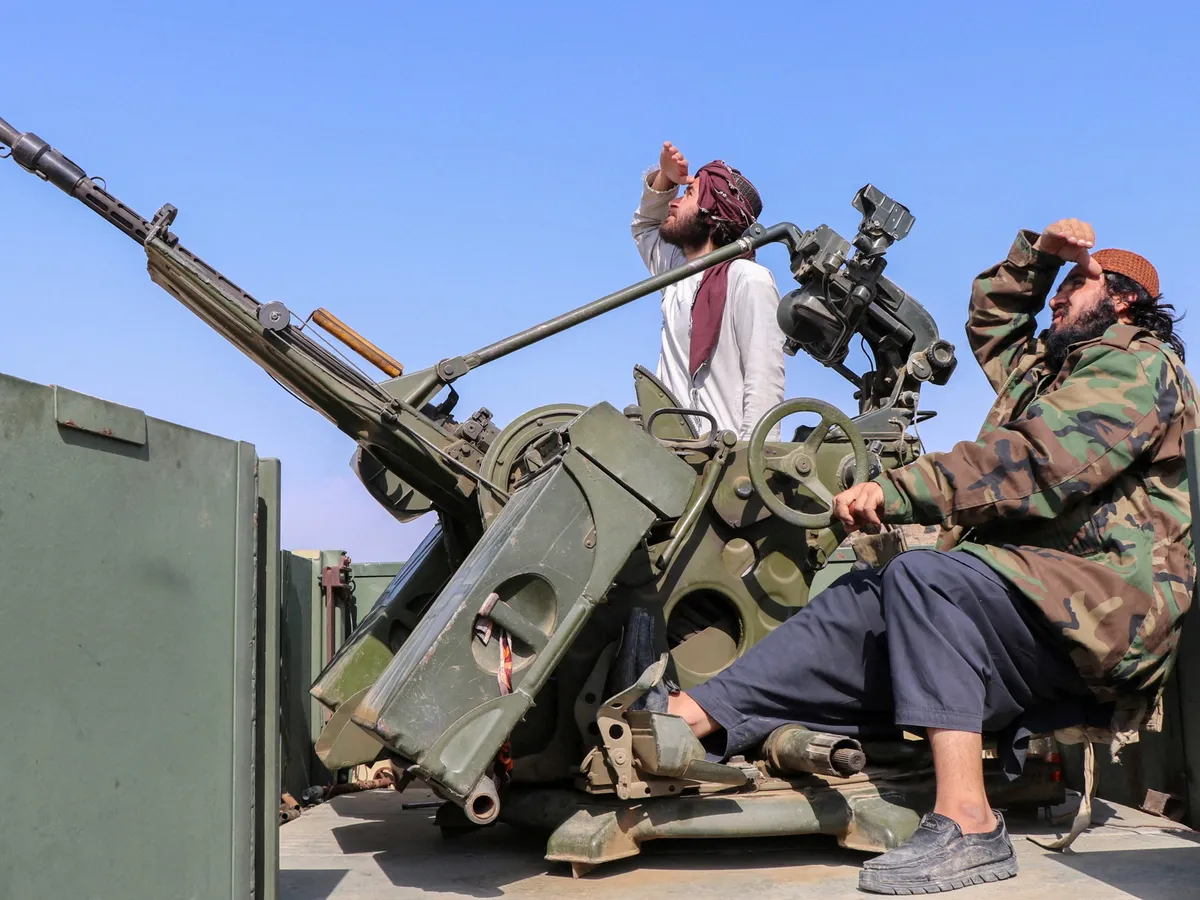
Analysts warn escalation may embolden armed groups and destabilise both Afghanistan and Pakistan. What happens next?Taliban soldiers sit next to an anti-aircraft gun while on lookout for Pakistan's fighter jets, in Khost province, Afghanistan, February 27, 2026 [Stringer/Reuters]Published On 27 Feb 2026Islamabad, Pakistan – Pakistan launched air strikes on Afghanistan’s capital, Kabul, as well as on Kandahar and Paktia, early on Friday. The attacks targeted Taliban military installations as Islamabad declared “open war” on the group’s government, in the most serious military confrontation between the two neighbours in years.The strikes came hours after Afghan forces launched coordinated cross-border attacks on Pakistani military positions in six border provinces late on Thursday. Kabul claimed 55 Pakistani soldiers were killed and 19 outposts captured.Recommended Stories list of 4 itemslist 1 of 4Pakistan bombs Kabul: Why are Afghanistan and Pakistan fighting?list 2 of 4‘Open war’: Pakistan and Afghanistan’s Taliban claim major casualtieslist 3 of 4Afghanistan launches attacks against Pakistan, draws ‘immediate response’list 4 of 4Afghanistan bombing: What’s Pakistan’s strategy as India-Taliban ties grow?end of listPakistan acknowledged two soldiers had been killed but dismissed the other claims as propaganda. It said Pakistan had eliminated at least 133 Afghan fighters in retaliation, while destroying at least 27 Afghan outposts.Defence Minister Khawaja Asif declared Pakistan’s patience exhausted. “Our cup of patience has overflowed. Now it is open war between us and you,” he wrote on social media, as Prime Minister Shehbaz Sharif warned there would be “no leniency” in defending Pakistan’s homeland.Taliban spokesman Zabihullah Mujahid confirmed the strikes on Kabul, Kandahar and Paktia but claimed there had been no casualties. He announced retaliatory operations had begun from Kandahar and Helmand.The exchanges have shattered a ceasefire brokered by Turkiye and Qatar, which was reached after 10 days of deadly border fighting in October killed more than 70 people on both sides. Subsequent negotiations in Doha and Istanbul failed to produce a formal agreement.What is unfolding now, analysts say, is categorically more dangerous, with no framework in place to contain it.Why has Pakistan escalated now?Pakistan’s rationale for Friday’s heavy attacks lies in a renewed wave of violence at home.On February 6, a suicide bomber killed at least 36 people at a Shia mosque in Islamabad. This was followed, days later, by another incident in which an explosives-laden vehicle rammed a security post in Bajaur in Khyber Pakhtunkhwa, killing 11 soldiers and a child.Pakistani authorities said the attacker was an Afghan national and issued a demarche to the Afghan deputy head of mission in Islamabad.On February 21, another suicide bomber struck a security convoy in Bannu, also in Khyber Pakhtunkhwa, killing two soldiers.Those attacks prompted Pakistan’s first round of strikes last weekend inside Afghanistan, targeting what it said were hideouts linked to armed groups, particularly the Pakistan Taliban, known by the acronym TTP.The TTP, formed in 2007, fought alongside the Afghan Taliban against United States-led forces in Afghanistan and hosted Afghan fighters in Pakistan. It is organisationally distinct from the Afghan Taliban but shares deep ideological, social and linguistic ties. Pakistan accuses Kabul of providing sanctuary to the TTP, a charge the Taliban denies.The TTP has been waging a rebellion against the state of Pakistan for more than a decade. The group demands the imposition of hardline Islamic law, release of key members arrested by the government and a reversal of the merger of Pakistan’s tribal areas with Khyber Pakhtunkhwa province, among other demands.Another major armed group, which Pakistan alleges benefits from sanctuary in Afghanistan, is the Balochistan Liberation Army (BLA), an organisation officially designated “terrorist” by several countries and international bodies. The group has been fighting its own war against the Pakistani state, seeking independence for the Balochistan province, which is a natural mineral-rich province in southwest Pakistan, and also shares a border with Afghanistan.Kabul said at least 18 people were killed in Pakistani strikes last Sunday and pledged retaliation, which culminated in Thursday night’s cross-border fire.For analysts tracking Pakistan’s escalatory ladder over the past year, Friday’s strikes were not surprising, though their scope was unprecedented.Tariq Khan, a retired three-star general who has served extensively in Khyber Pakhtunkhwa and led operations against the TTP, said this is only the beginning.“We have not seen the peak, and there will be more to come,” he told Al Jazeera.“Pakistan asked the Taliban to control TTP, held several talks along with Turkiye and Qatar, but it was not going to work because the Taliban refused to take responsibility,” he said.Tameem Bahiss, a Kabul-based security analyst, said the crisis revolves around a single unresolved dispute.“Tensions have been largely driven by Pakistan’s repeated accusations that Afghan authorities are allowing the TTP to operate from Afghan soil, which Kabul has denied,” he said.“As long as this core issue remains unresolved, attacks will continue. From Islamabad’s perspective, these operations are framed as counterterrorism measures. From Kabul’s perspective, they are violations of sovereignty and territorial integrity,” Bahiss told Al Jazeera.Striking military installations in Kabul and Kandahar marks a shift from peripheral border zones to the Taliban’s administrative and ideological centres. Yet dismantling decentralised and mobile TTP networks embedded along both sides of the porous frontier remains far from guaranteed.Abdul Basit, a security researcher at Singapore’s S Rajaratnam School of International Studies, questioned the strategic payoff.“Whatever has happened represents a dangerous escalation. While I understand the compulsion for Pakistan to retaliate, I do not understand the logic of how it will help address terrorism,” he said.“It will lead to instability, and instability is precisely what terrorist networks crave, including TTP and other armed groups which have sought sanctuary in Afghanistan, and have all grown stronger as a result,” Basit told Al Jazeera. “The message is: We will not absorb hits. This is the new normal.”Pakistani soldiers patrol near the Pakistan-Afghanistan border crossing in Chaman in Balochistan province on February 27, 2026, following overnight cross-border fighting between the two countries [Abdul Basit/AFP]The Taliban’s asymmetric optionsThe Taliban has no air force, and comparing the two militaries conventionally misses the point, Khan said.“The Afghan system conducts kinetic operations through proxies, guerrilla warfare, and a war of attrition,” he said. “But if you get drawn into a war of attrition, you are on the losing side, no matter what nuclear capability or air power you possess, because you are fighting on their turf.”Bahiss pointed to the most immediate lever available to Kabul: Pakistan’s thousands of fixed security posts along the long and porous border.“The Taliban have repeatedly demonstrated that in moments of escalation, their preferred response is to target Pakistani military posts along the long and porous border,” he said.Basit, though, warned of broader “unconventional options”.“They have suicide bombers and the poor man’s air force, kamikaze drones. I think they will use both these options in large numbers, and it appears that Pakistani urban centres will see violence for the foreseeable future,” he said.On Friday afternoon, Pakistan’s Information Minister Attaullah Tarar confirmed drone attacks in three Pakistani cities, blaming the Taliban government. He said “small drones in Abbotabad, Swabi and Nowshera” were brought down. “No damage to life,” he added in his message on social media platform X.Another variable is the TTP itself. Kabul’s most potent asymmetric card may be its capacity to restrain or loosen tolerance for TTP operations inside Pakistan.“So far, there has been no publicly verified evidence that Kabul is providing extensive, overt military support to the TTP in response to Pakistani strikes,” Bahiss said.Iftikhar Firdous, a security analyst and cofounder of The Khorasan Diary, a journalism platform, argued that proxy leverage lies at the heart of this confrontation.“Even a cursory sentiment analysis of Afghan social media linked to the Taliban clearly shows the alignment in agenda and, at times, a clear call for action by proxy groups. And while they don’t have an air force, the drone warfare is an indication of what the future of conflict looks like,” he told Al Jazeera.A villager looks at damaged solar plates and a portion following overnight cross-border fighting between Pakistan and Afghan forces, at a village in Bajaur, a district of Pakistan’s Khyber Pakhtunkhwa province bordering Afghanistan, on Friday, February 27, 2026 [AP Photo]Is there an off-ramp?Neither side appears to have an obvious exit from all this.Pakistan’s operation received backing from the president, prime minister and across the political spectrum, with the government pledging to respond to any attack emanating from Afghan soil.For the Taliban, absorbing strikes on Kabul and stepping back risks projecting weakness to fighters and the public it governs.Basit said the threshold has already shifted.“This has been a step-by-step escalation; not one step has been reversed, we have only moved forward. Tensions may come down temporarily, but in my calculation, there is no going back. Summer has arrived early in the Af-Pak region, and we are bracing for a bloody summer in both countries,” he said.Bahiss said the trajectory will depend on two factors: Violence inside Pakistan and external diplomatic pressure.“If attacks inside Pakistan continue and there is no meaningful diplomatic intervention, further rounds of escalation remain a real possibility. At this stage, there is little indication that either side is stepping back strategically,” he said.Khan, the former general, outlined de-escalation only on Pakistan’s terms.“One likely outcome is that the Afghan government concludes it has had enough, signals to its proxies that it is over, and eventually comes to the table. They agree to share intelligence and curtail all proxies, including TTP and others. The second option is that they do not agree and continue as they are, in which case Pakistan’s response will continue as well.”Can diplomacy still work?The international community reacted swiftly on Friday in the wake of these tit-for-tat attacks.United Nations Secretary-General Antonio Guterres urged both countries to adhere to international humanitarian law and resolve differences through diplomacy.Iran’s Foreign Minister Abbas Araghchi invoked the holy month of Ramadan, writing on X that Tehran stood “ready to provide any assistance necessary to facilitate dialogue”.Saudi Foreign Minister Prince Faisal bin Farhan Al Saud held urgent discussions with his Pakistani counterpart, Ishaq Dar, who is in Riyadh on an official visit. Dar, also deputy prime minister, spoke by telephone with Turkish Foreign Minister Hakan Fidan.But Bahiss said durable de-escalation requires more than just statements.“A credible de-escalation process would likely involve Pakistan sharing actionable intelligence regarding alleged TTP presence inside Afghanistan, followed by verifiable steps taken by Kabul against any confirmed elements,” he said.“The fundamental obstacle is denial and mistrust. Kabul rejects the claim that TTP operates from its territory, while Islamabad insists that it does. As long as one side frames the issue as external aggression and the other as counterterrorism necessity, bridging that gap becomes extremely difficult.”Former military official Khan argued Pakistan’s diplomatic approach must widen beyond the Taliban to include Pashtun communities and anti-Taliban political forces.“Islamabad should be simultaneously talking to Pashtun communities and anti-Taliban political forces and empowering the locals who stand against the Taliban,” he said.Firdous, however, said any sustained de-escalation would require the same external mediators who previously facilitated talks.“This, however, will not be possible without the intervention of the same friendly actors involved in the process, all of whom have already been in touch with both countries,” he said.
SRCAl Jazeera
LANGEN
LEANCenter
WORDS1 847
ENT12
FRI · 2026-02-27 · 12:52 GMTBRIEF NSR-2026-0227-19853
NSR-2026-0227-19853News Report·EN·Conflict
Air attacks on Kabul push Pakistan-Taliban crisis into uncharted territory
On February 27, 2026, Pakistan launched air strikes on Kabul, Kandahar, and Paktia in Afghanistan, targeting Taliban military installations, after claiming "open war." This followed coordinated cross-border attacks by Afghan forces on Pakistani military positions, with Kabul claiming significant Pakistani casualties, which Pakistan disputes. Pakistan stated the strikes were retaliation for increased violence within its borders and claimed to have inflicted heavy casualties on Afghan fighters.
Abid HussainAl JazeeraFiled 2026-02-27 · 12:52 GMTLean · CenterRead · 8 min
Al JazeeraFIG 01
Reading time
8min
Word count
1 847words
Sources cited
4cited
Entities identified
12entities
Quality score
100%
§ 01
Briefing Summary
AI-generatedNEWSAR · AI
On February 27, 2026, Pakistan launched air strikes on Kabul, Kandahar, and Paktia in Afghanistan, targeting Taliban military installations, after claiming "open war." This followed coordinated cross-border attacks by Afghan forces on Pakistani military positions, with Kabul claiming significant Pakistani casualties, which Pakistan disputes. Pakistan stated the strikes were retaliation for increased violence within its borders and claimed to have inflicted heavy casualties on Afghan fighters. The Taliban confirmed the strikes and announced retaliatory operations. This escalation shatters a previous ceasefire and raises concerns among analysts about regional destabilization, as negotiations had failed to produce a formal agreement.
Confidence 0.90Sources 4Claims 5Entities 12
§ 02
Article analysis
Model · rule-basedFraming
Conflict
National Security
Tone
Mixed Tone
AI-assessed
CalmNeutralAlarmist
Factuality
0.70 / 1.00
Factual
LowHigh
Sources cited
4
Well sourced
FewMany
§ 03
Key claims
5 extracted01
Afghan forces launched coordinated cross-border attacks on Pakistani military positions in six border provinces late on Thursday.
factualArticle
Confidence
1.00
02
Pakistan launched air strikes on Afghanistan’s capital, Kabul, as well as on Kandahar and Paktia, early on Friday.
factualArticle
Confidence
1.00
03
Pakistan had eliminated at least 133 Afghan fighters in retaliation, while destroying at least 27 Afghan outposts.
factualPakistan
Confidence
0.90
04
Pakistan acknowledged two soldiers had been killed but dismissed the other claims as propaganda.
factualPakistan
Confidence
0.90
05
Kabul claimed 55 Pakistani soldiers were killed and 19 outposts captured.
factualKabul
Confidence
0.90
§ 04
Full report
8 min read · 1 847 words§ 05
Entities
12 identifiedKey playerOppositionContextPositiveNeutralNegative
People3
Organizations1
§ 06
Keywords & salience
10 termsafghanistan
1.00
pakistan
1.00
taliban
1.00
open war
0.90
air strikes
0.90
military confrontation
0.80
kabul
0.70
cross-border attacks
0.70
escalation
0.60
border fighting
0.50
§ 07
Topic connections
Interactive graph Network visualization showing 51 related topics
View Full Graph Person Organization Location Event|Click node to navigate|Edge numbers = shared articles