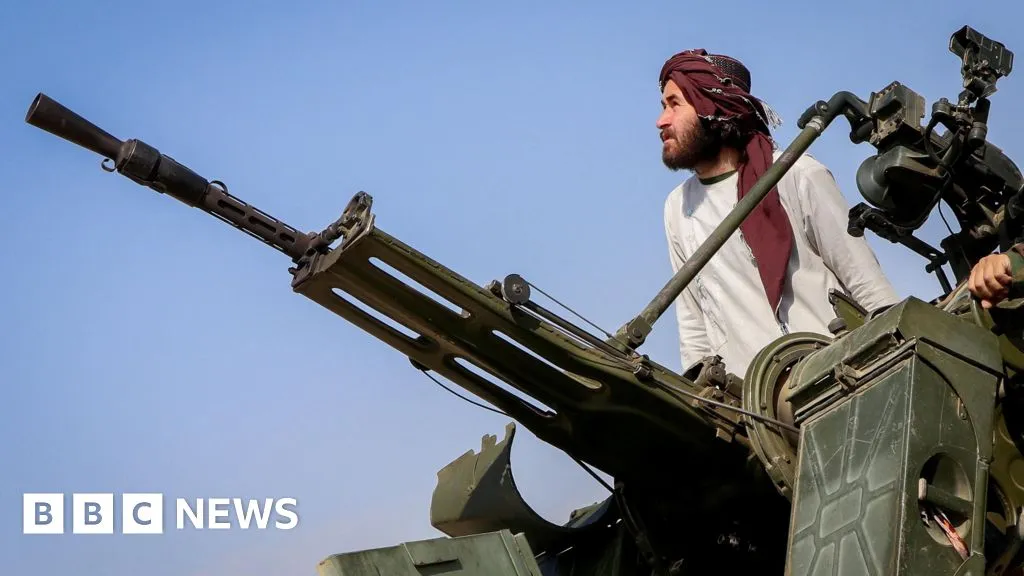
3 hours agoYogita LimayeSouth Asia and Afghanistan correspondentWatch: Pakistan releases footage it claims shows strikes on KabulResidents of Kabul's District 6 were awakened abruptly on Thursday night by the sound of an explosion that shook their homes. They rushed out in the street and heard jets flying overhead.It was a night that saw a serious escalation in violence between Afghanistan and Pakistan, with Pakistan launching airstrikes in Afghanistan - including its capital city, Kabul. Other places struck were in Paktia and Kandahar provinces, the latter a stronghold and the birthplace of the Taliban movement.Hostilities between the two sides have been ongoing for months, yet the answer to who started the aggression depends on who you ask.Earlier in the night, Afghanistan's Taliban government said it had launched a major ground operation against Pakistani military positions near the border, claiming to have captured several posts, and also claiming to have captured and killed Pakistani soldiers. The Taliban government says they were "retaliatory operations" - a response after "Pakistani military elements carried out an incursion into Afghan territory, violated Afghan sovereignty, and caused the deaths of several civilians, including women and children".They were referring to an earlier round of Pakistani airstrikes carried out less than a week ago - on the night of 21 February - targeting the eastern Nangarhar and Paktika provinces. The United Nations has said it has credible reports that 13 Afghan civilians were killed in those strikes.AFP via Getty ImagesThis latest escalation comes days after Pakistan carried out air strikes inside Afghanistan following suicide blasts on its soil (file photo)Islamabad has a different view. It says its airstrikes have not targeted civilians but instead have targeted militant hideouts in Afghanistan, specifically those of the Tehreek-i-Taliban Pakistan (TTP) or the Pakistani Taliban, which Pakistan's government refers to as Fitna al Khawarij.Pakistan also alleges the attacks are being carried out at the behest of the TTP's Afghanistan-based leadership and handlers, who are being supported by the Taliban government.The Taliban government repeatedly maintains that its territory is not being used to threaten the security of any country, and that Pakistan's actions in Afghanistan are "unprovoked".Qatar and Turkey mediated between the two sides, with talks held in Doha and Istanbul. A fragile ceasefire followed, but the negotiations failed to bring about a ceasing of hostilities between the two sides.Both countries blamed the other for not engaging seriously in diplomacy.Militarily, Pakistan has the upper hand by a long mile. It is a significant military power with hundreds of tanks and aircraft, and advanced defence technology.ReutersThe Taliban do not have the upper hand militarily, but are experienced in guerrilla and unconventional warfare Afghanistan's Taliban government has military equipment left behind by the former Afghan and foreign forces. And despite sanctions, reports suggest it has been able to purchase some military equipment through the black market.So far, there's no evidence that it has the planes or the capability to launch airstrikes deep into Pakistan.But as a group, the Taliban sustained more than 20 years of war against the US and its Nato allies, so its capacity to carry out unconventional and guerrilla warfare is well evidenced.And in the latest stand-off, the Taliban government used drones to strike targets in Pakistan. Drones, which are cheap, small and easy to use, will undoubtedly alter the nature of this conflict like they have changed battlefields around the world.The difficulty with assessing how far the latest escalation might go, stems in part from the lack of verified information available from either side.The Taliban government does not allow easy access to foreign journalists, and verifying information, particularly from border areas, is even more challenging.In Pakistan too, gathering verified information from border areas independently is not easy.Trade between the two countries has been closed since October 2025, the longest in decades which is affecting small businesses in Afghanistan, and the availability of supplies, including crucial medicines.For ordinary Afghans, reeling under a severe crisis of hunger and poverty, and living under the Taliban government's stringent restrictions, the one positive since 2021 was that after four decades of war, they didn't have to worry about bombs falling on them and their families.That feeling of relative security has now been punctured by the violence of the past six months.
SRCBBC News - World
LANGEN
LEANCenter
WORDS704
ENT10
FRI · 2026-02-27 · 13:26 GMTBRIEF NSR-2026-0227-19875
NSR-2026-0227-19875News Report·EN·Conflict
Why are Afghanistan and Pakistan fighting?
Recent airstrikes by Pakistan inside Afghanistan, including in Kabul, have escalated ongoing hostilities between the two countries. The strikes targeted areas in Paktia and Kandahar provinces, following earlier Pakistani airstrikes on February 21st in Nangarhar and Paktika provinces.
BBC News - WorldFiled 2026-02-27 · 13:26 GMTLean · CenterRead · 3 min
BBC News - WorldFIG 01
Reading time
3min
Word count
704words
Sources cited
2cited
Entities identified
10entities
Quality score
100%
§ 01
Briefing Summary
AI-generatedNEWSAR · AI
Recent airstrikes by Pakistan inside Afghanistan, including in Kabul, have escalated ongoing hostilities between the two countries. The strikes targeted areas in Paktia and Kandahar provinces, following earlier Pakistani airstrikes on February 21st in Nangarhar and Paktika provinces. Pakistan claims these actions target militant hideouts of the Tehreek-i-Taliban Pakistan (TTP), alleging the group operates from Afghanistan with the Taliban government's support. The Taliban government maintains that its territory is not used to threaten any country and claims the Pakistani actions are unprovoked, following an earlier incursion into Afghan territory. The Taliban also reported launching a ground operation against Pakistani military positions near the border. Qatar and Turkey previously mediated talks between the two sides, resulting in a fragile ceasefire.
Confidence 0.90Sources 2Claims 5Entities 10
§ 02
Article analysis
Model · rule-basedFraming
Conflict
National Security
Tone
Measured
AI-assessed
CalmNeutralAlarmist
Factuality
0.80 / 1.00
Factual
LowHigh
Sources cited
2
Limited
FewMany
§ 03
Key claims
5 extracted01
The United Nations has said it has credible reports that 13 Afghan civilians were killed in strikes on 21 February.
factualThe United Nations
Confidence
1.00
02
Pakistan says its airstrikes targeted militant hideouts, specifically those of the Tehreek-i-Taliban Pakistan (TTP).
factualIslamabad
Confidence
1.00
03
The Taliban government says Pakistani military actions are 'unprovoked'.
quoteThe Taliban government
Confidence
1.00
04
Afghanistan's Taliban government said it launched a major ground operation against Pakistani military positions near the border.
quoteAfghanistan's Taliban government
Confidence
1.00
05
Pakistan launched airstrikes in Afghanistan, including Kabul.
factualArticle
Confidence
1.00
§ 04
Full report
3 min read · 704 words§ 05
Entities
10 identifiedKey playerOppositionContextPositiveNeutralNegative
Organizations2
§ 06
Keywords & salience
10 termspakistan
1.00
afghanistan
1.00
airstrikes
0.90
taliban
0.80
military operation
0.70
border conflict
0.70
civilian casualties
0.60
ttp
0.60
sovereignty
0.50
mediation
0.40
§ 07
Topic connections
Interactive graph Network visualization showing 51 related topics
View Full Graph Person Organization Location Event|Click node to navigate|Edge numbers = shared articles