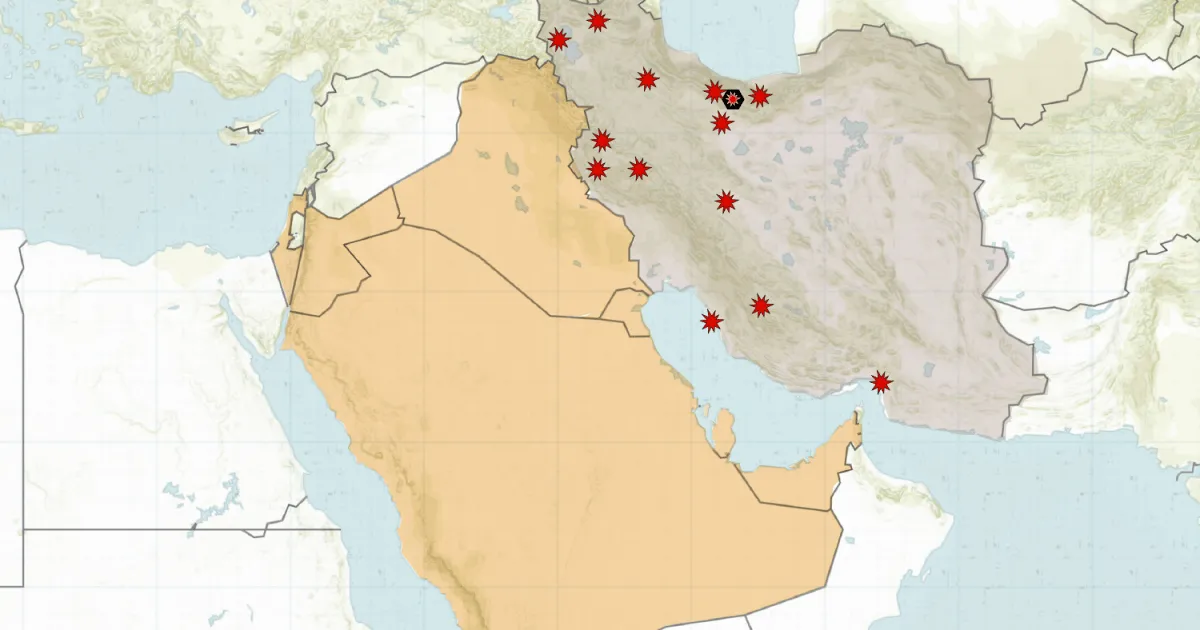
EXPLAINERThe US and Israel on Saturday launched an attack on Iran. Tehran has responded by launching missiles at Israel and in the Middle East where US forces operate.(Al Jazeera)Published On 28 Feb 2026The United States and Israel on Saturday launched an attack on Iran, with explosions seen across Tehran and in multiple cities across the country. Tehran has responded by launching waves of missiles and drones at Israel and towards several military bases in the Middle East where US forces operate.Iran had previously warned that if it were attacked, it would respond by targeting US military facilities across the region. “This operation will continue relentlessly until the enemy is decisively defeated,” Iran’s Islamic Revolutionary Guard Corps (IRGC) said. All US assets throughout the region are considered legitimate targets for Iran’s army, it added.Details of casualties and damage are still being collected.US and Israeli attacks on IranAt about 9:27am (06:27 GMT), Iran’s semi-official Fars news agency reported a series of explosions in the capital, Tehran.Al Jazeera’s correspondent in western Tehran said he heard two explosions, while videos shared on social media showed smoke rising from several parts of the city.TehranMissiles struck several areas of Tehran, including districts where key government ministries and military compounds are located.Iranian media reported strikes on the Ministry of Intelligence, the Ministry of Defence, the Iran" class="entity-link entity-organization" data-entity-id="37863" data-entity-type="organization">Atomic Energy Organization of Iran and the Parchin military complex.Several missiles also hit University Street and the Jomhouri area of the capital, according to the Fars News Agency. Mehr News Agency reported that at least two students were killed in an attack on a school east of the capital.Iran’s National Security Council has advised residents to leave Tehran amid fears of further escalation.MinabIn the southern city of Minab, an Israeli strike hit an elementary girls’ school, killing at least 51 people, state media reported.IsfahanWhile it is not yet clear what was hit, the central city of Isfahan was previously targeted in strikes in 2025 by the US and Israel, when military and nuclear-linked facilities in the area were attacked.Isfahan is considered a key hub for Iran’s ballistic missile programme, with production plants and research facilities in and around the city.Other locations that were struck include: Kermanshah, Qom, Tabriz, Ilam, Karaj, Lorestan province, Zanjan, Urmia, Bushehr, Damavand, and Shiraz.These locations are shown in the map below. Al Jazeera will update it as more information becomes available.Iranian attacks on Israel and US targets in the GulfAt their closest points, Israel and Iran are less than 1,000km (620 miles) apart. The distance from Tel-Aviv to Iran’s capital, Tehran, is about 1,600km (1,000 miles).Iran has retaliated by attacking US bases across the Middle East. Most of these attacks have been intercepted.IsraelIsrael has declared a “special state of emergency”. Multiple explosions were reported in the skies above northern and central parts of Israel, including in the Tel Aviv area and Haifa, where sirens have been sounding continuously.The Israeli army said it was intercepting a new wave of Iranian missiles, prompting people to shelter in bunkers.A nine-storey building was hit in northern Israel after Iranian missiles had been intercepted, leaving one man with minor injuries after he was struck by shrapnel from interceptor missiles, according to Israel’s Channel 12 broadcaster.QatarSmoke was seen billowing from a residential area on the outskirts of the capital, caused by falling debris from an intercepted missile.Several interceptions were made: The Ministry of Defense says it “thwarted” several attacks on the country.UAEA Pakistani national was killed in the UAE after being struck by falling debris, according to the Ministry of Defence. The ministry says it has intercepted a wave of missiles.There were also reports of explosions heard in Dubai, which might have been caused by the interceptions.BahrainBahrain says a missile attack targeted the headquarters of the US Navy’s 5th Fleet, which it hosts.KuwaitKuwait’s Ministry of Defence says that Ali al-Salem Air Base came under attack by a number of ballistic missiles, all of which were intercepted by Kuwaiti air defence systems.Saudi ArabiaLoud explosions were heard in the Saudi capital, Riyadh, the AFP news agency reported. Saudi Arabia’s Ministry of Foreign Affairs issued a statement standing in solidarity with Qatar, Jordan, Bahrain, Kuwait and the UAE.IraqA drone attack reportedly attempted to target Erbil International Airport, but air defences intercepted it.JordanMissiles have been intercepted over Amman, and flaming debris fell near a house. There were no reported injuries.US military presence in the Middle EastThe US has operated military bases in the Middle East for decades.According to the Council on Foreign Relations, the US operates a broad network of military sites, both permanent and temporary, across at least 19 locations in the region.Of these, eight are permanent bases, located across Bahrain, Egypt, Iraq, Jordan, Kuwait, Qatar, Saudi Arabia and the UAE.As of mid-2025, there are about 40,000 to 50,000 US soldiers in the Middle East, comprising personnel stationed in both large, permanent bases and smaller forward sites across the region.The countries with the most US troops include Qatar, Bahrain, Kuwait, the UAE and Saudi Arabia. These installations serve as critical hubs for air and naval operations, regional logistics, intelligence gathering and force projection.Major US military buildup in the regionThe US has amassed its largest military presence in the Middle East in decades.This historic buildup features two carrier strike groups: the USS Abraham Lincoln in the Arabian Sea and the USS Gerald R Ford off Israel’s coast, supported by more than 150 aircraft and dozens of warships.The USS Abraham Lincoln is a 333-metre (1,092ft) long, nuclear-powered aircraft carrier that can carry approximately 80 to 90 aircraft, including F-35C Lightning II stealth fighters, F/A-18E/F Super Hornets, and E-2D Advanced Hawkeye early-warning planes.The USS Gerald R Ford, the world’s largest aircraft carrier, was the same vessel that previously supported US military operations in Venezuela, including missions conducted under Operation Southern Spear.Iran’s missile arsenalThe exact size of Iran’s ballistic missile arsenal is unclear, but it is widely considered one of the largest and most advanced in the region.Iran has developed a range of ballistic and cruise missiles over the past three decades. The graphic below summarises some of Iran’s most prominent missiles and their ranges.How ballistic missiles work and where they can reachBallistic missiles are long-range weapons designed to deliver conventional or nuclear warheads by following a ballistic, or curved, trajectory.Launched using powerful rocket engines, these missiles shoot upwards into the upper atmosphere or even space, travelling at incredibly high speeds. Once their engines are cut off, the missile follows a predetermined path, re-entering the Earth’s atmosphere in a steep descent before striking its target.Ballistic missiles travel at extremely high speeds, allowing them to travel thousands of kilometres (miles) in just minutes.
SRCAl Jazeera
LANGEN
LEANCenter
WORDS1 101
ENT11
SAT · 2026-02-28 · 16:20 GMTBRIEF NSR-2026-0228-20154
NSR-2026-0228-20154News Report·EN·Conflict
Mapping US and Israeli attacks on Iran and Tehran’s retaliatory strikes
On Saturday, February 28, 2026, the United States and Israel launched an attack on Iran, targeting Tehran and multiple other cities. Explosions were reported in Tehran, with strikes hitting government ministries, military compounds, and civilian areas.
AJLabsAl JazeeraFiled 2026-02-28 · 16:20 GMTLean · CenterRead · 5 min
Al JazeeraFIG 01
Reading time
5min
Word count
1 101words
Sources cited
3cited
Entities identified
11entities
Quality score
100%
§ 01
Briefing Summary
AI-generatedNEWSAR · AI
On Saturday, February 28, 2026, the United States and Israel launched an attack on Iran, targeting Tehran and multiple other cities. Explosions were reported in Tehran, with strikes hitting government ministries, military compounds, and civilian areas. An Israeli strike in Minab reportedly hit a girls' school, causing casualties. In response, Iran launched missiles and drones at Israel and US military bases in the Middle East, warning of continued attacks until the "enemy is decisively defeated" and considering all US assets in the region legitimate targets. Casualties and damage details are still being collected, and Iran's National Security Council has advised residents to leave Tehran amid escalation fears. Other locations struck include Isfahan, Kermanshah, Qom, Tabriz, and Shiraz.
Confidence 0.90Sources 3Claims 5Entities 11
§ 02
Article analysis
Model · rule-basedFraming
Conflict
National Security
Tone
Mixed Tone
AI-assessed
CalmNeutralAlarmist
Factuality
0.80 / 1.00
Factual
LowHigh
Sources cited
3
Well sourced
FewMany
§ 03
Key claims
5 extracted01
Iran has retaliated by attacking US bases across the Middle East.
factualAl Jazeera
Confidence
1.00
02
This operation will continue relentlessly until the enemy is decisively defeated.
quoteIran’s Islamic Revolutionary Guard Corps (IRGC)
Confidence
1.00
03
Tehran has responded by launching missiles at Israel and in the Middle East where US forces operate.
factualAl Jazeera
Confidence
1.00
04
The US and Israel launched an attack on Iran.
factualAl Jazeera
Confidence
1.00
05
An Israeli strike hit an elementary girls’ school in Minab, killing at least 51 people.
factualstate media
Confidence
0.90
§ 04
Full report
5 min read · 1 101 words§ 05
Entities
11 identifiedKey playerOppositionContextPositiveNeutralNegative
Organizations4
§ 06
Keywords & salience
8 termsattacks on iran
0.90
retaliatory strikes
0.80
missile strikes
0.70
us forces
0.70
tehran
0.60
military bases
0.60
islamic revolutionary guard corps
0.50
middle east
0.50
§ 07
Topic connections
Interactive graph Network visualization showing 51 related topics
View Full Graph Person Organization Location Event|Click node to navigate|Edge numbers = shared articles