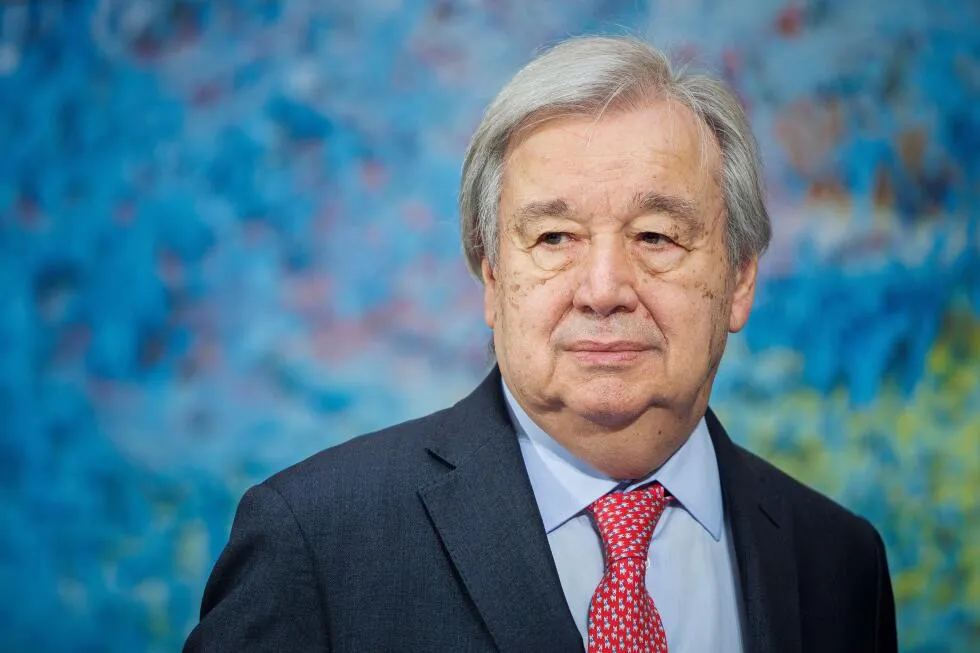
UN chief condemns US-Israeli attacks on Iran during emergency Security Council meeting 1 of 3 | Secretary-General Antonio Guterres told an emergency meeting of the U.N. Security Council that U.S. and Israeli airstrikes reportedly killed Iran’s Supreme Leader Khamenei. 2 of 3 | Ambassador Danny Danon told reporters ahead of an emergency meeting of the U.N. Security Council that Iran is responsible for escalating actions by its proxies and its nuclear and missile programs, and “now Israel and the U.S. act to prevent an irreversible and immediate threat.” 3 of 3 | U.N. Secretary-General Antonio Guterres attends the opening of the 61st session of the United Nations Human Rights Council at the European headquarters of the United Nations in Geneva, Monday, Feb. 23, 2026. (Valentin Flauraud/Keystone via AP) 1 of 3 Secretary-General Antonio Guterres told an emergency meeting of the U.N. Security Council that U.S. and Israeli airstrikes reportedly killed Iran’s Supreme Leader Khamenei. Add AP News on Google Add AP News as your preferred source to see more of our stories on Google. 2 of 3 Ambassador Danny Danon told reporters ahead of an emergency meeting of the U.N. Security Council that Iran is responsible for escalating actions by its proxies and its nuclear and missile programs, and “now Israel and the U.S. act to prevent an irreversible and immediate threat.” Add AP News on Google Add AP News as your preferred source to see more of our stories on Google. 3 of 3 U.N. Secretary-General Antonio Guterres attends the opening of the 61st session of the United Nations Human Rights Council at the European headquarters of the United Nations in Geneva, Monday, Feb. 23, 2026. (Valentin Flauraud/Keystone via AP) Add AP News on Google Add AP News as your preferred source to see more of our stories on Google. Updated [hour]:[minute] [AMPM] [timezone], [monthFull] [day], [year] UNITED NATIONS (AP) — The United Nations chief condemned the U.S.-Israeli airstrikes on Iran and called for an immediate return to negotiations “to pull the region, and our world, back from the brink.”Secretary-General António Guterres told an emergency meeting of the U.N. Security Council on Saturday that everything must be done to prevent further escalation. “The alternative,” he warned, “is a potential wider conflict with grave consequences for civilians and regional stability.”Guterres said the U.S. and Israeli airstrikes violated international law, including the U.N. Charter. He also condemned Iran’s retaliatory attacks for violating the sovereignty and territorial integrity of Bahrain, Iraq, Jordan, Kuwait, Qatar, Saudi Arabia and the United Arab Emirates.The U.S. ambassador to the United Nations, Mike Waltz, insisted the U.S. military action was lawful. “Iran cannot have a nuclear weapon,” he told the council. “That principle is not a matter of politics. It’s a matter of global security. And to that end, the United States is taking lawful actions.”Israel’s U.N. Ambassador Danny Danon, speaking to reporters before the meeting, said it was “hypocrisy” to condemn the airstrikes. He said Iran is responsible for the actions of its proxies in the Middle East and for its nuclear and missile programs, and Israel and the U.S. acted “to prevent an irreversible and immediate threat.” The attack on Iran killed Supreme Leader Ayatollah Ali Khamenei, The Associated Press has reported. The assassination of the second leader of the Islamic Republic, who had no designated successor, raised the prospects of a protracted conflict given Iranian threats of retaliation. President Donald Trump on social media called his passing “the single greatest chance for the Iranian people to take back their Country.” Russia’s ambassador condemned the U.S.-Israeli airstrikes, while China’s ambassador was more measured in his criticism. “We demand that the United States and Israel immediately cease their aggressive actions,” Russian U.N. Ambassador Vassily Nebenzia said. “We insist on the immediate resumption of political and diplomatic settlement efforts … based on international law, mutual respect and a balance of interests.”China’s U.N. Ambassador Fu Cong said China was very concerned by “the sudden escalation of regional tensions” and supported Russia’s call for a return to diplomatic negotiations. Iranian Foreign Minister Abbas Araghchi, in a letter to the secretary-general, accused the United States and Israel of “flagrantly” violating Iran’s sovereignty and territorial integrity and the U.N. Charter. He said Iran was exercising its right to self-defense under the charter in response.He urged the council members “to take the necessary and immediate measures to halt this unlawful use of force and to ensure accountability.” And he called for an unequivocal condemnation of “this act of aggression … as it undoubtedly poses an unprecedented threat to regional as well as global peace and security.” Five council members — Bahrain, which is the Arab representative on the council, France, Russia, China and Colombia — called for the emergency meeting.In a joint statement, the leaders of Britain and France — both veto-wielding members of the council — along with Germany’s chancellor called for a resumption of U.S.-Iranian talks on Tehran’s nuclear program. The three countries, part of the 2015 nuclear deal with Iran, have led efforts to reach a negotiated solution. Trump pulled the U.S. out of the deal in 2018.The three European leaders strongly condemned Iranian airstrikes in the region — not the U.S.-Israeli airstrikes — and urged Iran’s leaders to seek a negotiated solution, saying: “Ultimately, the Iranian people must be allowed to determine their future.”The Security Council meeting is taking place on the last day of the United Kingdom’s presidency and a day before the United States takes over the rotating presidency for the month of March.___Amiri reported from Atlanta. Amiri covers foreign policy and the United Nations as a correspondent for The Associated Press, based in New York.
SRCAssociated Press (AP)
LANGEN
LEANCenter
WORDS940
ENT9
SAT · 2026-02-28 · 22:23 GMTBRIEF NSR-2026-0228-20198
NSR-2026-0228-20198News Report·EN·Conflict
UN chief condemns US-Israeli attacks on Iran during emergency Security Council meeting
Following reported US-Israeli airstrikes that allegedly killed Iran's Supreme Leader Khamenei, UN Secretary-General Antonio Guterres condemned the attacks during an emergency Security Council meeting. Guterres stated the airstrikes violated international law and the UN Charter, urging an immediate return to negotiations to prevent further escalation and a wider conflict.
By
EDITH M. LEDERER and FARNOUSH AMIRIAssociated Press (AP)Filed 2026-02-28 · 22:23 GMTLean · CenterRead · 4 min
Associated Press (AP)FIG 01
Reading time
4min
Word count
940words
Sources cited
3cited
Entities identified
9entities
Quality score
100%
§ 01
Briefing Summary
AI-generatedNEWSAR · AI
Following reported US-Israeli airstrikes that allegedly killed Iran's Supreme Leader Khamenei, UN Secretary-General Antonio Guterres condemned the attacks during an emergency Security Council meeting. Guterres stated the airstrikes violated international law and the UN Charter, urging an immediate return to negotiations to prevent further escalation and a wider conflict. He warned of grave consequences for civilians and regional stability. Israeli Ambassador Danny Danon told reporters that Iran is responsible for escalating actions by its proxies and its nuclear and missile programs, justifying the US and Israeli actions as a preventative measure against an irreversible threat. The emergency meeting was held at the UN headquarters.
Confidence 0.90Sources 3Claims 5Entities 9
§ 02
Article analysis
Model · rule-basedFraming
Conflict
Diplomatic
Tone
Mixed Tone
AI-assessed
CalmNeutralAlarmist
Factuality
0.70 / 1.00
Factual
LowHigh
Sources cited
3
Well sourced
FewMany
§ 03
Key claims
5 extracted01
Iran cannot have a nuclear weapon.
quoteMike Waltz
Confidence
1.00
02
Iran is responsible for escalating actions by its proxies and its nuclear and missile programs.
quoteAmbassador Danny Danon
Confidence
1.00
03
Iran’s retaliatory attacks violated the sovereignty and territorial integrity of Bahrain, Iraq, etc.
factualSecretary-General António Guterres
Confidence
0.90
04
U.S. and Israeli airstrikes violated international law, including the U.N. Charter.
factualSecretary-General António Guterres
Confidence
0.90
05
U.S. and Israeli airstrikes reportedly killed Iran’s Supreme Leader Khamenei.
factualSecretary-General Antonio Guterres
Confidence
0.80
§ 04
Full report
4 min read · 940 words§ 05
Entities
9 identifiedKey playerOppositionContextPositiveNeutralNegative
People3
Organizations3
§ 06
Keywords & salience
8 termsus-israeli airstrikes
0.90
iran
0.80
escalation
0.70
un security council
0.70
regional stability
0.60
international law
0.60
nuclear program
0.50
conflict
0.50
§ 07
Topic connections
Interactive graph Network visualization showing 36 related topics
View Full Graph Person Organization Location Event|Click node to navigate|Edge numbers = shared articles