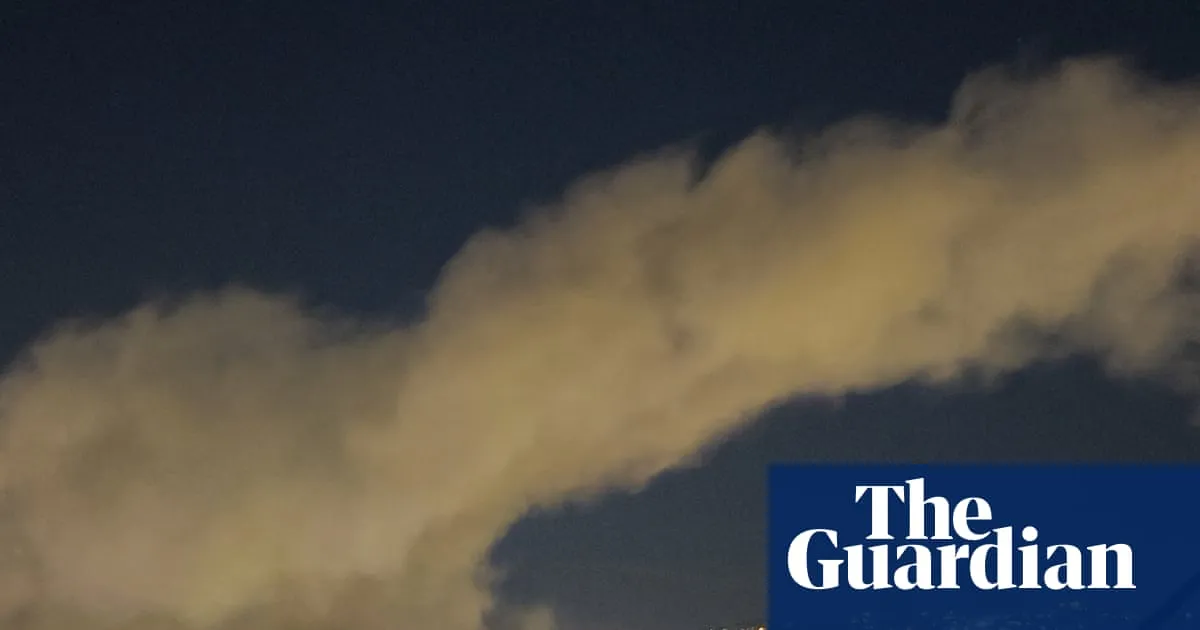
Israel carried out heavy airstrikes on the Hezbollah-controlled southern suburbs of Beirut on Monday, after the Iran-backed group launched missiles and drones towards Israel in retaliation for the killing of Iran’s Supreme Leader Ali Khamenei.Residents of Beirut were awoken by the sounds of about a dozen blasts at 3am on Monday, as Israel struck three different locations in the southern suburbs of the capital.The explosions rocked windows around the capital city and were heard from miles away. People in southern Lebanon heard warplanes and bombs being dropped as airstrikes were carried out over wide swathes of the south of the country, collapsing buildings in the villages near Tyre, southern Lebanon.Hezbollah said in a statement that it had launched a barrage of missiles and drones at the Mishmar al-Karmel missile defence facility near Haifa, around midnight, in “retaliation” for the killing of Khameinei" and “in defence of Lebanon and its people”Israel responded just a few hours later, hitting what it described as Hezbollah targets across south Lebanon, the Bekaa valley and the Beirut suburb of Dahieh. The Israeli military claimed the strikes on Dahieh had killed several senior Hezbollah officers.“Hezbollah opened a campaign against Israel overnight and is fully responsible for any escalation. Any enemy that threatens our security will pay a heavy price,” the chief of the Israeli military Lt Gen Eyal Zamir said in a statement.An Israeli military spokesperson issued evacuation orders for 55 different villages and towns across Lebanon, asking people to get at least 1,000 meters away from them as they are near “Hezbollah operatives and facilities.” Earlier on Sunday, the Israeli military announced the deployment of 100,000 reservists, many of them along the border with Lebanon.People leave in their cars after Israeli strikes on Beirut's southern suburbs. Photograph: Ahmad Al Kerdi/ReutersStreams of people began to flee Dahieh by car and by foot, and lines of cars began to form outside petrol stations in the southern city of Tyre as residents began to head northwards. The highways from Dahieh to the capital city were gridlocked with scooters and cars driving over rubble and debris from the earlier strikes. In the south, people drove northwards on both sides of the highway to escape the traffic.Videos showed the tops of buildings in Dahieh engulfed in flames, while burnt out husks of cars lay at the feet of the crumpled buildings. As they scrambled to flee, witnesses reported seeing rocket barrages flying from south Lebanon towards Israel, in what seemed to be Hezbollah artillery volleys. The memory of the 13-month war between Israel and Hezbollah that ended in 2024 loomed large in the minds of Lebanese. Fears spread quickly that Dahieh, the Bekaa valley and large parts of the south could be rendered uninhabitable as it was then. Israeli bombed those areas daily during the war and nearly 4,000 people were killed and a million displaced.In the early hours of Monday, families and friends quickly devised plans for what they should do and tried to understand what exactly was happening, as the number of displaced people from affected areas in Lebanon grew.Lebanon’s government quickly condemned Hezbollah’s decision to bomb Israel without consulting the state. Without naming the militant group by name, Lebanese prime minister Nawaf Salam said he will “not allow the country to be dragged into new adventures.”“The rocket fire from southern Lebanon is an irresponsible and suspicious act that jeopardises Lebanon’s security and safety and provides Israel with pretexts to continue its aggression,” Salam said in a post on X.For weeks, Lebanese officials had scrambled to prevent Hezbollah from joining any potential war in Iran, as Israel passed messages to its Lebanese counterparts that any attack would engender a wide-ranging response against the entire country.
SRCThe Guardian - World News
LANGEN
LEANCenter-Left
WORDS617
ENT9
MON · 2026-03-02 · 02:43 GMTBRIEF NSR-2026-0302-20483
NSR-2026-0302-20483News Report·EN·Conflict
Israel strikes Hezbollah in Lebanon after Iran-allied group launches missiles over the border
Following missile and drone launches by Hezbollah targeting northern Israel, Israel conducted heavy airstrikes on Hezbollah-controlled areas in Lebanon early Monday. The strikes, which targeted southern Beirut and southern Lebanon, were in response to Hezbollah's attacks, which the group claimed were retaliation for the killing of Iran's Supreme Leader and in defense of Lebanon.
William Christou in BeirutThe Guardian - World NewsFiled 2026-03-02 · 02:43 GMTLean · Center-LeftRead · 3 min
The Guardian - World NewsFIG 01
Reading time
3min
Word count
617words
Sources cited
3cited
Entities identified
9entities
Quality score
100%
§ 01
Briefing Summary
AI-generatedNEWSAR · AI
Following missile and drone launches by Hezbollah targeting northern Israel, Israel conducted heavy airstrikes on Hezbollah-controlled areas in Lebanon early Monday. The strikes, which targeted southern Beirut and southern Lebanon, were in response to Hezbollah's attacks, which the group claimed were retaliation for the killing of Iran's Supreme Leader and in defense of Lebanon. Israel stated the strikes on Dahieh killed senior Hezbollah officers. The Israeli military issued evacuation orders for 55 villages and towns in Lebanon and deployed 100,000 reservists to the border. Residents of southern Beirut and southern Lebanon fled northwards following the Israeli strikes, causing gridlock on highways.
Confidence 0.90Sources 3Claims 5Entities 9
§ 02
Article analysis
Model · rule-basedFraming
Conflict
National Security
Tone
Mixed Tone
AI-assessed
CalmNeutralAlarmist
Factuality
0.80 / 1.00
Factual
LowHigh
Sources cited
3
Well sourced
FewMany
§ 03
Key claims
5 extracted01
An Israeli military spokesperson issued evacuation orders for 55 different villages and towns across Lebanon.
factualIsraeli military spokesperson
Confidence
1.00
02
The Israeli military claimed the strikes on Dahieh had killed several senior Hezbollah officers.
quoteIsraeli military
Confidence
1.00
03
Hezbollah said it launched a barrage of missiles and drones at the Mishmar al-Karmel missile defence facility.
quoteHezbollah
Confidence
1.00
04
Hezbollah launched missiles and drones towards Israel in retaliation for the killing of Iran’s Supreme Leader Ali Khamenei.
factual
Confidence
1.00
05
Israel carried out heavy airstrikes on the Hezbollah-controlled southern suburbs of Beirut.
factual
Confidence
1.00
§ 04
Full report
3 min read · 617 words§ 05
Entities
9 identifiedKey playerOppositionContextPositiveNeutralNegative
Organizations1
§ 06
Keywords & salience
10 termsisrael
1.00
hezbollah
1.00
lebanon
0.90
airstrikes
0.90
missiles
0.80
military strikes
0.70
retaliation
0.70
beirut
0.60
iran
0.60
escalation
0.50
§ 07
Topic connections
Interactive graph Network visualization showing 51 related topics
View Full Graph Person Organization Location Event|Click node to navigate|Edge numbers = shared articles