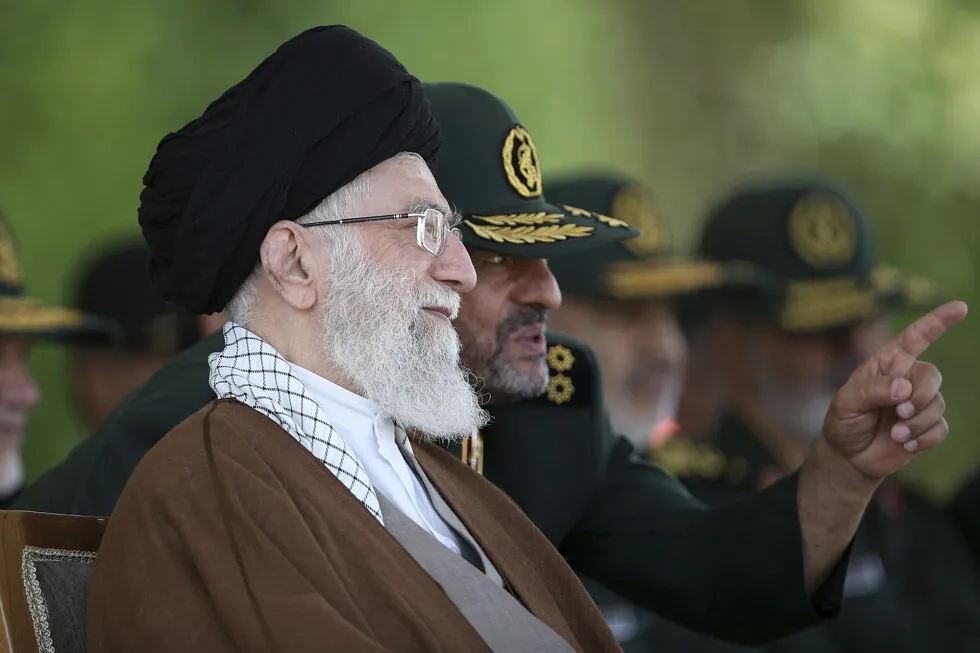
FILE- In this picture released by the official website of the office of the Iranian supreme leader, Supreme Leader Ayatollah Ali Khamenei listens to the then commander of the Revolutionary Guard Mohammad Ali Jafari during a graduation ceremony of a group of the guard’s officers in Tehran, Iran, May 20, 2015. (Office of the Iranian Supreme Leader via AP, File) Updated [hour]:[minute] [AMPM] [timezone], [monthFull] [day], [year] DUBAI, United Arab Emirates (AP) — Iran’s paramilitary Revolutionary Guard has grown into a powerful force within the country’s theocracy, answering only to its supreme leader and overseeing its ballistic missile arsenal and launching attacks overseas. The force is again in the spotlight as Iran widens its attacks across the Middle East following the start of a U.S.-Israeli airstrike campaign that’s already killed the country’s Supreme Leader Ayatollah Ali Khamenei. Here’s what to know about the Guard. Born out of a revolutionThe Guard rose out of Iran’s 1979 Islamic Revolution as a force meant to protect the country’s Shiite cleric-overseen government and later became enshrined in its constitution. It operated parallel to Iran’s regular armed forces, growing in prominence and power during a long and ruinous war with Iraq in the 1980s.Though it faced possible disbandment after the war, Khamenei granted it powers to expand into private enterprise, allowing the force to thrive. The Guard runs a massive construction company called Khatam al-Anbia and has firms that also build roads, man ports, run telecommunication networks and even offer laser eye surgery. Foreign operations are key for the GuardThe Guard’s expeditionary Quds Force was key in creating what Iran describes as its “Axis of Resistance” against Israel and the United States. It backed Syria’s former President Bashar Assad, Lebanon’s militant Hezbollah group, Yemen’s Houthi rebels and other groups in the region, growing in power in the wake of the U.S.-led invasion of Iraq in 2003.U.S. officials say the Guard taught Iraqi militants how to manufacture and use especially deadly roadside bombs against U.S. troops there. The Quds Force, as well as Iranian intelligence agencies, are believed to have hired criminal gangs and others to target dissidents and Iran’s perceived enemies abroad. Since the latest Israel-Hamas war, Israel has arrested citizens it has accused of receiving orders from Iran to surveil targets or conduct vandalism. Iran has denied being involved in those plots. The Guard is also believed to be heavily involved in smuggling throughout the Middle East. Guard’s intelligence arm is tied to arrests of foreignersThe Guard also operates its own intelligence services and has been behind a series of arrests and convictions of dual nationals and those with Western ties on espionage charges in closed hearings. Western nations and others described Iran as using those prisoners as bargaining chips in negotiations, particularly over its nuclear program. War with Israel puts new pressure on the GuardThe Guard’s carefully laid “Axis of Resistance” has faced its greatest challenge in the wake of the Oct. 7, 2023, Hamas attack on Israel that triggered the war in Gaza. The Palestinian militant Hamas group is among those backed by Iran. Israel is still battling Hamas in Gaza even as it has targeted other Iranian-backed groups, decimating Hezbollah and repeatedly targeting the Houthis in Yemen.In Syria, Assad’s government fell in December 2024, taking away a key ally for Tehran and the Guard. Israel and Iran exchanged missile fire, something overseen by the Guard. In June, Israel launched a massive airstrike campaign targeting Iran. In its first day, those strikes killed top generals in the Guard, throwing the force into disarray. Israeli attacks also destroyed ballistic missile sites and launchers, as well as Guard-manned air defense systems. Crackdown on recent protestsIn Iran, one of the main ways its theocracy can squash demonstrations is through the Basij, the Guard’s all-volunteer arm. Videos from the protests that began on Dec. 28 show Basij members holding long guns, batons and pellet guns. Their forces have been seen beating protesters and chasing them through the streets. One well-known Basij commander even went on state television to warn parents to keep their children at home as he called for the force’s members to assemble to put down the demonstrations. The European Union in January listed the Guard as a terrorist organization over Tehran’s bloody crackdown on the protests. Who controls the Guard now in questionIran’s foreign minister has suggested his country’s military units are acting independently from any central government control after being pressed about attacks on Gulf Arab nations that have served as intermediaries for Tehran in the past.Already, there have been attacks on Oman, which served as an intermediary in recent nuclear talks with the United States, and on Qatar, which also has negotiated with Tehran and shares a massive offshore natural gas field in the Persian Gulf with the Islamic Republic.“What happened in Oman was not our choice. We have already told our, you know, army, armed forces to be careful about the targets that they choose,” Abbas Araghchi told Al Jazeera on March 1. “As a matter of fact, our, you know, military units are now in fact independent and somehow isolated and they are acting based on instructions — you know, general instructions — given to them in advance.” Militaries around the world do contingency planning for wars, including what to do if their central governments are affected. But Iran is a special case given that the Guard controls its vast ballistic missile arsenal and much of its stockpile of bomb-carrying drones. Araghchi’s comments also could serve as an excuse for the attacks as well to try to ease tensions with Iran’s Gulf Arab neighbors, who have grown increasingly enraged by the constant fire targeting them despite efforts at easing tensions in recent years. Gambrell is the news director for the Gulf and Iran for The Associated Press. He has reported from each of the Gulf Cooperation Council countries, Iran and other locations across the world since joining the AP in 2006.
SRCAssociated Press (AP)
LANGEN
LEANCenter
WORDS992
ENT12
MON · 2026-03-02 · 05:53 GMTBRIEF NSR-2026-0302-20534
NSR-2026-0302-20534News Report·EN·National Security
What to know about Iran’s Revolutionary Guard, a powerful force within the country’s theocracy
The Iranian Revolutionary Guard is a powerful paramilitary force within Iran, established after the 1979 Islamic Revolution to protect the theocracy. It answers only to the Supreme Leader and operates independently of the regular armed forces.
By
JON GAMBRELLAssociated Press (AP)Filed 2026-03-02 · 05:53 GMTLean · CenterRead · 4 min
Associated Press (AP)FIG 01
Reading time
4min
Word count
992words
Sources cited
2cited
Entities identified
12entities
Quality score
100%
§ 01
Briefing Summary
AI-generatedNEWSAR · AI
The Iranian Revolutionary Guard is a powerful paramilitary force within Iran, established after the 1979 Islamic Revolution to protect the theocracy. It answers only to the Supreme Leader and operates independently of the regular armed forces. The Guard controls Iran's ballistic missile arsenal, conducts foreign operations through its Quds Force, and backs groups like Hezbollah and the Houthis. It also has significant economic power, running construction companies and other businesses. The Guard's Quds Force is accused of training militants and hiring criminals to target Iran's enemies abroad, which Iran denies.
Confidence 0.90Sources 2Claims 5Entities 12
§ 02
Article analysis
Model · rule-basedFraming
National Security
Political Strategy
Tone
Measured
AI-assessed
CalmNeutralAlarmist
Factuality
0.80 / 1.00
Factual
LowHigh
Sources cited
2
Limited
FewMany
§ 03
Key claims
5 extracted01
The Guard runs a massive construction company called Khatam al-Anbia.
factualAP
Confidence
1.00
02
The Guard also operates its own intelligence services and has been behind a series of arrests and convictions of dual nationals.
factualAP
Confidence
0.90
03
The Guard’s expeditionary Quds Force was key in creating what Iran describes as its “Axis of Resistance” against Israel and the United States.
quoteAP
Confidence
0.90
04
Iran’s paramilitary Revolutionary Guard has grown into a powerful force within the country’s theocracy.
factualAP
Confidence
0.90
05
U.S. officials say the Guard taught Iraqi militants how to manufacture and use especially deadly roadside bombs against U.S. troops there.
factualU.S. officials
Confidence
0.80
§ 04
Full report
4 min read · 992 words§ 05
Entities
12 identifiedKey playerOppositionContextPositiveNeutralNegative
People2
Organizations3
§ 06
Keywords & salience
10 termsrevolutionary guard
1.00
iran
0.90
theocracy
0.80
ballistic missile arsenal
0.70
islamic revolution
0.60
quds force
0.60
middle east
0.50
supreme leader
0.50
axis of resistance
0.50
foreign operations
0.40
§ 07
Topic connections
Interactive graph Network visualization showing 51 related topics
View Full Graph Person Organization Location Event|Click node to navigate|Edge numbers = shared articles