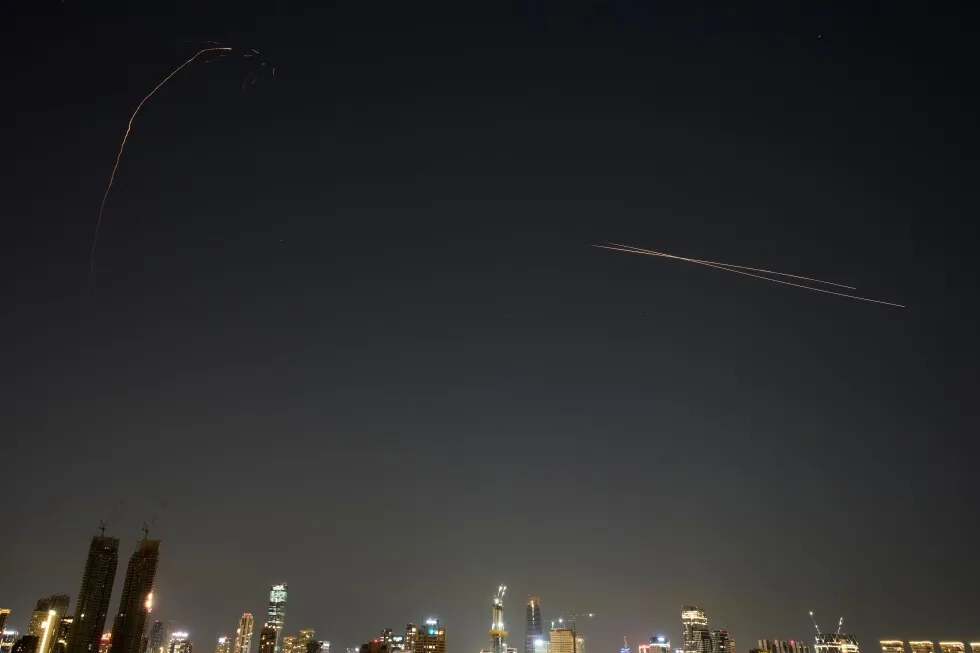
Israeli air defense system fires to intercept missiles during an Iranian attack over Tel Aviv, Israel, early Tuesday, March 3, 2026. (AP Photo/Ohad Zwigenberg) Updated [hour]:[minute] [AMPM] [timezone], [monthFull] [day], [year] WASHINGTON (AP) — The U.S. and Israeli attacks on Iran add yet more question marks around a U.S. economy already buffeted by on-and-off tariffs, weak hiring, and lingering inflationary pressures. The war has already raised oil prices and could lift prices at the pump as early as this week, but the ultimate impact on the economy and inflation will depend on the length and severity of the conflict, economists say. Should it wind down in a week or two, its economic effects would be minor and short-lived. Yet a longer war that pushed oil past $100 a barrel for an extended period would worsen inflation, at least temporarily, while slowing growth and intensifying Americans’ unhappiness with the cost of essentials. After nearly five years of rising prices, concerns around affordability have undercut President Donald Trump’s support in polls and bolstered Democrats in recent elections. For now, the price of a barrel of benchmark U.S. crude rose 6.3% Monday to settle at $71.23. Brent crude, the international standard, climbed 6.7% to $77.74 per barrel. An increase at that level, even if sustained, would barely lift inflation, economists said. “While cost-conscious Americans who are dealing with an affordability crisis will not take this increase lightly, such an increase will not materially affect economic growth,” Joe Brusuelas, an economist at RSM, a consulting firm, said. Stock prices rebounded to show a small gain Monday after initially falling sharply, a sign of optimism that the war will be short-lived.But a longer-lasting conflict, particularly one that closed down the Strait of Hormuz at the edge of the Persian Gulf, through which roughly 25% of the world’s oil passes, could push oil past that $100 a barrel mark. Gas prices in the U.S. could then reach $3.50 a gallon, up from just under $3 on average nationwide on Monday. Such price jumps would accelerate inflation in the U.S. and slow growth, economists said. “Markets are right now really under-pricing the tail risk of a sustained engagement and an operation that does not wrap up quickly, restore travel through the Strait of Hormuz and get everything back to de-escalation and normal in a timely manner,” said Alex Jacquez, chief of policy and advocacy at the Groundwork Collaborative and an economic adviser to the Biden White House. Here are some ways the war could affect the economy. Inflation has lingered even as gas prices have fallen While some measures of inflation have cooled in recent months, the Federal Reserve’s preferred measure has been stuck at about 3% for roughly a year. That is above the central bank’s 2% target, and has occurred even as gas prices fell steadily in 2025. Should gas prices rise significantly, air fares could also rise as airlines face bigger fuel costs. Shipping would also become more expensive, which could add to grocery prices.Natural gas prices also jumped Monday, as roughly 20% of the world’s gas travels through the Strait of Hormuz and a liquid natural gas plant was shut down in Qatar. That could raise heating prices in the U.S. Natural gas has already gotten 10% more expensive in the past year, thanks in part to spiking energy usage by data centers powering AI. Still, economists noted that the U.S. economy is not as oil-dependent as it has been in the past, with most Americans now working in services, rather than manufacturing. And other factors may help keep oil price increases relatively limited. Rory Johnston, founder of Commodity Context, an oil analytics firm, pointed out that oil inventories were quite high before the conflict, which helped keep prices in check. That’s in sharp contrast to the winter of 2022, he said, when post-COVID supply chain problems had already pushed up oil costs even before Russia’s invasion of Ukraine caused a much bigger spike. Monday’s increase “is a very minor spike relative to” what happened after Russia’s invasion, Johnston said. Businesses may pull back amid uncertaintyIf the Iran war drags on for months, it could also torpedo business confidence, which could lead companies to invest and hire less, said Kathy Bostjancic, chief economist at Nationwide Financial. “When there is an injection of new uncertainty into the business environment ... that’s a hit to confidence,” she said. The result could be similar to the impact of Trump’s tariffs, which did not raise prices as much as many economists feared, but did appear to weigh on job gains. Hiring in 2025 was the weakest, outside of a recession, since 2002. Consumers sour further on economyEven without a big inflation spike, a major risk for Trump is that Americans sour on his economic leadership. According to surveys, Americans already have a gloomy outlook on the economy, largely because of the lingering effects of the price spikes of the past five years. Trump’s attempts to portray the U.S. as in a “golden age” have had little impact on those attitudes.A protracted conflict in Iran that raised gas prices would likely make it worse, Jacquez said. “People generally don’t think that President Trump is focused on the things that they are focused on,” Jacquez added, “and what they want him to be focused on is the price of groceries. What they think he’s focused on are things like tariffs and foreign policy.” Rugaber has covered the Federal Reserve and the U.S. economy for the AP for 16 years. He is a two-time finalist for the Gerald Loeb award for business reporting.
SRCAssociated Press (AP)
LANGEN
LEANCenter
WORDS933
ENT9
TUE · 2026-03-03 · 08:53 GMTBRIEF NSR-2026-0303-20914
NSR-2026-0303-20914News Report·EN·Economic Impact
Iran attacks threaten US economy with more uncertainty around inflation, growth
The recent U.S. and Israeli attacks on Iran have introduced economic uncertainty, potentially impacting inflation and growth in the U.S.
By
CHRISTOPHER RUGABERAssociated Press (AP)Filed 2026-03-03 · 08:53 GMTLean · CenterRead · 4 min
Associated Press (AP)FIG 01
Reading time
4min
Word count
933words
Sources cited
3cited
Entities identified
9entities
Quality score
100%
§ 01
Briefing Summary
AI-generatedNEWSAR · AI
The recent U.S. and Israeli attacks on Iran have introduced economic uncertainty, potentially impacting inflation and growth in the U.S. The conflict has already caused a rise in oil prices, with benchmark U.S. crude settling at $71.23 a barrel and Brent crude at $77.74. Economists suggest that a short conflict would have minimal economic impact, but a prolonged war, especially one disrupting oil flow through the Strait of Hormuz, could push oil prices above $100 a barrel. This could lead to increased gas prices, accelerate inflation, and slow economic growth in the U.S., exacerbating concerns about affordability. While stock prices initially fell, they rebounded, indicating some optimism for a swift resolution to the conflict.
Confidence 0.90Sources 3Claims 5Entities 9
§ 02
Article analysis
Model · rule-basedFraming
Economic Impact
Political Strategy
Tone
Measured
AI-assessed
CalmNeutralAlarmist
Factuality
0.70 / 1.00
Factual
LowHigh
Sources cited
3
Well sourced
FewMany
§ 03
Key claims
5 extracted01
For now, the price of a barrel of benchmark U.S. crude rose 6.3% Monday to settle at $71.23.
statistic
Confidence
1.00
02
Markets are right now really under-pricing the tail risk of a sustained engagement.
quoteAlex Jacquez, chief of policy and advocacy at the Groundwork Collaborative
Confidence
0.90
03
A longer war that pushed oil past $100 a barrel for an extended period would worsen inflation.
prediction
Confidence
0.80
04
The war has already raised oil prices and could lift prices at the pump as early as this week.
prediction
Confidence
0.70
05
Gas prices in the U.S. could then reach $3.50 a gallon.
prediction
Confidence
0.60
§ 04
Full report
4 min read · 933 words§ 05
Entities
9 identifiedKey playerOppositionContextPositiveNeutralNegative
Organizations2
§ 06
Keywords & salience
8 termsus economy
0.90
inflation
0.80
oil prices
0.70
economic growth
0.70
gas prices
0.60
strait of hormuz
0.60
affordability crisis
0.50
iran attacks
0.50
§ 07
Topic connections
Interactive graph Network visualization showing 51 related topics
View Full Graph Person Organization Location Event|Click node to navigate|Edge numbers = shared articles