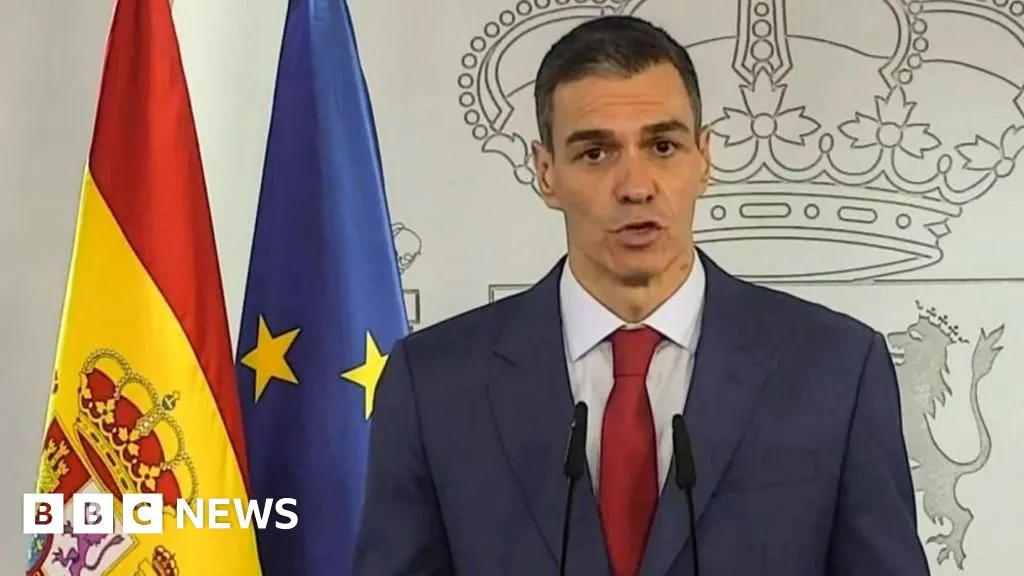
33 minutes agoGuy Hedgecoe,In MadridandPaul Kirby,Europe digital editorLa Moncloa HandoutPedro Sánchez told Spaniards that one 'illegality' could not be met with anotherSpanish Prime Minister Pedro Sánchez has delivered a strong rebuttal to US President Donald Trump's threat to end trade with Spain by restating his opposition to war and what he called the "breakdown of international law".In a 10-minute televised address, Sánchez reflected on the wars in Ukraine and Gaza as well as the Iraq War more than 20 years ago and said the Spanish government's position was "no to war".Trump threatened to impose a full trade embargo on Spain in response to Madrid's refusal to allow the US to use the jointly-run bases at Morón and Rotafor for strikes on Iran."Spain has been terrible," Trump said during a meeting with German Chancellor Friedrich Merz on Tuesday."We're going to cut off all trade with Spain. We don't want anything to do with Spain," he added.Merz said later he had told Trump very clearly that he could not conclude a separate trade agreement with Germany or all of Europe but not with Spain.Trump has also accused Spain of being a "terrible partner" in Nato for failing to increase its defence budget in line with a target of 5% of economic output (GDP). Earlier this year Sánchez drew Trump's anger by speaking out against the US military incursion into Venezuela.Watch: Trump lashes out at Spain, says he is 'going to cut off all trade'In his televised address from the prime minister's Madrid residence at La Moncloa, Sánchez said the government was studying economic measures to counter the impact of the conflict on Spaniards."The question is not if we are on the side of the ayatollahs - nobody is. The question is whether we are in favour of peace and international legality."Spain's Socialist prime minister explained that the government's position was comparable to its stance on Ukraine and Gaza. Sánchez has been a vociferous critic of Israel's military response to the Hamas attacks in 2023.Spain has been among Europe's most outspoken governments on Gaza, describing Israel's actions there as "genocide" and acknowledging a Palestinian state before many other EU members did. That position was in step with his coalition partners to his left and, broadly speaking, with Spanish attitudes to the Middle East.Looking back to the invasion of Iraq in 2003, which he said had failed to achieve its goals and had made life worse for ordinary people, he warned that the attacks on Iran could have a similar economic impact for millions.His reference to the Iraq invasion will connect with many Spanish voters. Spain's support at the time from the conservative People's Party (PP) government was deeply unpopular, and triggered mass anti-war protests. Many believe it also lay the groundwork for the Socialist Party's surprise election victory in March 2004, days after Madrid was hit by deadly jihadist bombings.Aside from the fierce criticism Sánchez is facing from the US, Sánchez's coalition government has faced months of enormous political pressure, generating constant speculation that its collapse could be imminent.It has been struggling to maintain its parliamentary majority, which includes an array of left-wing and regional nationalist parties. Allegations of corruption against several of his allies and his inner circle have severely weakened his position. In Spain's deeply polarised politics, much of the support for Sánchez is driven as much by concerns about the country's right and far right as it is by endorsement of his leadership and policies.Standing up to the US president may have electoral benefits for the Socialist leader. A recent poll by the CIS research institute found that 77% of Spaniards had a "bad" or "very bad" opinion of Trump, suggesting that even many right-wing voters might back Sánchez on this issue.However, there is now uncertainty in Spain over whether Trump's threats will translate into some form of economic reprisals, and many Spaniards will be watching this drama nervously.
SRCBBC News - World
LANGEN
LEANCenter
WORDS649
ENT12
WED · 2026-03-04 · 10:40 GMTBRIEF NSR-2026-0304-21277
NSR-2026-0304-21277News Report·EN·Diplomatic
Spain's Pedro Sánchez hits back at Trump threat to sever trade saying 'no to war'
Spanish Prime Minister Pedro Sánchez responded to Donald Trump's threat to end trade with Spain by reaffirming his opposition to war and defending international law. Trump's threat came after Spain refused to allow the US to use jointly-run military bases for potential strikes on Iran.
BBC News - WorldFiled 2026-03-04 · 10:40 GMTLean · CenterRead · 3 min
BBC News - WorldFIG 01
Reading time
3min
Word count
649words
Sources cited
3cited
Entities identified
12entities
Quality score
100%
§ 01
Briefing Summary
AI-generatedNEWSAR · AI
Spanish Prime Minister Pedro Sánchez responded to Donald Trump's threat to end trade with Spain by reaffirming his opposition to war and defending international law. Trump's threat came after Spain refused to allow the US to use jointly-run military bases for potential strikes on Iran. Trump also criticized Spain's defense spending and its stance on Venezuela. Sánchez stated that Spain's position is comparable to its stance on Ukraine and Gaza, emphasizing a commitment to peace and international legality. Sánchez also mentioned the government was studying economic measures to counter the impact of the conflict on Spaniards.
Confidence 0.90Sources 3Claims 5Entities 12
§ 02
Article analysis
Model · rule-basedFraming
Diplomatic
Economic Impact
Tone
Measured
AI-assessed
CalmNeutralAlarmist
Factuality
0.70 / 1.00
Factual
LowHigh
Sources cited
3
Well sourced
FewMany
§ 03
Key claims
5 extracted01
Sánchez said the government was studying economic measures to counter the impact of the conflict on Spaniards.
factualPedro Sánchez
Confidence
1.00
02
Spain has been among Europe's most outspoken governments on Gaza, describing Israel's actions there as "genocide".
factualGuy Hedgecoe, Paul Kirby
Confidence
1.00
03
Trump said, "We're going to cut off all trade with Spain. We don't want anything to do with Spain."
quoteDonald Trump
Confidence
1.00
04
Trump threatened to impose a full trade embargo on Spain in response to Madrid's refusal to allow the US to use bases for strikes on Iran.
factualGuy Hedgecoe, Paul Kirby
Confidence
1.00
05
Pedro Sánchez restated his opposition to war and the 'breakdown of international law' in response to Trump's threat.
factualGuy Hedgecoe, Paul Kirby
Confidence
1.00
§ 04
Full report
3 min read · 649 words§ 05
Entities
12 identifiedKey playerOppositionContextPositiveNeutralNegative
People3
Organizations1
§ 06
Keywords & salience
10 termstrade war
0.90
international law
0.80
pedro sánchez
0.80
donald trump
0.70
spain
0.70
trade embargo
0.60
ukraine
0.50
gaza
0.50
us military bases
0.50
peace
0.40
§ 07
Topic connections
Interactive graph Network visualization showing 29 related topics
View Full Graph Person Organization Location Event|Click node to navigate|Edge numbers = shared articles