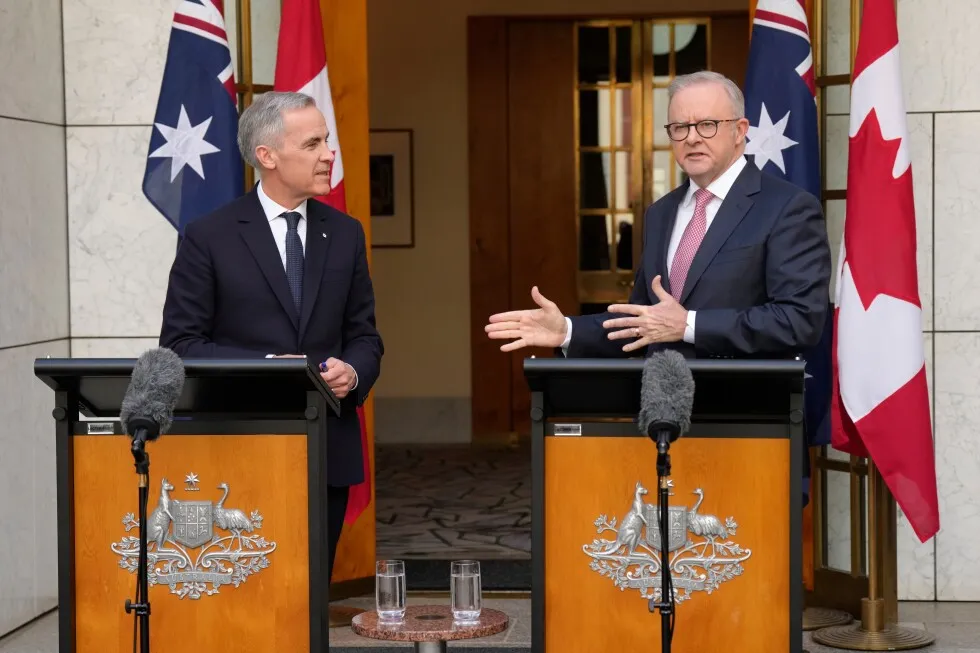
Canada and Australia leaders urge war de-escalation, but agree Iran can’t get nuclear weapons 1 of 4 | Canadian and Australian prime ministers have called for a de-escalation of the Iran-war" class="entity-link entity-event" data-entity-id="38748" data-entity-type="event">Iran war but added the Iranians must never gain a nuclear weapon. 2 of 4 | Canada’s Prime Minister Mark Carney, left, and Australian Prime Minister Anthony Albanese participate in a joint news conference, in Canberra, Australia, Thursday, March 5, 2026. (Adrian Wyld/The Canadian Press via AP) 3 of 4 | Canada’s Prime Minister Mark Carney, left, and Australian Prime Minister Anthony Albanese participate in a joint news conference, in Canberra, Australia, Thursday, March 5, 2026. (Adrian Wyld/The Canadian Press via AP) 4 of 4 | Canada’s Prime Minister Mark Carney, right, shakes hands with Australian Prime Minister Anthony Albanese as he arrives at Parliament in Canberra, Australia, Thursday, March 5, 2026. (Adrian Wyld/The Canadian Press via AP) 1 of 4 Canadian and Australian prime ministers have called for a de-escalation of the Iran-war" class="entity-link entity-event" data-entity-id="38748" data-entity-type="event">Iran war but added the Iranians must never gain a nuclear weapon. Add AP News on Google Add AP News as your preferred source to see more of our stories on Google. 2 of 4 Canada’s Prime Minister Mark Carney, left, and Australian Prime Minister Anthony Albanese participate in a joint news conference, in Canberra, Australia, Thursday, March 5, 2026. (Adrian Wyld/The Canadian Press via AP) Add AP News on Google Add AP News as your preferred source to see more of our stories on Google. 3 of 4 Canada’s Prime Minister Mark Carney, left, and Australian Prime Minister Anthony Albanese participate in a joint news conference, in Canberra, Australia, Thursday, March 5, 2026. (Adrian Wyld/The Canadian Press via AP) Add AP News on Google Add AP News as your preferred source to see more of our stories on Google. 4 of 4 Canada’s Prime Minister Mark Carney, right, shakes hands with Australian Prime Minister Anthony Albanese as he arrives at Parliament in Canberra, Australia, Thursday, March 5, 2026. (Adrian Wyld/The Canadian Press via AP) Add AP News on Google Add AP News as your preferred source to see more of our stories on Google. Updated [hour]:[minute] [AMPM] [timezone], [monthFull] [day], [year] MELBOURNE, Australia (AP) — The Canadian and Australian prime ministers on Thursday called for a de-escalation of the Iran-war" class="entity-link entity-event" data-entity-id="38748" data-entity-type="event">Iran war but added the Iranians must never gain a nuclear weapon.Canada’s Mark Carney and his Australian counterpart Anthony Albanese discussed the war during their meeting in Australia’s capital, Canberra.The meeting came after news that a U.S. submarine sank an Iranian warship in the Indian Ocean and Turkey said NATO defenses intercepted a ballistic missile launched from Iran before it entered Turkey’s airspace.“We want to see a broader de-escalation of these hostilities with a broader group of countries than just the direct belligerents involved,” Carney said at a press conference with Albanese.“We stress that that cannot be achieved unless we’re in a position that Iran’s ability to acquire a nuclear weapon, develop a nuclear weapon, and to export terrorism, is ended. So that process must lead to those outcomes,” Carney added. He said the six-nation Gulf Cooperation Council, which were “showing tremendous restraint,” should become involved in the de-escalation process. Albanese said: “The world wants to see a de-escalation and wants to see Iran cease to spread the destinations of its attacks.”“We’re seeing Gulf states, that have not been involved, attacked across the board, including the attacks on civilian and tourist areas as well. But we also want to see the objectives achieved. I want to see the possibility of Iran getting a nuclear weapon removed once and for all,” Albanese said. Questioned by a reporter, Carney could not rule out the Canadian military ever becoming involved in the conflict.“You’ve asked a fundamental hypothetical in a conflict that can spread very broadly,” Carney said.“So one can never categorically rule out participation. We will stand by our allies when it makes sense,” he added.Carney is in Australia on a trade-focused, three-nation visit that began in India last week. He addressed the Australian Parliament on Thursday and will fly to Japan on Friday.
SRCAssociated Press (AP)
LANGEN
LEANCenter
WORDS684
ENT8
THU · 2026-03-05 · 07:53 GMTBRIEF NSR-2026-0305-21603
NSR-2026-0305-21603News Report·EN·Diplomatic
Canada and Australia leaders urge war de-escalation, but agree Iran can’t get nuclear weapons
In Canberra, Australia on Thursday, March 5, 2026, Canadian Prime Minister Mark Carney and Australian Prime Minister Anthony Albanese held a joint news conference addressing the Iran war. The leaders jointly urged for a de-escalation of the conflict.
By
ROD MCGUIRKAssociated Press (AP)Filed 2026-03-05 · 07:53 GMTLean · CenterRead · 3 min
Associated Press (AP)FIG 01
Reading time
3min
Word count
684words
Sources cited
2cited
Entities identified
8entities
Quality score
100%
§ 01
Briefing Summary
AI-generatedNEWSAR · AI
In Canberra, Australia on Thursday, March 5, 2026, Canadian Prime Minister Mark Carney and Australian Prime Minister Anthony Albanese held a joint news conference addressing the Iran war. The leaders jointly urged for a de-escalation of the conflict. However, both Carney and Albanese agreed that Iran must not be allowed to develop or acquire nuclear weapons. The prime ministers discussed the ongoing war during their meeting in Australia. The Associated Press reported on the leaders' statements regarding the need for de-escalation and the prevention of Iran obtaining nuclear capabilities.
Confidence 0.90Sources 2Claims 5Entities 8
§ 02
Article analysis
Model · rule-basedFraming
Diplomatic
National Security
Tone
Measured
AI-assessed
CalmNeutralAlarmist
Factuality
0.80 / 1.00
Factual
LowHigh
Sources cited
2
Limited
FewMany
§ 03
Key claims
5 extracted01
We want to see a broader de-escalation of these hostilities.
quoteMark Carney
Confidence
1.00
02
NATO defenses intercepted a ballistic missile launched from Iran before it entered Turkey’s airspace.
factualTurkey
Confidence
1.00
03
A U.S. submarine sank an Iranian warship in the Indian Ocean.
factualNews report
Confidence
1.00
04
The Iranians must never gain a nuclear weapon.
quoteCanadian and Australian prime ministers
Confidence
1.00
05
Canadian and Australian prime ministers have called for a de-escalation of the Iran war.
factualArticle
Confidence
1.00
§ 04
Full report
3 min read · 684 words§ 05
Entities
8 identifiedKey playerOppositionContextPositiveNeutralNegative
Organizations1
§ 06
Keywords & salience
6 termsnuclear weapons
1.00
war de-escalation
0.90
iran
0.80
australia
0.70
canada
0.70
prime ministers
0.60
§ 07
Topic connections
Interactive graph Network visualization showing 51 related topics
View Full Graph Person Organization Location Event|Click node to navigate|Edge numbers = shared articles