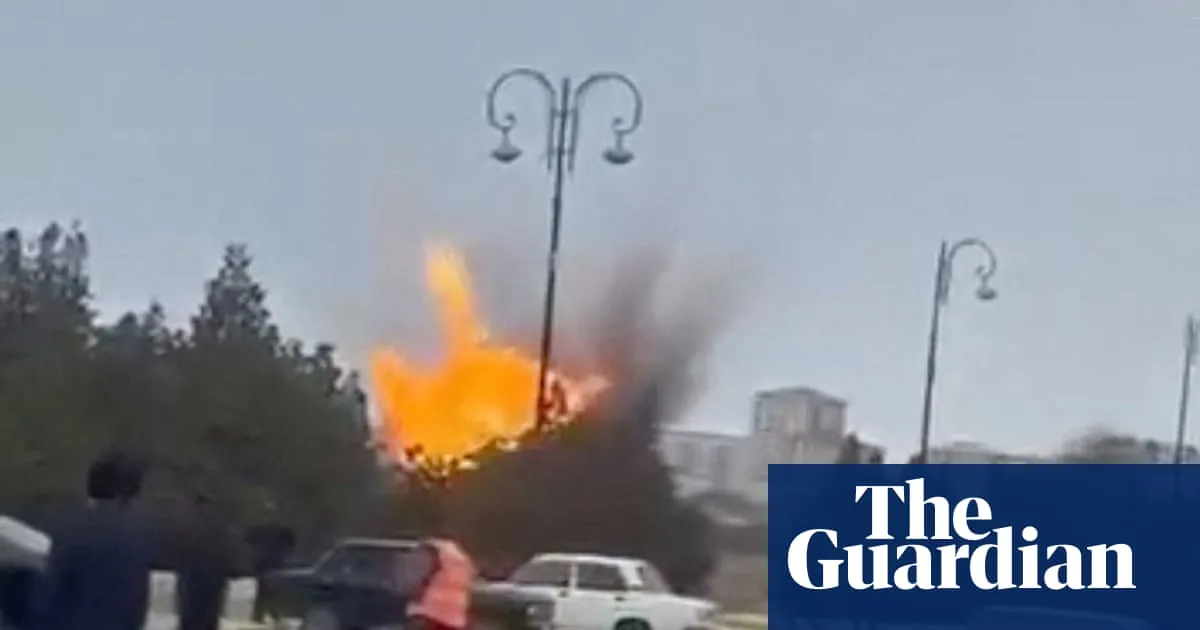
Azerbaijan has accused Iran of a “terrorist” drone attack that struck an airport and injured four civilians, raising concerns the conflict could spread beyond the Middle East.Azerbaijan’s defence ministry said Iran fired four drones at the country, one of which hit the terminal building at the only airport in Nakhchivan, an Azerbaijani exclave bordering Iran. A second drone fell close to a school in a nearby village, the ministry said.The strike would be the first Iranian attack on a Caucasus state since the start of the US-Israel war on the country.In a meeting with his security council, Azerbaijan’s president, Ilham Aliyev, announced he had instructed the military to “prepare and implement response measures.” “We will not tolerate this unprovoked act of terror and aggression against Azerbaijan,” he said.“The Iranian side must provide an official explanation to Azerbaijan, issue an apology and ensure that those responsible are held criminally accountable,” the Azerbaijani leader said, adding that his country “neither participated nor will participate in any operations against Iran this time around”.Iran has denied any connection to the drone attack on Nakhchivan airport. “The Islamic Republic of Iran has not targeted the Republic of Azerbaijan,” Iran’s deputy foreign minister, Kazem Gharibabadi, said in comments carried by Iran’s Tasnim News Agency. “We do not target our neighbouring countries.”An image taken from a video shows damage inside the airport. Photograph: APFootage on social media appeared to show a drone directly striking the airport before a fire broke out.Azerbaijan, an oil-rich authoritarian nation that has adopted a neutral stance in the Middle East conflict, has recently developed closer ties with Israel and the Trump administration while gradually moving away from Moscow, the traditional power broker in the Caucasus.The country hosts no US military bases, a sign Iran may be expanding its strikes beyond nations directly linked to accommodating American forces.Zaur Shiriyev, a non-resident scholar at the Carnegie Endowment for International Peace, said it was still unclear whether Iran had specifically intended to strike Nakhchivan airport. But he added that, if confirmed, the attack would be a serious incident and difficult to dismiss as an accident.“Airports are critical infrastructure, so this is bound to raise serious questions,” he said.Airspace closures in Middle East following Iran strikesThe timing of the apparent strike was notable. A day earlier, Aliyev had visited the Iranian embassy in Baku to offer condolences over the killing of the supreme leader, Ali Khamenei, in US-Israeli strikes last week.“No other head of state has visited any Iranian embassy,” Aliyev said during his meeting with officials. “Not appreciating this, downplaying it, and acting like vile and ungrateful people does not bring honour to anyone.”Baku’s growing military cooperation with Israel has caused growing friction with Tehran, though the two neighbours have largely maintained pragmatic relations. Both countries are majority Shia Muslim, and Iran is home to millions of ethnic Azeris – estimates range from about 15 to more than 20 million people – many living in the north-western provinces bordering Azerbaijan.Azerbaijan’s foreign ministry said the drone hit the terminal building at the airport. Photograph: APThe drone incident will raise tensions in the Caucasus regions. Armenia, Azerbaijan and Georgia have all proclaimed neutrality in the war, keen to avoid being drawn into the widening instability. Armenia and Azerbaijan, which share borders with Iran, fear the prospect of a migration crisis if the conflict escalates or the Iranian state collapses, potentially sending large numbers of refugees north across their frontiers.Further attacks on Azerbaijan could have far-reaching consequences for global air travel, which has already been heavily disrupted by airspace closures across the Middle East. Azerbaijan’s airspace has become a key corridor for flights between Asia and Europe seeking to avoid Russian airspace, and any disruption could create fresh headaches for airlines.Possible Iranian targets in Azerbaijan could include the Baku-Tbilisi-Ceyhan pipeline, which carries crude that accounts for about 30-40% of Israel’s oil imports.Azerbaijan’s threats to retaliate against Iran could also Turkey in a difficult position. Ankara maintains longstanding diplomatic and trade relations with Tehran, but it is also bound by close strategic and military ties with Baku. Under mutual defence agreements between the two countries, Turkey has pledged to provide assistance – including military support – if Azerbaijan is subjected to armed aggression.
SRCThe Guardian - World News
LANGEN
LEANCenter-Left
WORDS704
ENT11
THU · 2026-03-05 · 14:47 GMTBRIEF NSR-2026-0305-21698
NSR-2026-0305-21698News Report·EN·Conflict
Azerbaijan accuses Iran of ‘terrorist’ drone attack on airport that injured two people
Azerbaijan has accused Iran of a "terrorist" drone attack on an airport in Nakhchivan, an Azerbaijani exclave bordering Iran, which allegedly injured four civilians. Azerbaijan's president, Ilham Aliyev, has demanded an apology and accountability from Iran, threatening response measures.
Pjotr SauerThe Guardian - World NewsFiled 2026-03-05 · 14:47 GMTLean · Center-LeftRead · 3 min
The Guardian - World NewsFIG 01
Reading time
3min
Word count
704words
Sources cited
4cited
Entities identified
11entities
Quality score
100%
§ 01
Briefing Summary
AI-generatedNEWSAR · AI
Azerbaijan has accused Iran of a "terrorist" drone attack on an airport in Nakhchivan, an Azerbaijani exclave bordering Iran, which allegedly injured four civilians. Azerbaijan's president, Ilham Aliyev, has demanded an apology and accountability from Iran, threatening response measures. Iran has denied any involvement in the attack, stating they do not target neighboring countries. The alleged strike is the first Iranian attack on a Caucasus state since the start of the US-Israel war. The incident raises concerns about escalating conflict in the region, particularly given Azerbaijan's growing ties with Israel and its neutral stance in the Middle East.
Confidence 0.90Sources 4Claims 5Entities 11
§ 02
Article analysis
Model · rule-basedFraming
Conflict
National Security
Tone
Mixed Tone
AI-assessed
CalmNeutralAlarmist
Factuality
0.70 / 1.00
Factual
LowHigh
Sources cited
4
Well sourced
FewMany
§ 03
Key claims
5 extracted01
Aliyev visited the Iranian embassy in Baku to offer condolences over the killing of the supreme leader.
factual
Confidence
1.00
02
Iran has denied any connection to the drone attack on Nakhchivan airport.
factualIran
Confidence
1.00
03
Azerbaijan has accused Iran of a “terrorist” drone attack that struck an airport.
quoteAzerbaijan
Confidence
1.00
04
The strike would be the first Iranian attack on a Caucasus state since the start of the US-Israel war.
factual
Confidence
0.90
05
Iran fired four drones at Azerbaijan, one of which hit the terminal building at the only airport in Nakhchivan.
factualAzerbaijan’s defence ministry
Confidence
0.90
§ 04
Full report
3 min read · 704 words§ 05
Entities
11 identifiedKey playerOppositionContextPositiveNeutralNegative
Organizations2
§ 06
Keywords & salience
8 termsdrone attack
1.00
azerbaijan
0.90
iran
0.90
terrorism
0.70
nakhchivan airport
0.70
middle east conflict
0.60
international relations
0.50
security
0.40
§ 07
Topic connections
Interactive graph Network visualization showing 5 related topics
View Full Graph Person Organization Location Event|Click node to navigate|Edge numbers = shared articles