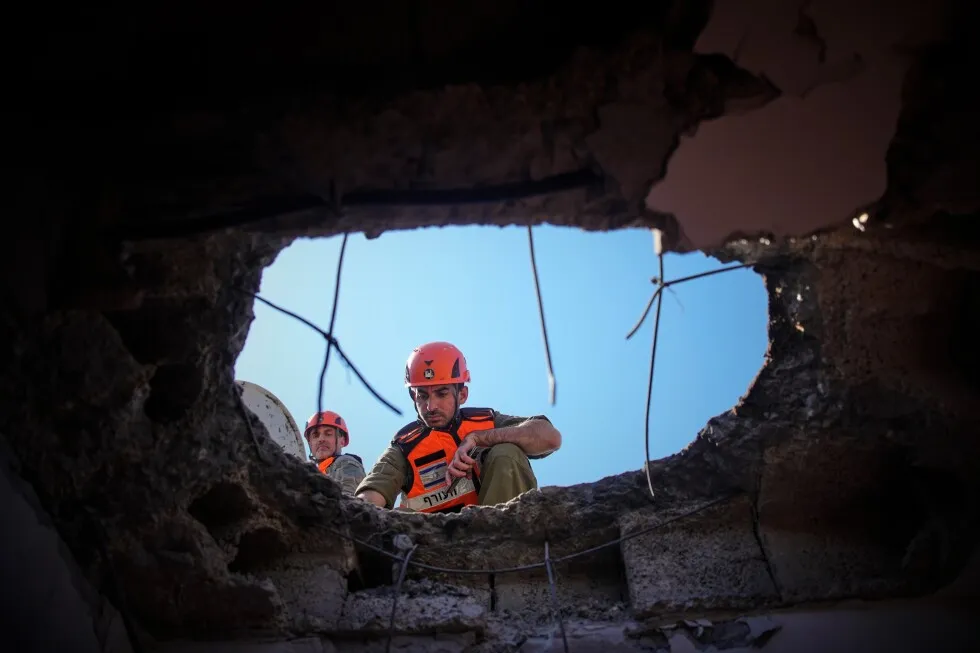
Chaos sown by Iran’s attacks across the Persian Gulf is key to its strategy 1 of 6 | Azerbaijan’s Foreign Ministry on Thursday accused Iran of carrying out a drone attack on its exclave of Nakhchivan. (Produced by Elaine Carroll) 2 of 6 | Officers from Israel’s Home Front Command inspect a damaged apartment building after an Iranian missile strike in Petah Tikva, Israel, Tuesday, March 3, 2026. (AP Photo/Ohad Zwigenberg) 3 of 6 | Large fire and plume of smoke is visible after, according to the authorities, debris of an Iranian intercepted drone hit the Fujairah oil facility, in Fujairah, United Arab Emirates, Tuesday, March 3, 2026. (AP Photo/Altaf Qadri) 4 of 6 | A cleric leads a group of volunteers in prayer next to a police facility struck during the U.S.–Israeli military campaign in Tehran, Iran, Wednesday, March 4, 2026. (AP Photo/Vahid Salemi) 5 of 6 | Debris cover the site of Hezbollah’s Al-Manar TV headquarters after it was hit in an Israeli airstrike on Dahiyeh, a southern suburb of Beirut, Lebanon, Tuesday, March 3, 2026. (AP Photo/Hassan Ammar) 6 of 6 | This satellite image provided by Vantor shows firefighting crews working to contain a fire and damage after a drone attack at Ras Tanura oil refinery, in Saudi Arabia, Monday, March 2, 2026. (Satellite image ©2026 Vantor via AP) 1 of 6 Azerbaijan’s Foreign Ministry on Thursday accused Iran of carrying out a drone attack on its exclave of Nakhchivan. (Produced by Elaine Carroll) Add AP News on Google Add AP News as your preferred source to see more of our stories on Google. 2 of 6 Officers from Israel’s Home Front Command inspect a damaged apartment building after an Iranian missile strike in Petah Tikva, Israel, Tuesday, March 3, 2026. (AP Photo/Ohad Zwigenberg) Add AP News on Google Add AP News as your preferred source to see more of our stories on Google. 3 of 6 Large fire and plume of smoke is visible after, according to the authorities, debris of an Iranian intercepted drone hit the Fujairah oil facility, in Fujairah, United Arab Emirates, Tuesday, March 3, 2026. (AP Photo/Altaf Qadri) Add AP News on Google Add AP News as your preferred source to see more of our stories on Google. 4 of 6 A cleric leads a group of volunteers in prayer next to a police facility struck during the U.S.–Israeli military campaign in Tehran, Iran, Wednesday, March 4, 2026. (AP Photo/Vahid Salemi) Add AP News on Google Add AP News as your preferred source to see more of our stories on Google. 5 of 6 Debris cover the site of Hezbollah’s Al-Manar TV headquarters after it was hit in an Israeli airstrike on Dahiyeh, a southern suburb of Beirut, Lebanon, Tuesday, March 3, 2026. (AP Photo/Hassan Ammar) Add AP News on Google Add AP News as your preferred source to see more of our stories on Google. 6 of 6 This satellite image provided by Vantor shows firefighting crews working to contain a fire and damage after a drone attack at Ras Tanura oil refinery, in Saudi Arabia, Monday, March 2, 2026. (Satellite image ©2026 Vantor via AP) Add AP News on Google Add AP News as your preferred source to see more of our stories on Google. Updated [hour]:[minute] [AMPM] [timezone], [monthFull] [day], [year] DUBAI, United Arab Emirates (AP) — For years, Iran’s theocratic government warned it would blanket the Middle East with missile and drone fire if it felt its existence was threatened.Now, the Islamic Republic is doing just that. Since the U.S. and Israel launched the war Saturday and killed Iranian Supreme Leader Ayatollah Ali Khamenei, Iran has unleashed thousands of drones and ballistic missiles targeting Israel, American military bases and embassies in the region, and energy facilities across the Persian Gulf. Iranian fire has even been directed over its borders with Turkey and Azerbaijan.Iran’s basic strategy is to instill fear about the dangers of a widening war in hopes that allies of the U.S. will apply enough pressure to halt their campaign. A protracted conflict, along with American and Israeli casualties, could also work in Iran’s favor.But the barrage-thy-neighbors strategy also could backfire. A bid to wear down regional defenses and instill fearIran’s first priority is to emerge from the war with its state institutions intact, said Ellie Geranmayeh, deputy director of the Middle East and North Africa program at the European Council on Foreign Relations.“Iran is upping the costs for this U.S. military campaign and regionalizing it from the get-go, as they promised they would if America restarts the war again with Iran,” she said. The U.S. joined Israel last June in a 12-day war, targeting nuclear enrichment sites. Iran maintains its program is peaceful, though its officials had threatened to pursue a bomb while enriching uranium to near-weapons-grade levels. Iran’s leaders believe that by inflicting casualties and disrupting energy production to drive up oil and gas prices, America’s allies or an unsettled public back home will pressure U.S. President Donald Trump to ease back. “The Iranians are banking on basically out-stomaching him, and exhausting him and his allies to the point where they would basically have a diplomatic off-ramp,” Geranmayeh said. Trump is unpredictable, Geranmayeh said, but for now he appears to be pressing for “unconditional surrender to his demands, rather than a negotiated settlement.” The U.S. and Israel have carried out hundreds of airstrikes and inflicted heavy damage on Iranian government, military and nuclear targets. Despite being greatly outgunned, Iran has continued to fire ballistic missiles into Israel, killing 11 people and disrupting life for millions of Israelis. More have been killed in the Gulf Arab states, and the U.S.-Israeli campaign has killed 1,045 people in Iran.After more than two years of war in the Gaza Strip, the Israeli public appears to have little appetite for another lengthy round of fighting. Polls suggest the U.S. public is leery of a protracted conflict. Friends and onetime foes hit alike by IranThe American and Israeli onslaught came after failed U.S.-Iranian talks over Iran’s nuclear program and the West’s sanctions. Trump said Monday his four objectives were to destroy Iran’s missile capabilities, wipe out its navy, prevent it from obtaining a nuclear weapon and ensure that it cannot continue to support allied armed groups.The Iranian response has spared no one in the region — not even Oman, which mediated the latest round of nuclear talks and for decades has maintained a close relationship to Iran. In the 1970s, Iran’s shah helped the late Sultan Qaboos bin Said put down a rebellion. But now Oman has been dragged into the conflict. An Omani port and ships off its coast have been targeted by Iranian missiles. Oman’s port at Duqm helped the USS Abraham Lincoln aircraft carrier with pre-deployment logistics.Saudi Arabia, which has maintained a detente with Tehran since 2023, also came in the crosshairs this week. Its Ras Tanura oil refinery has been repeatedly attacked and the U.S. Embassy in Riyadh got hit by drones — an embarrassing moment for Crown Prince Mohammed bin Salman, who has worked to cultivate a close relationship with Trump.Qatar and the United Arab Emirates, which also have close ties to Trump, have been repeatedly targeted, too. Missile math grows more importantThere’s a grim math equation at play as the war goes on. Iran has a finite number of missiles and drones, just as the Gulf Arab states, the U.S. and Israel all have a limited number of interceptor missiles capable of downing the incoming fire.U.S. Defense Secretary Pete Hegseth said Wednesday that thousands of Iranian missiles and drones have been “intercepted and vaporized” during the war. The Israeli military says it has destroyed dozens of missile launchers.From the American and Israeli side, targeting missiles and their launchers remains key. Both countries had to shoot down Iranian missiles during the war in June and multiple times in the Israel-Hamas war.“In simple terms, we are focused on shooting all the things that can shoot at us,” said U.S. Navy Adm. Brad Cooper, the head of the American military’s Central Command. A senior Western official, speaking on condition of anonymity to discuss intelligence matters, said Iran has several days’ worth of ballistic missiles if it continues firing at current rates, but it may hold some back to wage a longer campaign. The Israeli military says there have been far fewer Iranian missiles launched in recent days as a result of the airstrikes — though warning sirens often wailed across Israel on Wednesday into Thursday.Iran’s strategy may be backfiringIran’s strategy of trying to threaten energy security, drive a wedge between Gulf and Western states and raise costs is “backfiring,” said Hasan Alhasan, a Middle East expert with the London-based International Institute for Strategic Studies. “It’s driving and pushing the Gulf states into closer alignment with the United States,” he said.“The Gulf states can’t simply sit idle and continue absorbing indefinite attacks to their critical infrastructure and to civilians in Gulf cities,” Alhasan said. They are probably trying to both acquire more weapons to intercept incoming fire and find ways to broker an end to the war, he said.Iran’s foreign minister has suggested his country’s military units are now isolated and acting independently from any central government control, a possible excuse for Iran’s increasingly erratic fire.“They are acting based on instructions — you know, general instructions — given to them in advance,” Abbas Araghchi told Al Jazeera on Sunday.But after a Wednesday phone call with Araghchi, Qatar’s prime minister, Sheikh Mohammed bin Abdulrahman Al Thani, “categorically rejected” his assertion that Iranian missiles were only directed at American interests and not intended to target Qatar.___ Keaten reported from Geneva. Associated Press writers Danica Kirka and Jill Lawless in London contributed to this report. Gambrell is the news director for the Gulf and Iran for The Associated Press. He has reported from each of the Gulf Cooperation Council countries, Iran and other locations across the world since joining the AP in 2006. Keaten is the chief Associated Press reporter in Geneva. He previously was posted in Paris and has reported from Afghanistan, the Middle East, North Africa and across Europe.
SRCAssociated Press (AP)
LANGEN
LEANCenter
WORDS1 690
ENT12
THU · 2026-03-05 · 13:23 GMTBRIEF NSR-2026-0305-21724
NSR-2026-0305-21724News Report·EN·Conflict
Iran’s barrage of attacks across the Persian Gulf shows regional chaos is key to its strategy
Iran has been conducting a series of attacks across the Persian Gulf region, targeting countries including Azerbaijan, Israel, the United Arab Emirates, and Saudi Arabia. The attacks, which include drone strikes and missile launches, have resulted in damage to oil facilities, apartment buildings, and other infrastructure.
By
JON GAMBRELL and JAMEY KEATENAssociated Press (AP)Filed 2026-03-05 · 13:23 GMTLean · CenterRead · 7 min
Associated Press (AP)FIG 01
Reading time
7min
Word count
1 690words
Sources cited
1cited
Entities identified
12entities
Quality score
100%
§ 01
Briefing Summary
AI-generatedNEWSAR · AI
Iran has been conducting a series of attacks across the Persian Gulf region, targeting countries including Azerbaijan, Israel, the United Arab Emirates, and Saudi Arabia. The attacks, which include drone strikes and missile launches, have resulted in damage to oil facilities, apartment buildings, and other infrastructure. Iran's Foreign Ministry was accused by Azerbaijan's government of carrying out a drone attack on its exclave of Nakhchivan. The attacks are believed to be part of Iran's strategy to create regional chaos, which is intended to distract from domestic issues and disrupt the stability of neighboring countries. The exact motivations behind these actions remain unclear, but they have been widely condemned by regional leaders.
Confidence 0.90Sources 1Claims 5Entities 12
§ 02
Article analysis
Model · rule-basedFraming
Conflict
Political Strategy
Tone
Mixed Tone
AI-assessed
CalmNeutralAlarmist
Factuality
0.70 / 1.00
Factual
LowHigh
Sources cited
1
Limited
FewMany
§ 03
Key claims
5 extracted01
Hezbollah’s Al-Manar TV headquarters was hit in an Israeli airstrike on Dahiyeh, Beirut, Lebanon, on March 3, 2026.
factualAP Photo/Hassan Ammar
Confidence
1.00
02
A U.S.–Israeli military campaign struck a police facility in Tehran, Iran, on March 4, 2026.
factualAP Photo/Vahid Salemi
Confidence
1.00
03
An Iranian missile strike damaged an apartment building in Petah Tikva, Israel, on March 3, 2026.
factualAP Photo/Ohad Zwigenberg
Confidence
1.00
04
Azerbaijan’s Foreign Ministry accused Iran of carrying out a drone attack on its exclave of Nakhchivan.
factualAzerbaijan’s Foreign Ministry
Confidence
1.00
05
Debris of an Iranian intercepted drone hit the Fujairah oil facility, in Fujairah, United Arab Emirates, on March 3, 2026.
factualAuthorities
Confidence
0.90
§ 04
Full report
7 min read · 1 690 words§ 05
Entities
12 identifiedKey playerOppositionContextPositiveNeutralNegative
Organizations1
§ 06
Keywords & salience
10 termsiran
1.00
attacks
0.90
persian gulf
0.80
regional chaos
0.80
strategy
0.70
drone attack
0.70
missile strike
0.60
oil facility
0.50
united arab emirates
0.40
israel
0.40
§ 07
Topic connections
Interactive graph Network visualization showing 51 related topics
View Full Graph Person Organization Location Event|Click node to navigate|Edge numbers = shared articles