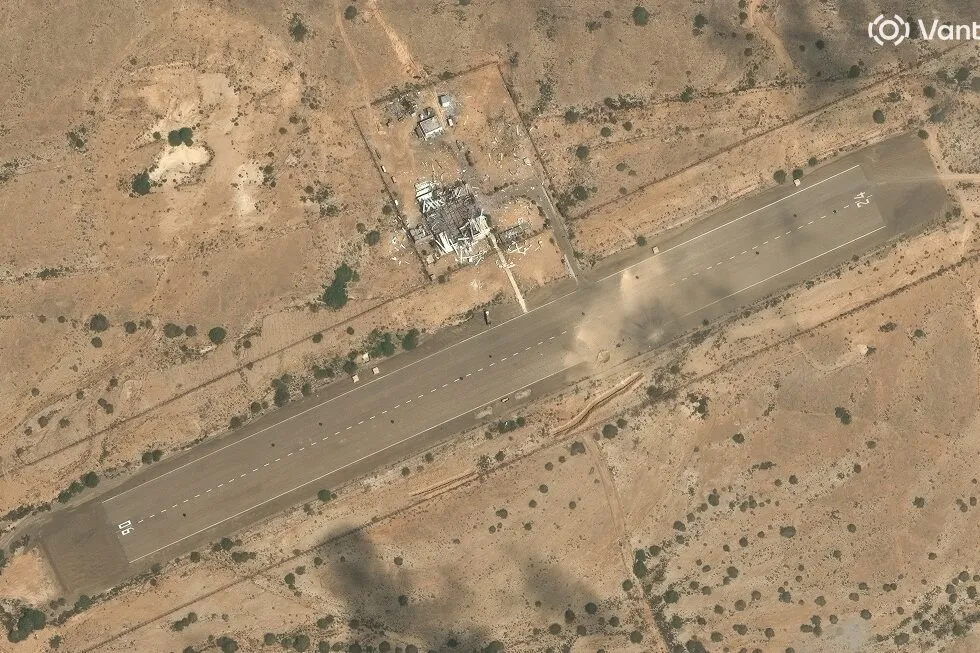
Every facet of Iran’s military and theocracy is under assault. These images show the damage 1 of 7 | This satellite image provided by Vantor shows a destroyed drone storage building and cratered airstrip at Konarak drone base in Iran on Wednesday, March 4, 2026. (Satellite image ©2026 Vantor via AP) 2 of 7 | This satellite image provided by Vantor shows after airstrikes destroyed buildings and equipment at a drone base at Choqa Balk-e facility, west of Kermanshah, Iran, Monday, March 2, 2026. (Satellite image ©2026 Vantor via AP) 3 of 7 | In this satellite image provided by Vantor, damaged buildings are seen in the Ayatollah Ali Khamenei’s official residence in Tehran, Iran, Sunday, March 1, 2026. (Satellite image ©2026 Vantor via AP) 4 of 7 | This satellite image provided by Vantor shows damaged buildings at the Garmdarah missile base in Iran, on Wednesday, March 4, 2025. (Satellite image ©2026 Vantor via AP) 5 of 7 | This satellite image provided by Vantor shows damage to Gandhi Hospital after airstrikes, in Tehran, Iran, Tuesday, March 3, 2026. (Satellite image ©2026 Vantor via AP) 6 of 7 | In this combo from satellite images provided by Vantor shows is a view of Natanz nuclear facility on March 1, 2026, left, and with damage on March 2, 2026 in Iran. (Satellite image ©2026 Vantor via AP) 7 of 7 | This satellite image provided by Vantor shows damage after airstrikes of Iran’s Revolutionary Guard Corps (IRGC) headquarters, in Tehran, Iran, Tuesday, March 3, 2026. (Satellite image ©2026 Vantor via AP) 1 of 7 This satellite image provided by Vantor shows a destroyed drone storage building and cratered airstrip at Konarak drone base in Iran on Wednesday, March 4, 2026. (Satellite image ©2026 Vantor via AP) Add AP News on Google Add AP News as your preferred source to see more of our stories on Google. 2 of 7 This satellite image provided by Vantor shows after airstrikes destroyed buildings and equipment at a drone base at Choqa Balk-e facility, west of Kermanshah, Iran, Monday, March 2, 2026. (Satellite image ©2026 Vantor via AP) Add AP News on Google Add AP News as your preferred source to see more of our stories on Google. 3 of 7 In this satellite image provided by Vantor, damaged buildings are seen in the Ayatollah Ali Khamenei’s official residence in Tehran, Iran, Sunday, March 1, 2026. (Satellite image ©2026 Vantor via AP) Add AP News on Google Add AP News as your preferred source to see more of our stories on Google. 4 of 7 This satellite image provided by Vantor shows damaged buildings at the Garmdarah missile base in Iran, on Wednesday, March 4, 2025. (Satellite image ©2026 Vantor via AP) Add AP News on Google Add AP News as your preferred source to see more of our stories on Google. 5 of 7 This satellite image provided by Vantor shows damage to Gandhi Hospital after airstrikes, in Tehran, Iran, Tuesday, March 3, 2026. (Satellite image ©2026 Vantor via AP) Add AP News on Google Add AP News as your preferred source to see more of our stories on Google. 6 of 7 In this combo from satellite images provided by Vantor shows is a view of Natanz nuclear facility on March 1, 2026, left, and with damage on March 2, 2026 in Iran. (Satellite image ©2026 Vantor via AP) Add AP News on Google Add AP News as your preferred source to see more of our stories on Google. 7 of 7 This satellite image provided by Vantor shows damage after airstrikes of Iran’s Revolutionary Guard Corps (IRGC) headquarters, in Tehran, Iran, Tuesday, March 3, 2026. (Satellite image ©2026 Vantor via AP) Add AP News on Google Add AP News as your preferred source to see more of our stories on Google. Updated [hour]:[minute] [AMPM] [timezone], [monthFull] [day], [year] CAIRO (AP) — The U.S. and Israel are striking a much wider array of targets in Iran than they did during 12 days of war last summer, when their focus was on the country’s nuclear enrichment sites. Now, the aim appears to be destroying Iran’s military and weakening the grip of its theocratic rulers, experts say.U.S. Central Command alone says it has hit more than 2,000 targets in less than a week, a far heavier barrage than any American bombing campaign in the Middle East in more than a decade, according to Airwars, an independent group that tracks global conflicts. Israel says it has hit hundreds of sites.From the capital of Tehran to cities across the country, the U.S. and Israeli airstrikes have bombarded the Islamic Republic -- its leaders, military bases, weapons factories, soldiers and police, and state TV. The totality of the damage is not clear. But it is “a more significant blow than anyone expected might happen in such a short time,” Armed Conflict Location and Event Data, an independent monitoring group, said in a statement. Still, even after the killing of Supreme Leader Ayatollah Ali Khamenei, the emergency leadership team still appears to have “the ability for domestic coercion,” said the group, which goes by the acronym ACLED. The mounting death toll is also difficult to independently assess because of poor communications. An Iranian government agency says at least 1,230 people have been killed. More than 165 people were killed when a school in southeastern Iran was hit, most of them of children, according to Iranian state media. Here is a deeper look at what has been targeted so far: Many top officials have been killedU.S. and Israeli strikes hit Khamenei’s residential compound in central Tehran, killing him in the opening barrages on Feb. 28. Airstrikes also killed the defense minister, the head of the Republican Guard, Khamenei’s top security adviser and other senior figures. A religious site connected to Khamenei’s predecessor was partially destroyed, and an airstrike smashed a hole through the dome of a building belonging to the Assembly of Experts, a council of senior Shiite clerics tasked with appointing the next supreme leader. The Revolutionary Guard and Basij come under heavy fire Many airstrikes have been directed at the Revolutionary Guard, Iran’s most powerful military force, and the Basij, a paramilitary force that brutally enforces Islamic law and crushes any public dissent.In more than 280 strikes that ACLED documented as of Wednesday, over 20% targeted Revolutionary Guard or Basij positions, mostly in Tehran and in western and southern Iran. Garrisons, air bases, underground complexes, ammunition depots, weapons factories and command buildings have all been attacked.At the Revolutionary Guard’s headquarters in northern Tehran, several buildings have been demolished, according to satellite photos from Vantor, a U.S. imaging company. Small, local branches of the Basij have also been targeted, according to ACLED. On Thursday, two sports facilities in Tehran were struck, including the sprawling Azadi Sports Complex, where Iran once hoped to host the Olympics. There is now a giant hole in the roof of a 12,000-person arena, according to video verified by AP. The Guard and Basij have been known to use sports facilities as mobilizing points. Not every bomb delivers meaningful impact. “A lot of empty buildings” are also being struck, ACLED said. Destroying missile factories and storage sites is a priorityEliminating Iran’s missile arsenal and launchers is a top priority, Israeli and U.S. officials say. A suspected missile site deep in the barren mountains overlooking the central city of Isfahan was struck, as was another outside the western city of Kermanshah. There, roads leading into tunnels beneath a mountain are now pockmarked with craters, according to satellite photos provided by Planet Labs PBC.On the outskirts of Tehran, several buildings at the Garmdarah missile site were also heavily damaged. Before the war, Iran was believed to have several thousand short- and medium-range missiles. It is still firing missiles and drones at Israel, American bases in the Persian Gulf, and at energy facilities across the region. A senior Western official, speaking on condition of anonymity to discuss intelligence matters, said Iran has several days’ worth of ballistic missiles if it continues firing at current rates, but it may hold some back to wage a longer campaign. The military and national police are key targetsMany buildings and assets belonging to Iran’s armed forces have been hit. Satellite photos from Vantor show a capsized ship in the waters of the Konarak Naval Base on Iran’s southern coast after strikes there. A U.S. submarine sank an Iranian warship off the coast of Sri Lanka, which on Wednesday recovered 87 bodies and rescued 32 Iranian sailors. Manufacturers with ties to the military have also been attacked. In the central city of Isfahan, ACLED documented a strike on Isfahan Optics Industries, which is under international sanctions for its suspected connections to Iran’s nuclear program. At the main police headquarters in Tehran, strikes flattened multiple buildings, according to satellite photos from Planet Labs. The national police, commanded by a Revolutionary Guard general, is key to Iran’s internal security apparatus and has been involved in violently halting anti-government protests.Local police stations have also been in the line of fire, including one across the street from Tehran’s Grand Bazaar, where protests began in late December that swelled into massive nationwide demonstrations across the country, before being crushed in early January. Iranian state TV still on air after multiple barragesThe state TV and radio broadcaster IRIB has faced multiple barrages, though it has continued to stay on air. Its main headquarters, located in a large park in northern Tehran, shows signs of damage. A strike on Sunday hit an IRIB station elsewhere in the capital, bringing down an antenna. The strike caused heavy damage to the Gandhi Hospital across the street, shattering its façade and sending debris across its wards inside.So far, nuclear facilities have not been a focus of the attacksNuclear facilities have not appeared to be a priority yet, though Israel has indicated it will attack them. Satellite images on Monday show newly damaged buildings at the Natanz nuclear facility in central Iran, the country’s main enrichment site. The International Atomic Energy Agency said there was “no radiological consequence expected.” The Israeli military said it also struck mountains north of Tehran where it said Iran had secretly moved some nuclear activities to underground bunkers after June’s 12-day war.Iran maintains its program is peaceful, though its officials had threatened to pursue a bomb while enriching uranium to near-weapons-grade levels.——El Deeb reported from Beirut, Biesecker from Washington. Associated Press reporters Sam Metz and Julia Frankel in Jerusalem and Jill Lawless in London, contributed to this report. Keath is the chief editor for feature stories in the Middle East for The Associated Press. He has reported from Cairo since 2005. El Deeb is part of the AP’s Global Investigative team. She is based in the Middle East, a region she covered for two decades Biesecker is a global investigative reporter for The Associated Press, based in Washington. He reports on a wide range of topics, including human conflict, climate change and political corruption.
SRCAssociated Press (AP)
LANGEN
LEANCenter
WORDS1 836
ENT9
THU · 2026-03-05 · 21:23 GMTBRIEF NSR-2026-0305-21853
NSR-2026-0305-21853News Report·EN·Conflict
Every facet of Iran’s military and theocracy is under assault. These images show the damage
Satellite images from Vantor, dated between March 1-4, 2026, reveal widespread damage across Iran. The images show destruction at military and government facilities, including drone bases in Konarak and Choqa Balk-e, a missile base in Garmdarah, and the headquarters of the Islamic Revolutionary Guard Corps (IRGC) in Tehran.
By
LEE KEATH, SARAH EL DEEB and MICHAEL BIESECKERAssociated Press (AP)Filed 2026-03-05 · 21:23 GMTLean · CenterRead · 8 min
Associated Press (AP)FIG 01
Reading time
8min
Word count
1 836words
Sources cited
1cited
Entities identified
9entities
Quality score
100%
§ 01
Briefing Summary
AI-generatedNEWSAR · AI
Satellite images from Vantor, dated between March 1-4, 2026, reveal widespread damage across Iran. The images show destruction at military and government facilities, including drone bases in Konarak and Choqa Balk-e, a missile base in Garmdarah, and the headquarters of the Islamic Revolutionary Guard Corps (IRGC) in Tehran. Damage is also visible at the Ayatollah Ali Khamenei's official residence and the Natanz nuclear facility. Additionally, Gandhi Hospital in Tehran appears to have sustained damage from airstrikes. The images suggest a broad assault impacting various facets of Iran's military and theocratic infrastructure. The reasons behind the damage are not stated in the provided text.
Confidence 0.90Sources 1Claims 5Entities 9
§ 02
Article analysis
Model · rule-basedFraming
Conflict
National Security
Tone
Mixed Tone
AI-assessed
CalmNeutralAlarmist
Factuality
0.80 / 1.00
Factual
LowHigh
Sources cited
1
Limited
FewMany
§ 03
Key claims
5 extracted01
Gandhi Hospital in Tehran, Iran, sustained damage after airstrikes on Tuesday, March 3, 2026.
factualVantor via AP
Confidence
0.90
02
Damaged buildings are seen at the Garmdarah missile base in Iran, on Wednesday, March 4, 2025.
factualVantor via AP
Confidence
0.90
03
Damaged buildings are seen in the Ayatollah Ali Khamenei’s official residence in Tehran, Iran, on Sunday, March 1, 2026.
factualVantor via AP
Confidence
0.90
04
Buildings and equipment at a drone base at Choqa Balk-e facility, west of Kermanshah, Iran, were destroyed by airstrikes on Monday, March 2, 2026.
factualVantor via AP
Confidence
0.90
05
A drone storage building and airstrip at Konarak drone base in Iran were destroyed on Wednesday, March 4, 2026.
factualVantor via AP
Confidence
0.90
§ 04
Full report
8 min read · 1 836 words§ 05
Entities
9 identifiedKey playerOppositionContextPositiveNeutralNegative
§ 06
Keywords & salience
10 termsiran
0.90
damage
0.80
airstrikes
0.70
theocracy
0.70
military
0.70
satellite image
0.60
drone base
0.60
nuclear facility
0.50
irgc
0.50
missile base
0.50
§ 07
Topic connections
Interactive graph Network visualization showing 51 related topics
View Full Graph Person Organization Location Event|Click node to navigate|Edge numbers = shared articles