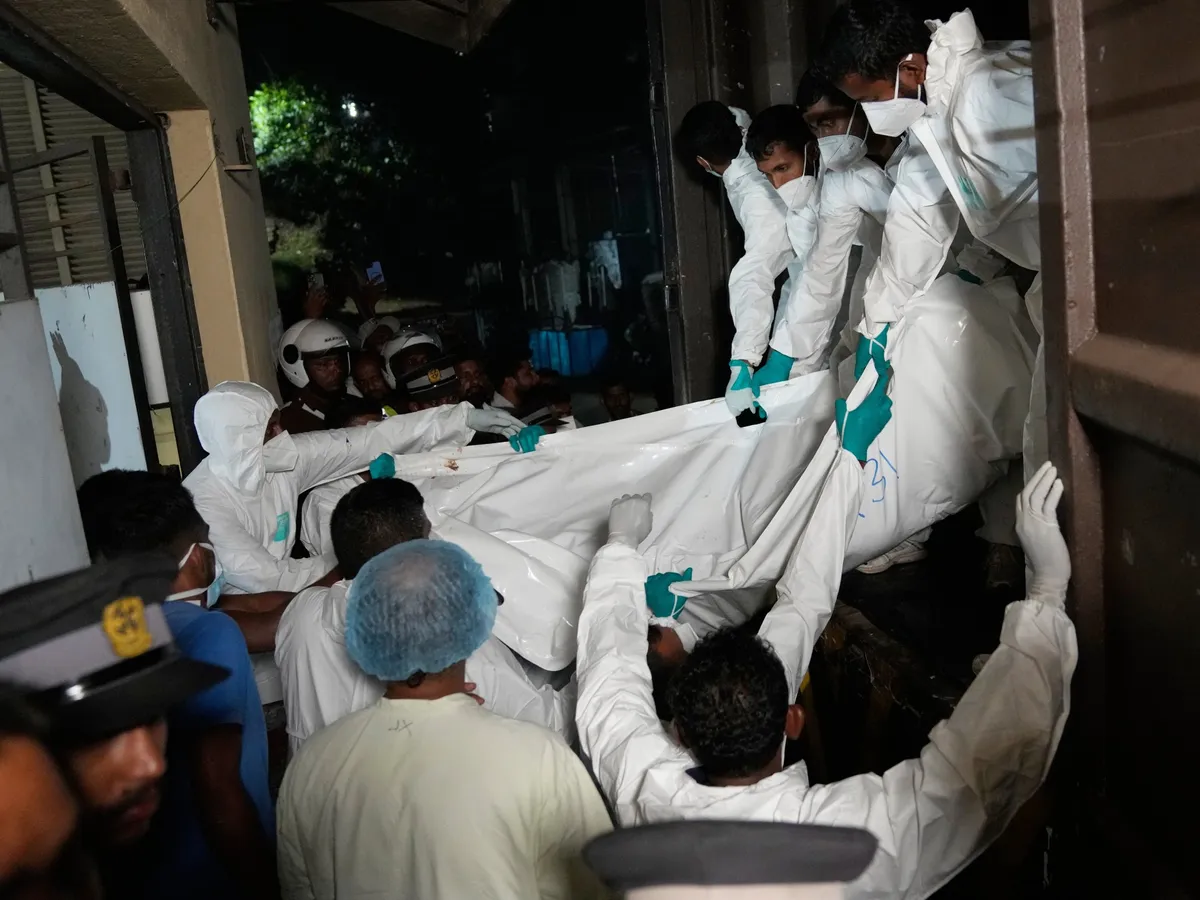
India sees itself a security provider in the Indian Ocean. On Wednesday, it couldn’t save even its own guest.Healthcare workers unload the bodies of Iranian sailors from a vehicle who died when their IRIS Dena warship sank outside Sri Lanka's territorial waters, in Galle, Sri Lanka, Wednesday, March 4, 2026 [Eranga Jayawardena/AP Photo]Published On 6 Mar 2026New Delhi, India — Dressed in a blue Navy uniform and sleek sunglasses, Indian Prime Minister Narendra Modi, in late October, addressed a gathering of the country’s sea warriors.He listed out the strategic significance of the Indian Ocean — the massive volumes of trade and oil that pass through it. “The Indian Navy is the guardian of the Indian Ocean,” he then said, to loud, proud chants of “Long Live Mother India” from his audience.Less than five months later, India has been shown up as a “guardian”, unable to protect its own guest.On Wednesday, the Iranian warship, IRIS Dena, was torpedoed by a US submarine just 44 nautical miles off (81km) southern Sri Lanka, as it was returning home from naval drills hosted by India. During the “Milan” biennial multilateral naval exercise, Indian President Droupadi Murmu had posed with sailors from the Dena.Yet it took the Indian Navy more than a day after the Iranian warship was struck to respond formally to the attack, which US officials made clear was a sign of how the Donald Trump administration was willing and ready to expand its war against Iran.“An American submarine sank an Iranian warship that thought it was safe in international waters,” US Defense Secretary Pete Hegseth said at the Pentagon on Wednesday. “Instead, it was sunk by a torpedo. Quiet death.”Tehran is furious over the attack on its warship hundreds of miles away from home. And Iran made sure to note that the IRIS Dena warship was “a guest of India’s navy”, returning after completing the exercise it joined upon New Delhi’s invitation.“The US has perpetrated an atrocity at sea, 2,000 miles [3,218km] away from Iran’s shores,” Iran’s foreign minister Abbas Araghchi said, referring to the sinking of the frigate. “Mark my words: The US will come to bitterly regret [the] precedent it has set.”Now, the IRIS Dena is at the bottom of the Indian Ocean, and more than 80 Iranian sailors, who marched during joint parades and posed for selfies with Indian naval officers during their two-week visit, are dead.What has also fallen, said retired Indian naval officers and analysts, is India’s self-image as a net security provider in the Indian Ocean. Instead, they said, the US attack on the Dena has exposed the limits of India’s power and influence in its own maritime back yard.A vessel sails off the Galle coast after a submarine attack on the Iranian military ship, IRIS Dena, off Sri Lanka, in Galle, Sri Lanka, March 4, 2026 [Thilina Kaluthotage/Reuters]‘War reaches India’s backyard’After participating in the naval exercises, IRIS Dena left Visakhapatnam on India’s eastern coast on February 26. It was hit in international waters, just south of Sri Lanka’s territorial waters, in the early hours of March 4, local time.In response, Sri Lankan Navy rescuers recovered more than 80 bodies and picked up 32 survivors, reportedly including the commander and some senior officers from the warship. More than 100 men are still missing.In a tweet welcoming the Dena to the naval drills, the Indian Navy’s Eastern Command had posted: “Her arrival … [reflects] long-standing cultural links between the two nations [Iran and India]”.Vice Admiral Shekhar Sinha, the former vice chief of India’s naval staff, told Al Jazeera that he attended the Iranian parade at the function.“I met and really liked them, especially their march for sailors travelling thousands of miles,” Sinha said. “It is always sad to see a ship sinking. But in a war, emotions don’t work. There’s nothing ethical in a war.”Sinha said that the Indian Ocean — central to the strategic and energy security of the nation with the world’s largest population — was thought to be a fairly safe zone earlier. “But that is not the case, as we are learning now,” he told Al Jazeera.“The unfolding battle [between the US and Israel on the one hand, and Iran on the other] has reached India’s back yard. New Delhi has to be concerned,” Sinha, who served in the Indian Navy for four decades, added. “The liberty we enjoyed in the Indian Ocean has apparently shrunk.”Security personnel stand guard as an ambulance enters inside the Galle National Hospital, following a submarine attack on the Iranian military ship, IRIS Dena, off the coast of Sri Lanka, in Galle, Sri Lanka, March 5, 2026 [Thilina Kaluthotage/Reuters]India’s Catch-22 situationOnly on Thursday evening did the Indian Navy issue any formal statement on the attack — more than 24 hours after the Dena was hit by a torpedo.The Navy said that it received distress signals from the Iranian ship and had decided on deploying resources to help with rescuing sailors. But by then, it said, the Sri Lankan Navy had already stepped to lead the rescue effort.Neither New Delhi nor the Navy has criticised — even mildly — the decision by the US to sink the Iranian warship.Military analysts and former Indian naval officers say India is caught in a classic catch-22: Was India aware of the incoming US attack in the Indian Ocean on an Iranian warship, or was it blindsided by a nuclear-submarine in its backyard?Admiral Arun Prakash, the former chief of India’s naval staff, told Al Jazeera that if New Delhi was blindsided, “it reflects on the US-India relationship directly.”“If it is a surprise, then that’s a great concern since we have a so-called strategic partnership with the USA.”And if India knew about the attacks, it would be seen by many as strategically siding with the US and Israel over their war on Iran.C Uday Bhaskar, a retired Indian Navy officer and currently the director of the Society for Policy Studies, an independent think tank based in New Delhi, said that the US sinking an Iranian warship in the Indian Ocean muddies the Indian perception of itself as a “net security provider” in the region.Bhaskar said the incident is a “strategic embarrassment” for India and weakens New Delhi’s credibility in the Indian Ocean, while its moral standing “takes a beating” because of the Indian government’s near-silence.An injured Iranian sailor is moved on a stretcher at Galle National Hospital, where the sailors are receiving treatment, following a submarine attack on the Iranian military ship, IRIS Dena, off the coast of Sri Lanka, in Galle, Sri Lanka, March 5, 2026 [Thilina Kaluthotage/Reuters]‘India on aggressor’s side’In the post-colonial world order, India was a leader of the non-alignment movement, the Cold War-era neutrality posture adopted by several developing nations.India now no longer calls its approach non-alignment, instead referring to it as “strategic autonomy”. But, in reality, it has inched closer to the United States and its allies, most importantly, Israel.Merely two days before the US and Israel bombed Iran, Modi was in Israel, addressing the Knesset and warmly hugging Prime Minister Benjamin Netanyahu, who called his Indian counterpart a brother.But Iran, under the late Supreme Leader Khamenei, was a friend of India as well, with New Delhi making strategic, business, and humanitarian investments in the country.However, Modi has not said a word in condolence after Khamenei’s assassination. On Thursday, Indian Foreign Secretary Vikram Misri visited the Iranian embassy in New Delhi to sign a memorial book. Indian governments normally deploy ministers — not bureaucrats or diplomats — for such sombre occasions.It is against that backdrop that India’s response to the attack on the Dena has come under scrutiny.Because the frigate was hit when it was in international waters, India had “no formal responsibility”, said Srinath Raghavan, an Indian military historian and strategic analyst.
SRCAl Jazeera
LANGEN
LEANCenter
WORDS1 294
ENT12
FRI · 2026-03-06 · 01:09 GMTBRIEF NSR-2026-0306-21872
NSR-2026-0306-21872News Report·EN·National Security
How US sinking of Iranian warship blew hole in Modi’s ‘guardian’ claims
In March 2026, the Iranian warship IRIS Dena was sunk by a US submarine in the Indian Ocean, 44 nautical miles off the coast of Sri Lanka. The incident occurred as the Dena was returning from naval exercises hosted by India.
Yashraj SharmaAl JazeeraFiled 2026-03-06 · 01:09 GMTLean · CenterRead · 6 min
Al JazeeraFIG 01
Reading time
6min
Word count
1 294words
Sources cited
3cited
Entities identified
12entities
Quality score
100%
§ 01
Briefing Summary
AI-generatedNEWSAR · AI
In March 2026, the Iranian warship IRIS Dena was sunk by a US submarine in the Indian Ocean, 44 nautical miles off the coast of Sri Lanka. The incident occurred as the Dena was returning from naval exercises hosted by India. The US Defense Secretary stated the sinking was a deliberate act demonstrating the US's willingness to confront Iran. Iranian officials condemned the attack, emphasizing the Dena was a guest of the Indian Navy after participating in the "Milan" exercise. The sinking resulted in the deaths of over 80 Iranian sailors. The event has raised questions about India's self-proclaimed role as a security provider in the Indian Ocean.
Confidence 0.90Sources 3Claims 5Entities 12
§ 02
Article analysis
Model · rule-basedFraming
National Security
Diplomatic
Tone
Mixed Tone
AI-assessed
CalmNeutralAlarmist
Factuality
0.70 / 1.00
Factual
LowHigh
Sources cited
3
Well sourced
FewMany
§ 03
Key claims
5 extracted01
The IRIS Dena warship was a guest of India’s navy, returning after completing the exercise it joined upon New Delhi’s invitation.
factualIran
Confidence
1.00
02
The US has perpetrated an atrocity at sea, 2,000 miles away from Iran’s shores.
quoteIran’s foreign minister Abbas Araghchi
Confidence
1.00
03
An American submarine sank an Iranian warship that thought it was safe in international waters.
quoteUS Defense Secretary Pete Hegseth
Confidence
1.00
04
It took the Indian Navy more than a day after the Iranian warship was struck to respond formally to the attack.
factualArticle
Confidence
1.00
05
The Iranian warship, IRIS Dena, was torpedoed by a US submarine just 44 nautical miles off southern Sri Lanka.
factualArticle
Confidence
1.00
§ 04
Full report
6 min read · 1 294 words§ 05
Entities
12 identifiedKey playerOppositionContextPositiveNeutralNegative
People5
Organizations2
§ 06
Keywords & salience
10 termsiranian warship
0.90
indian ocean
0.90
us submarine
0.80
security provider
0.70
naval exercise
0.70
iris dena
0.70
india
0.60
united states
0.60
maritime security
0.50
military conflict
0.50
§ 07
Topic connections
Interactive graph Network visualization showing 51 related topics
View Full Graph Person Organization Location Event|Click node to navigate|Edge numbers = shared articles