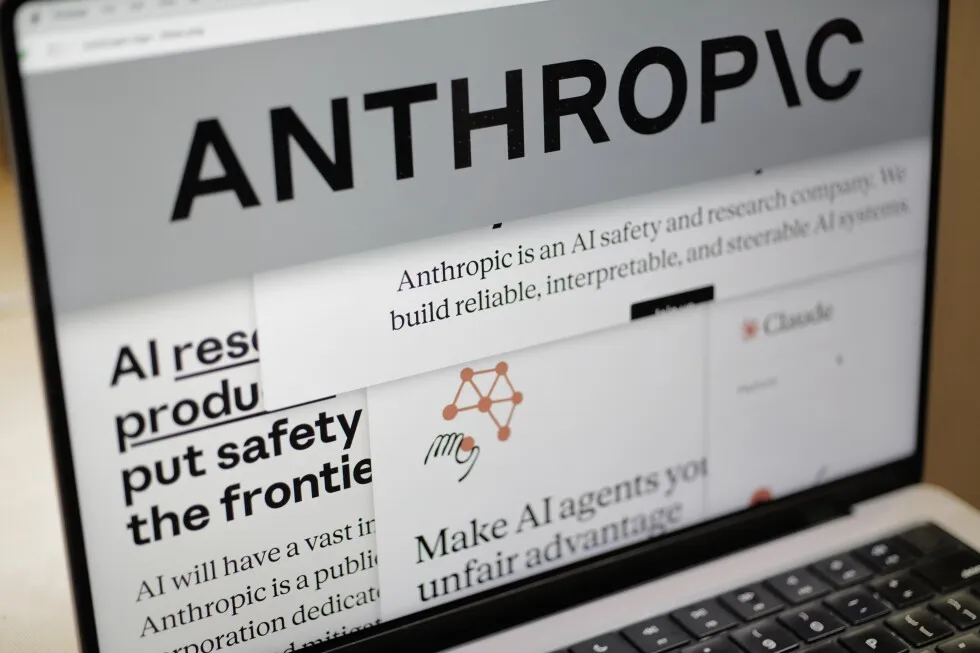
Pentagon says it is labeling AI company Anthropic a supply chain risk ‘effective immediately’ 1 of 3 | Pages from the Anthropic website and the company’s logo are displayed on a computer screen in New York on Thursday, Feb. 26, 2026. (AP Photo/Patrick Sison) 2 of 3 | Defense Secretary Pete Hegseth stands outside the Pentagon during a welcome ceremony for the Japanese defense minister at the Pentagon in Washington, Jan. 15, 2026. (AP Photo/Kevin Wolf, File) 3 of 3 | Dario Amodei, CEO y cofundador de Anthropic, asiste a la reunión anual del Foro Económico Mundial en Davos, Suiza, el 23 de enero de 2025. (AP Foto/Markus Schreiber, Archivo) 1 of 3 Pages from the Anthropic website and the company’s logo are displayed on a computer screen in New York on Thursday, Feb. 26, 2026. (AP Photo/Patrick Sison) Add AP News on Google Add AP News as your preferred source to see more of our stories on Google. 2 of 3 Defense Secretary Pete Hegseth stands outside the Pentagon during a welcome ceremony for the Japanese defense minister at the Pentagon in Washington, Jan. 15, 2026. (AP Photo/Kevin Wolf, File) Add AP News on Google Add AP News as your preferred source to see more of our stories on Google. 3 of 3 Dario Amodei, CEO y cofundador de Anthropic, asiste a la reunión anual del Foro Económico Mundial en Davos, Suiza, el 23 de enero de 2025. (AP Foto/Markus Schreiber, Archivo) Add AP News on Google Add AP News as your preferred source to see more of our stories on Google. Updated [hour]:[minute] [AMPM] [timezone], [monthFull] [day], [year] The Trump administration is following through with its threat to designate artificial intelligence company Anthropic as a supply chain risk in an unprecedented move that could force other government contractors to stop using the AI chatbot Claude.The Pentagon said in a statement Thursday that it has “officially informed Anthropic leadership the company and its products are deemed a supply chain risk, effective immediately.”The decision appeared to shut down the opportunity for further negotiation with Anthropic, nearly a week after President Donald Trump and Defense Secretary Pete Hegseth accused the company of endangering national security. Trump and Hegseth announced a series of threatened punishments last Friday, on the eve of the Iran war, after Anthropic CEO Dario Amodei refused to back down over concerns the company’s products could be used for mass surveillance of Americans or autonomous weapons. Amodei said in a statement Thursday that “we do not believe this action is legally sound, and we see no choice but to challenge it in court.”The Pentagon statement said, “this has been about one fundamental principle: the military being able to use technology for all lawful purposes. The military will not allow a vendor to insert itself into the chain of command by restricting the lawful use of a critical capability and put our warfighters at risk.“ Amodei countered that the narrow exceptions Anthropic sought to limit surveillance and autonomous weapons “relate to high-level usage areas, and not operational decision-making.” He said “productive conversations” continued this week with the Pentagon over whether it could keep using Claude or establish a “smooth transition” if no agreement was reached. Trump gave the military six months to phase out Claude, which is already widely embedded in military and national security platforms. Amodei said it’s a priority to make sure warfighters won’t be “deprived of important tools in the middle of major combat operations.” Some military contractors were already cutting ties with Anthropic, a rising star in the tech industry that sells Claude to a variety of businesses and government agencies. Lockheed Martin said it will “follow the President’s and the Department of War’s direction” and look to other providers of large language models.“We expect minimal impacts as Lockheed Martin is not dependent on any single LLM vendor for any portion of our work,” the company said. It’s not yet clear if the designation aims to block Anthropic’s use by all federal government contractors or just those that partner with the military. Amodei said a notification Anthropic received from the Defense Department on Wednesday shows it only applies to Claude’s use by customers as a “direct part of” their military contracts. The Pentagon’s decision to apply a rule designed to address supply threats posed by foreign adversaries was quickly met with criticism from both opponents and some supporters of Trump’s Republican administration. Federal codes have defined supply chain risk as a “risk that an adversary may sabotage, maliciously introduce unwanted function, or otherwise subvert” a system in order to disrupt, degrade or spy on it. U.S. Sen. Kirsten Gillibrand, a New York Democrat and member of the Senate Armed Services Committee and Senate Intelligence Committee, called it “a dangerous misuse of a tool meant to address adversary-controlled technology.”“This reckless action is shortsighted, self-destructive, and a gift to our adversaries,” she said in a written statement Thursday.Neil Chilson, a Republican former chief technologist for the Federal Trade Commission who now leads AI policy at the Abundance Institute, said the decision looks like “massive overreach that would hurt both the U.S. AI sector and the military’s ability to acquire the best technology for the U.S. warfighter.”Earlier in the day, a group of former defense and national security officials sent a letter to U.S. lawmakers expressing “serious concern” about the designation. “The use of this authority against a domestic American company is a profound departure from its intended purpose and sets a dangerous precedent,” said the letter from former officials and policy experts, including former CIA director Michael Hayden and retired Air Force, Army and Navy leaders. They added that such a designation is meant to “protect the United States from infiltration by foreign adversaries — from companies beholden to Beijing or Moscow, not from American innovators operating transparently under the rule of law. Applying this tool to penalize a U.S. firm for declining to remove safeguards against mass domestic surveillance and fully autonomous weapons is a category error with consequences that extend far beyond this dispute.”While losing its big partnerships with defense contractors, Anthropic experienced a surge of consumer downloads over the past week due to people siding with its moral stance. Anthropic has boasted of more than a million people signing up for Claude each day this week, lifting it past OpenAI’s ChatGPT and Google’s Gemini as the top AI app in more than 20 countries in Apple’s app store. The dispute with the Pentagon has also further deepened Anthropic’s bitter rivalry with OpenAI that started when ex-OpenAI leaders, including Amodei, started Anthropic in 2021.Hours after the Pentagon punished Anthropic last Friday, OpenAI announced a deal to effectively replace Anthropic with ChatGPT in classified military environments. OpenAI said it sought similar protections against domestic surveillance and fully autonomous weapons but later had to amend its agreements, leading CEO Sam Altman to later say he shouldn’t have rushed a deal that “looked opportunistic and sloppy.”Amodei also expressed regret about his own part in that “difficult day for the company,” saying Thursday he wanted to “directly apologize” for an internal note he sent to Anthropic staff that attacked OpenAI’s behavior and suggested Anthropic was being punished for not giving ”dictator-like praise” to Trump. O’Brien covers the business of technology and artificial intelligence for The Associated Press.
SRCAssociated Press (AP)
LANGEN
LEANCenter
WORDS1 217
ENT10
FRI · 2026-03-06 · 01:53 GMTBRIEF NSR-2026-0306-21890
NSR-2026-0306-21890News Report·EN·National Security
Pentagon says it is labeling AI company Anthropic a supply chain risk ‘effective immediately’
The Pentagon has labeled AI company Anthropic a supply chain risk, effective immediately. This decision follows accusations from President Trump and Defense Secretary Hegseth that Anthropic endangers national security.
By
MATT O’BRIEN and KONSTANTIN TOROPINAssociated Press (AP)Filed 2026-03-06 · 01:53 GMTLean · CenterRead · 5 min
Associated Press (AP)FIG 01
Reading time
5min
Word count
1 217words
Sources cited
4cited
Entities identified
10entities
Quality score
100%
§ 01
Briefing Summary
AI-generatedNEWSAR · AI
The Pentagon has labeled AI company Anthropic a supply chain risk, effective immediately. This decision follows accusations from President Trump and Defense Secretary Hegseth that Anthropic endangers national security. The Trump administration's action could force government contractors to cease using Anthropic's Claude chatbot. The move comes after Anthropic CEO Dario Amodei refused to concede to concerns that the company's AI could be used for mass surveillance or autonomous weapons. The announcement shuts down further negotiation with Anthropic.
Confidence 0.90Sources 4Claims 5Entities 10
§ 02
Article analysis
Model · rule-basedFraming
National Security
Political Strategy
Tone
Measured
AI-assessed
CalmNeutralAlarmist
Factuality
0.80 / 1.00
Factual
LowHigh
Sources cited
4
Well sourced
FewMany
§ 03
Key claims
5 extracted01
The military will not allow a vendor to restrict the lawful use of a critical capability.
quotePentagon statement
Confidence
1.00
02
Amodei said that they will challenge the action in court.
quoteDario Amodei
Confidence
1.00
03
Trump and Hegseth accused the company of endangering national security.
factualArticle
Confidence
1.00
04
The Trump administration is designating Anthropic as a supply chain risk.
factualArticle
Confidence
1.00
05
Pentagon is labeling AI company Anthropic a supply chain risk ‘effective immediately’
factualPentagon
Confidence
1.00
§ 04
Full report
5 min read · 1 217 words§ 05
Entities
10 identifiedKey playerOppositionContextPositiveNeutralNegative
People3
Organizations3
§ 06
Keywords & salience
9 termsanthropic
1.00
supply chain risk
0.90
artificial intelligence
0.80
pentagon
0.70
national security
0.60
autonomous weapons
0.50
mass surveillance
0.50
government contractors
0.50
claude
0.40
§ 07
Topic connections
Interactive graph Network visualization showing 51 related topics
View Full Graph Person Organization Location Event|Click node to navigate|Edge numbers = shared articles