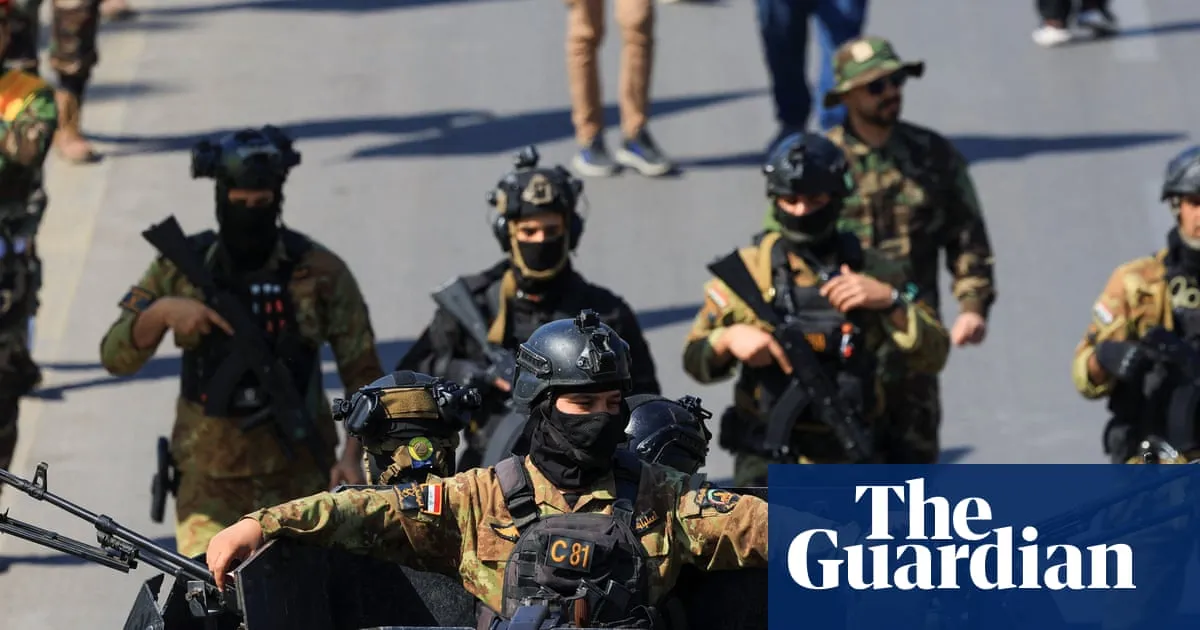
Iran-backed militias around the Middle East are intensifying attacks against Israel, the US and their allies, in retaliation for the ongoing joint US-Israeli offensive against Tehran as the war draws in new armed actors, threatening wider chaos and violence.Israel and the US have targeted Iran’s network of militant groups, with Iraq emerging as a key front in this new and often clandestine confrontation.Militia in Iraq have launched dozens of attacks since the war began on Saturday, targeting Israel and US bases in Jordan and Iraq itself.In recent days, they have also targeted the infrastructure of Iranian-Kurdish opposition groups based in the self-governing Kurdish-dominated north of Iraq.Israel and the US are trying to degrade the capabilities of pro-Iranian militias in Iraq with airstrikes and special forces operations on the ground, according to analysts and well-informed former regional intelligence officials.Since the 2003 US-led invasion, Iraq has been a proxy battleground between the US, its allies and Iran, but the country’s current leaders have sought to avoid becoming drawn into this new conflict. The militias are recruited among Iraq’s majority Shia community, and follow orders from senior officers from Iran’s Islamic Revolutionary Guard Corps (IRGC).On Tuesday, in a sign of an intensifying war of proxies across the region, officials in Washington suggested they were considering mobilising the opposition Iranian Kurds, possibly for an invasion of Iran’s north-west region.Several Iran-backed armed factions have claimed attacks on the US base at Erbil airport in Iraq’s north in recent days. Other drones and missiles have been launched from sites in Iran’s western desert at targets in Jordan; while militia in the south fired a missile into Kuwait.On Thursday, the militias issued a joint statement telling European countries not to join the war and threatening their “forces and bases in Iraq and the region”.Iraq’s state-run Iraqi News Agency reported that an attempt to launch missiles from an area in Basra province in southern Iraq “intended to target a neighbouring country” had been thwarted and that security forces had seized a mobile launch platform carrying two missiles that were ready to be fired.A spokesperson for Israel’s military confirmed on Wednesday evening that drones had been launched at Israel from Iraq though “not in significant numbers”.Michael Knights, an Iraq expert at Horizon Engage, a strategic advisory based in New York, said Iran-backed Iraqi groups were trying to work out how to be relevant and how to respond to the killing of Ayatollah Ali Khamenei.In what appears to be a clandestine counteroffensive, militia bases south of Baghdad, and near the southern cities of Nasariya and Basra, have come under attack from small “suicide drones” that are reported to have killed 15 fighters, mostly from Kataib Hezbollah, the most powerful among the Iraq-based pro-Iran groups.Knights said: “There are short-range drone systems being used in Iraq that can’t have been flown all the way from Israel. We saw exactly this during the last war [between Iran and Israel last year] and suggests some kind of covert action under way on the ground. There is a lot of proxy war happening.”On Thursday, Kataib Hezbollah said that one of its commanders had been killed in a strike in southern Iraq the previous day. Two sources from the faction told Agence France-Presse on Wednesday that a strike had hit a vehicle near the group’s main base in southern Iraq, killing two fighters. The toll then rose to three, including the commander.The group’s Jurf al-Nasr base has been repeatedly attacked since the weekend. There are also reports of large explosions at militia bases in Iraq’s western Anbar province.There have also been a series of unexplained blasts that have immobilised Iraqi government radar systems that monitor air traffic through Iraqi airpsace.Two former senior intelligence officials in Israel said they could not comment on the explosions but that the suggestion that Israel’s intelligence services or special forces were responsible was “credible”. A third said US forces might be involved.Iran has spent decades investing in a coalition of militant groups stretching from the Indian Ocean to the Mediterranean intended to both deter attack on Iran itself and project influence across the region.Israel has launched a broad offensive in Lebanon after Hezbollah, the major Islamist movement in Lebanon which also has very close relations with Iran, joined the conflict, attacking Israel but also launching a drone towards a UK base in Cyprus.However the so-called “axis of resistance” has been seriously weakened by successive Israeli offensives since one of its members, Hamas, launched a surprise attack into Israel on 7 October 2023, triggering the series of recent wars.Hamas, the Palestinian militant Islamist movement, and the Houthis in Yemen both have close ties with Tehran, but have so far remained on the sidelines of the current conflict.Renad Mansour, a senior research fellow focused on the Middle East at Chatham House, said: “It’s very much about survival … And survival to them is based on calculations that aren’t necessarily about Iran’s survival.”Phillip Smyth, a US-based independent analyst of Iran’s allies and proxies, said Tehran might be holding the Houthis “in reserve” but that the movement’s leaders might also be “hedging their bets in case the Iranian regime collapses”.In a further sign of the possible use by the US of proxies recruited from among Iran’s ethnic minorities to weaken the Iranian regime, there are reports of attacks by an armed group affiliated to separatist movements among Iran’s Arab community against Islamic Revolutionary Guard Corps targets in south-western Iran.A strike on an IRGC base in Ahwaz, an Iranian city close to the border with Iraq, was claimed by an apparently newly formed group calling itself the “Ahwaz Falcons”.
SRCThe Guardian - World News
LANGEN
LEANCenter-Left
WORDS933
ENT10
FRI · 2026-03-06 · 05:00 GMTBRIEF NSR-2026-0306-21925
NSR-2026-0306-21925News Report·EN·Conflict
Iran-backed militias intensify attacks against US, Israel and allies
Iran-backed militias are escalating attacks against the US, Israel, and their allies in the Middle East, particularly in Iraq, in response to a joint US-Israeli offensive against Tehran. These militias, primarily recruited from Iraq's Shia community and directed by Iran's IRGC, have launched attacks from Iraq into Israel, Jordan and Kuwait, targeting US bases and infrastructure.
Jason Burke in JerusalemThe Guardian - World NewsFiled 2026-03-06 · 05:00 GMTLean · Center-LeftRead · 4 min
The Guardian - World NewsFIG 01
Reading time
4min
Word count
933words
Sources cited
3cited
Entities identified
10entities
Quality score
100%
§ 01
Briefing Summary
AI-generatedNEWSAR · AI
Iran-backed militias are escalating attacks against the US, Israel, and their allies in the Middle East, particularly in Iraq, in response to a joint US-Israeli offensive against Tehran. These militias, primarily recruited from Iraq's Shia community and directed by Iran's IRGC, have launched attacks from Iraq into Israel, Jordan and Kuwait, targeting US bases and infrastructure. The US and Israel are attempting to degrade the militias' capabilities through airstrikes and special operations. Iraq has become a key battleground in this proxy conflict, though its current leaders are trying to avoid direct involvement. The US is considering mobilizing Iranian Kurdish opposition groups, potentially for operations in Iran. Militias have warned European countries against involvement, threatening their forces in the region.
Confidence 0.90Sources 3Claims 5Entities 10
§ 02
Article analysis
Model · rule-basedFraming
Conflict
National Security
Tone
Mixed Tone
AI-assessed
CalmNeutralAlarmist
Factuality
0.70 / 1.00
Factual
LowHigh
Sources cited
3
Well sourced
FewMany
§ 03
Key claims
5 extracted01
Iran-backed militias are intensifying attacks against Israel, the US and their allies.
factual
Confidence
0.90
02
Officials in Washington suggested they were considering mobilising the opposition Iranian Kurds.
factualofficials in Washington
Confidence
0.80
03
Militia in Iraq have launched dozens of attacks since the war began, targeting Israel and US bases.
factual
Confidence
0.80
04
Israel and the US are trying to degrade the capabilities of pro-Iranian militias in Iraq with airstrikes.
factualanalysts and well-informed former regional intelligence officials
Confidence
0.70
05
Iran-backed Iraqi groups were trying to work out how to be relevant and how to respond to the killing of Ayatollah Ali Khamenei.
quoteMichael Knights, an Iraq expert at Horizon Engage
Confidence
0.60
§ 04
Full report
4 min read · 933 words§ 05
Entities
10 identifiedKey playerOppositionContextPositiveNeutralNegative
Organizations2
§ 06
Keywords & salience
9 termsiran-backed militias
1.00
attacks
0.90
us
0.80
israel
0.80
iraq
0.70
proxy war
0.60
iranian kurds
0.50
islamic revolutionary guard corps
0.50
regional conflict
0.40
§ 07
Topic connections
Interactive graph Network visualization showing 51 related topics
View Full Graph Person Organization Location Event|Click node to navigate|Edge numbers = shared articles