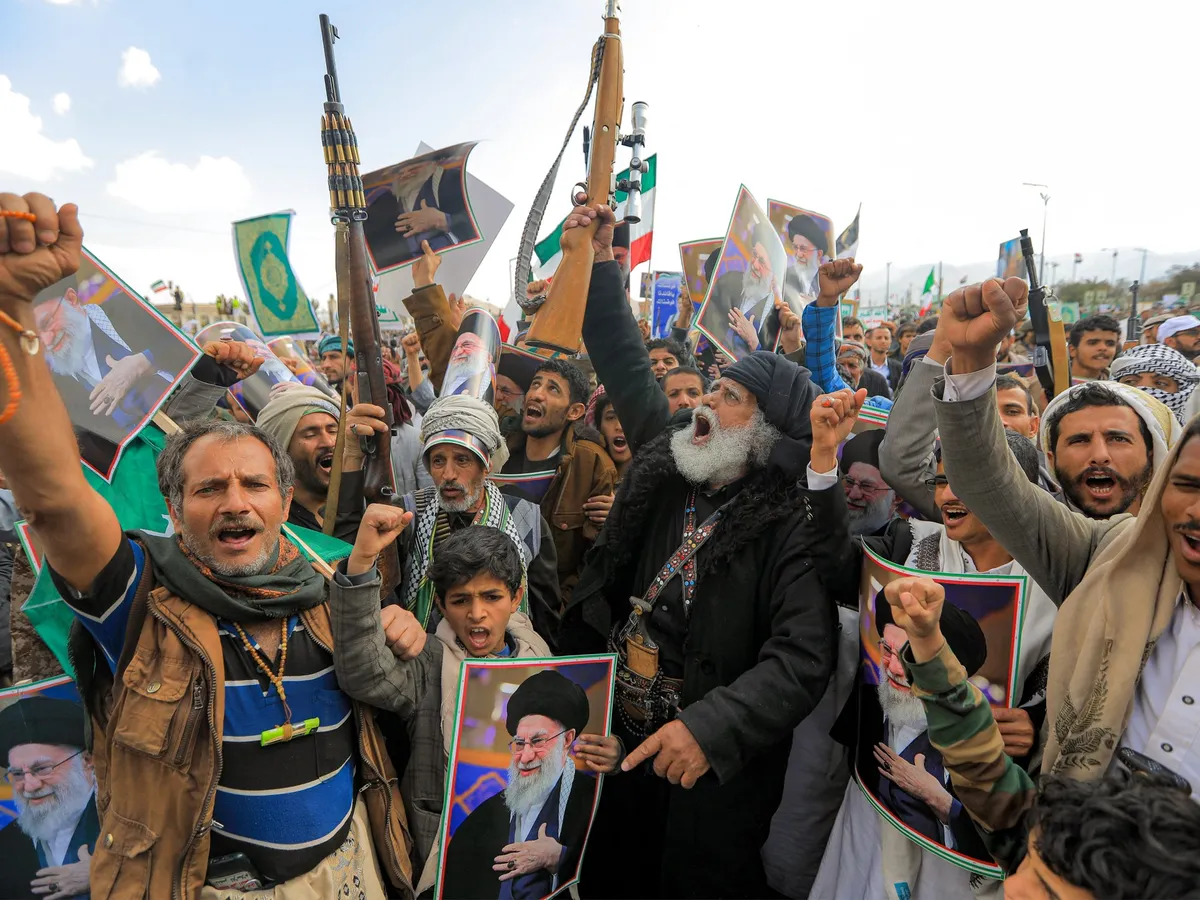
As the regional conflict escalates, Abdel-Malik al-Houthi faces a strategic choice: intervene or stay out.Mourners attend a memorial rally held by supporters of Yemen's Houthis, a day after Iran's supreme leader was assassinated during United States and Israeli strikes on Tehran, in the Houthi-held capital, Sanaa, on March 1, 2026 [AFP]Al Jazeera’s Yemen affairs editor.Published On 6 Mar 2026The United States-Israeli military strike against Iran on February 28, 2026, was not merely another episode in the region’s long cycle of tensions. That attack quickly transformed into a pivotal event with the announcement of the assassination of Iranian Supreme Leader Ali Khamenei, a development that disrupted the balance of power within the regional axis Tehran had built over decades.In Yemen specifically, a different question arose: how will Abdel-Malik al-Houthi deal with this moment? Will these developments push the group to engage in a new confrontation, or will it choose to manage the situation cautiously and wait for the conflict’s trajectory to become clear?And what will be the fate of the group and its leadership if it decides to wage this war?In Sanaa, where the Houthi group is politically and ideologically linked to the Iranian axis, it was natural for attention to turn to the speeches of the group’s leader.Abdel-Malik al-Houthi has appeared three times since the outbreak of the war. In his first speech, he declared his solidarity with Iran and affirmed his readiness for “all developments,” in a message that seemed more like a political statement than a declaration of military resolve. In the second speech, the tone was more emotional, offering condolences for Khamenei’s death and reaffirming support for Tehran.The third speech was similar, without any different pronouncements, and reinforced the same message.However, what was left unsaid in the speeches was as striking as what was said.The group did not issue a clear declaration of military intervention, as it had done in the past when it wanted to send messages of deterrence or practical solidarity with its allies. Nor were there any direct escalations or clear military threats against Israeli or US interests recorded on the ground. Even the group’s media messaging appeared more disciplined and subdued this time, unlike its usual approach in similar regional moments, which typically featured widespread escalatory rhetoric.This discrepancy between the mobilisation rhetoric and the actions on the ground suggests that the decision to go to war is not as simple as it seems. The group, which has built a large part of its political discourse on the idea of the “axis of resistance,” is also aware that entering into a direct confrontation at a highly complex regional juncture could open a Pandora’s box with uncontrollable consequences.Comparing this with the behaviour of the other members of the axis reveals a clearer picture. Hezbollah in Lebanon, one of Iran’s most important military proxies in the region, wasted no time in entering the fray after the outbreak of the latest war. The party’s entry into the conflict reflects its role within what is known as the Iranian axis, where it is seen as one of the most important regional deterrents and among the most ready for rapid military action should Tehran come under direct attack.This development reinforces the impression that Iran has already begun activating some of its military proxies in the region. With Hezbollah and Iraqi factions now engaged in the conflict, the question of the Houthis’ position becomes even more pressing: will they remain on the sidelines, or will they join the fray later if the war escalates?The Houthi situation appears somewhat different. Despite its close ties to the Iranian axis, the group operates within a different geographical and political environment and faces complex internal and regional considerations that make any decision to enter the war more delicate. Therefore, the restraint evident in its current behaviour may reflect an awareness that any large-scale escalation could open multiple fronts against it at a time of regional instability.Recent experience also reveals that the Houthis are capable of a degree of pragmatism when circumstances dictate different calculations. In May 2025, the Sultanate of Oman brokered an agreement between the group and the US that reduced tensions in the Red Sea, following months of heightened tensions stemming from Houthi attacks on international shipping. This agreement reflected the group’s willingness to readjust its military behaviour when the cost of escalation outweighed its potential gains, especially given the heavy price they paid from US air strikes in 2025.During the 12-day war in June 2025, a sensitive regional moment, the Houthis confined themselves to rhetoric of solidarity rather than direct military intervention, despite the moral pressure exerted within the Iranian axis. These precedents indicate that the group possesses the ability to separate its mobilisation rhetoric from its operational decisions when cost-benefit considerations take precedence.Therefore, the most likely scenario – should the regional war continue for an extended period – appears to be a calculated escalation through symbolic operations or carefully calibrated pressure tactics, without engaging in a full-scale confrontation. Such an option would give the group room to demonstrate solidarity with Iran and maintain the cohesion of its internal base, without provoking a large-scale strike that could target its military infrastructure at a time of regional instability.In this context, there is another equally important possibility: that the group will postpone its direct intervention but seek to support Iran through a different front, such as the Red Sea and the Bab al-Mandeb Strait. This region represents one of the most important strategic pressure points on global trade and energy routes, and the Houthis have proven in recent years their ability to use it as an effective pressure tactic by targeting or threatening shipping.Such a scenario could allow the group to participate in the confrontation indirectly, by disrupting international supply lines and sending a political and military message simultaneously, without engaging in open conflict with Israel. It also aligns with the role the Houthis have played in recent months, when the Red Sea attacks became part of the regional pressure equation linked to the war in Gaza.Direct intervention, whether through bombing Israel or carrying out large-scale operations against American interests, remains a high-risk option, especially given growing assessments that Israel has considered the Houthis a deferred target for months, and that any opportune moment could be exploited to launch a broad strike against its leadership and military infrastructure.The group’s calculations are not limited to the regional arena; the internal dynamics in Yemen play an equally influential role in determining its choices. It understands that any broad involvement in an external confrontation could open the door to unpredictable internal shifts, particularly amid efforts to rearrange the balance of power within the government camp and attempts to reorganise military decision-making with Saudi support.The situation within Houthi-controlled areas is also not immune to pressure. Accumulating economic challenges, along with intermittent security and social tensions, make external escalation a risky decision. In such a context, the Houthi leadership may prefer to manage tensions cautiously in order to avoid adding a new military burden at a sensitive moment.However, these calculations could change if the regional war moves in a different direction. If it evolves into an existential threat to the Iranian regime, or if it drags on long enough to reshape the regional balance of power, the Houthis may find themselves facing a new set of calculations.
SRCAl Jazeera
LANGEN
LEANCenter
WORDS1 219
ENT9
FRI · 2026-03-06 · 09:12 GMTBRIEF NSR-2026-0306-21970
NSR-2026-0306-21970Analysis·EN·Political Strategy
Will the Houthis join Iran’s war?
Following a US-Israeli military strike on Iran in February 2026 that resulted in the death of Supreme Leader Ali Khamenei, questions arose about the potential response of Yemen's Houthi group. The Houthis, politically and ideologically linked to Iran, are led by Abdel-Malik al-Houthi, who has addressed the situation in three speeches.
Ahmed al-ShalafiAl JazeeraFiled 2026-03-06 · 09:12 GMTLean · CenterRead · 5 min
Al JazeeraFIG 01
Reading time
5min
Word count
1 219words
Sources cited
1cited
Entities identified
9entities
Quality score
100%
§ 01
Briefing Summary
AI-generatedNEWSAR · AI
Following a US-Israeli military strike on Iran in February 2026 that resulted in the death of Supreme Leader Ali Khamenei, questions arose about the potential response of Yemen's Houthi group. The Houthis, politically and ideologically linked to Iran, are led by Abdel-Malik al-Houthi, who has addressed the situation in three speeches. While expressing solidarity with Iran and readiness for "all developments," al-Houthi has stopped short of declaring military intervention or issuing direct threats against US or Israeli interests. The Houthis' subdued media messaging and lack of concrete action contrast with their typical escalatory rhetoric during regional conflicts, leaving their future involvement uncertain. The article analyzes the Houthi leader's speeches and actions to understand whether they will join the conflict or remain cautious.
Confidence 0.90Sources 1Claims 4Entities 9
§ 02
Article analysis
Model · rule-basedFraming
Political Strategy
Conflict
Tone
Measured
AI-assessed
CalmNeutralAlarmist
Factuality
0.60 / 1.00
Mixed
LowHigh
Sources cited
1
Limited
FewMany
§ 03
Key claims
4 extracted01
Abdel-Malik al-Houthi appeared three times since the outbreak of the war, expressing solidarity with Iran.
factualAl Jazeera
Confidence
1.00
02
The Houthi group did not issue a clear declaration of military intervention.
factualAl Jazeera
Confidence
0.90
03
United States-Israeli military strike against Iran on February 28, 2026, resulted in the assassination of Iranian Supreme Leader Ali Khamenei.
factualAl Jazeera
Confidence
0.90
04
Entering into a direct confrontation could open a Pandora’s box with uncontrollable consequences.
predictionAl Jazeera
Confidence
0.60
§ 04
Full report
5 min read · 1 219 words§ 05
Entities
9 identifiedKey playerOppositionContextPositiveNeutralNegative
People2
Organizations1
§ 06
Keywords & salience
8 termshouthi
1.00
iran
0.90
regional conflict
0.80
military intervention
0.70
abdel-malik al-houthi
0.70
us-israeli strike
0.60
balance of power
0.50
military resolve
0.40
§ 07
Topic connections
Interactive graph No topic relationship data available yet. This graph will appear once topic relationships have been computed.